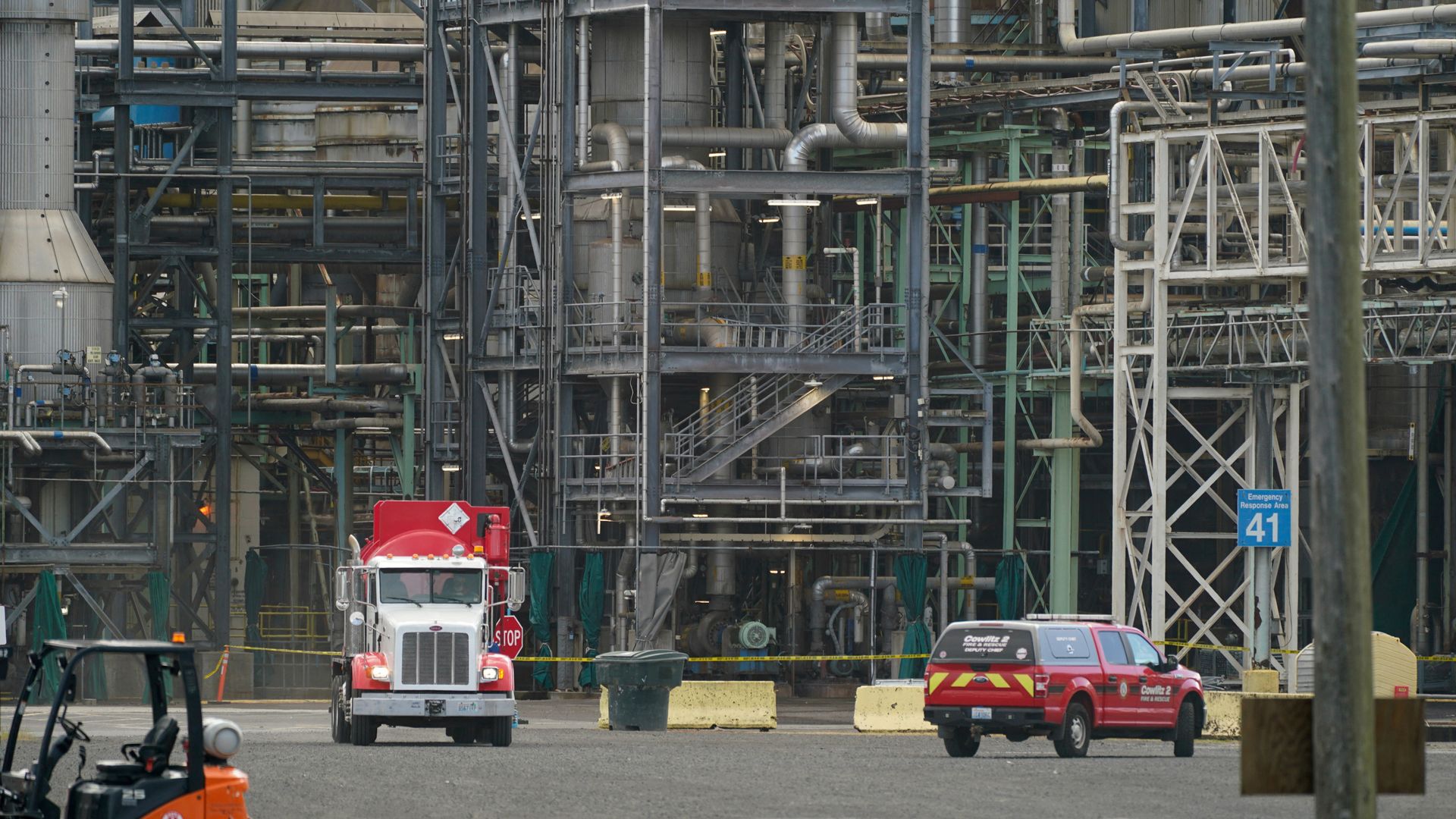
Atmospheric storage vessels are fundamentally vulnerable to pressure differentials that deviate by even fractions of a pound per square inch from equilibrium. When an 80,000-gallon industrial storage tank containing white liquor at the Nippon Dynawave Packaging facility in Longview, Washington, underwent a catastrophic structural collapse, mainstream reporting focused heavily on the immediate casualty count. The deeper operational reality, however, centers on a sudden, negative pressure differential that converted a standard industrial asset into an unpredictable hazard zone, claiming lives and leaving multiple personnel missing.
Understanding the failure of these systems requires an examination of the precise fluid dynamics, chemical realities, and structural vulnerabilities that govern heavy manufacturing infrastructure.
The Mechanics of Vacuum Collapse
An industrial implosion occurs when the external atmospheric pressure exceeds the internal pressure of a vessel beyond the structural capacity of its walls. While high-pressure storage tanks are engineered with substantial wall thickness to contain outward forces, atmospheric tanks used for process chemicals like white liquor are designed primarily to hold hydrostatic liquid weight. Their resistance to external radial pressure is remarkably low.
A negative pressure differential of as little as 0.5 pounds per square inch ($3.4\text{ kPa}$) is sufficient to buckle a large-diameter steel tank. This vulnerability is governed by the structural physics of thin-walled cylinders, where the critical buckling pressure ($P_{cr}$) is dictated by the material's modulus of elasticity, the wall thickness-to-radius ratio, and the length of the tank shell.
This mechanical imbalance typically triggers through three primary operational bottlenecks:
- Vent Path Occlusion: Atmospheric tanks rely on breathing vents or conservation valves to equalize internal pressure as liquid levels fluctuate. If a vent becomes obstructed by chemical crystallization, particulate buildup, or mechanical icing, the tank becomes a sealed system.
- Rapid Liquid Drawdown: The Nippon Dynawave tank was operating at approximately 60% capacity, holding roughly 48,000 gallons of liquid. When pumps extract fluid from a sealed or poorly vented tank at a high volumetric flow rate, the disappearing liquid creates an immediate internal vacuum. The air zone above the liquid must expand to fill the void; without an atmospheric air inflow, internal pressure drops rapidly.
- Thermal Shock and Condensation: If hot process chemistry is introduced to a tank and subsequently subjected to rapid cooling—either via a cold ambient air shift, internal fluid mixing, or the activation of an external deluge system—the vapor space rapidly contracts. The steam or warm air within the headspace condenses, generating a severe localized vacuum in a matter of seconds.
[System Vent Blockage] + [High-Rate Liquid Extraction]
                       │
                       ▼
         [Internal Pressure Drop (< 1 atm)]
                       │
                       ▼
 [Atmospheric Pressure Exceeds Structural Limits]
                       │
                       ▼
     [Elastic Buckling and Tank Wall Collapse]
Chemical Vulnerability and Material Fatigue
The specific chemical composition of the stored medium plays a critical role in both the long-term degradation of the vessel and the complexity of the post-collapse response. White liquor is a highly alkaline, corrosive solution consisting primarily of sodium hydroxide ($\text{NaOH}$) and sodium sulfide ($\text{Na}_2\text{S}$). It serves as the primary chemical agent in the kraft pulping process, utilized at elevated temperatures to dissolve the lignin holding wood fibers together.
Storage of this chemistry introduces severe material challenges. Over extended operational lifecycles, carbon steel vessels exposed to hot caustic solutions are highly susceptible to caustic embrittlement—a form of stress corrosion cracking. This process alters the mechanical properties of the steel, lowering the ductile-to-brittle transition temperature and reducing the structural safety margins required to withstand unforeseen vacuum loads.
Furthermore, the physical properties of white liquor amplify the severity of a physical breach. Because the chemical is a heavy base, contact with human tissue induces saponification, converting fats into soap and causing deep, liquefactive necrosis. This explains the severe burn and inhalation injuries reported among the ten injured personnel, including responding firefighters.
The Operational Post-Collapse Bottleneck
The immediate aftermath of a structural implosion does not mirror a typical explosion site. In a positive-pressure explosion, kinetic energy propels fragments outward, often clearing the immediate footprint. In an implosion, the structure folds inward on itself, trapping remaining fluids and creating a highly unstable pile of compromised steel.
+-------------------------------------------------------------+
|              POST-INCIDENT HAZARD MATRIX                    |
+------------------------------+------------------------------+
| Physical Constraints         | Chemical Constraints         |
+------------------------------+------------------------------+
| * Buckled steel plate        | * Residual caustic pools     |
|   under tension              | * Saponification risk on site|
| * Unpredictable center of    | * Exothermic reactions with  |
|   gravity                    |   debris                     |
| * Shifting load points       | * Off-gassing of toxic vapors|
+------------------------------+------------------------------+
Stabilization operations must resolve these conflicting variables before recovery teams can access the core of the failure site. The presence of roughly 48,000 gallons of corrosive liquid creates a secondary containment challenge. Responders cannot easily cut into the collapsed shell using traditional thermal tools (such as torch cutting) due to the risk of igniting residual vapors or triggering localized structural shifts as steel sections are unburdened.
Strategic Asset Management Protocols
Mitigating the risk of catastrophic vacuum failure requires process plants to look beyond basic compliance and implement aggressive mechanical integrity programs. Relying strictly on standard maintenance intervals introduces blind spots that do not account for accelerated chemical wear or sudden operational deviations.
First, continuous digital monitoring of tank headspace pressure must be linked directly to automated pump interlocks. If the internal pressure drops below a critical threshold ($< 0.95\text{ atm}$), the system must execute an immediate emergency shutdown of all outflow pumps to halt the growth of the internal vacuum.
Second, validation of vent path functionality requires high-frequency inspection. In environments handling crystallizing chemicals like white liquor, manual inspections should be paired with differential pressure sensors installed across the flame arrestor or vent screen. A rising differential pressure across the vent indicates a restriction, triggering a predictive maintenance alert before an occlusion can form.
Third, engineering teams must evaluate structural reinforcement options during routine turnarounds. Adding external stiffening rings—welded circumferentially around the tank shell—significantly increases the critical buckling pressure without requiring a complete retrofitting of the tank wall thickness. This structural optimization ensures that even during unexpected process upsets, the vessel retains sufficient geometric rigidity to prevent elastic collapse.