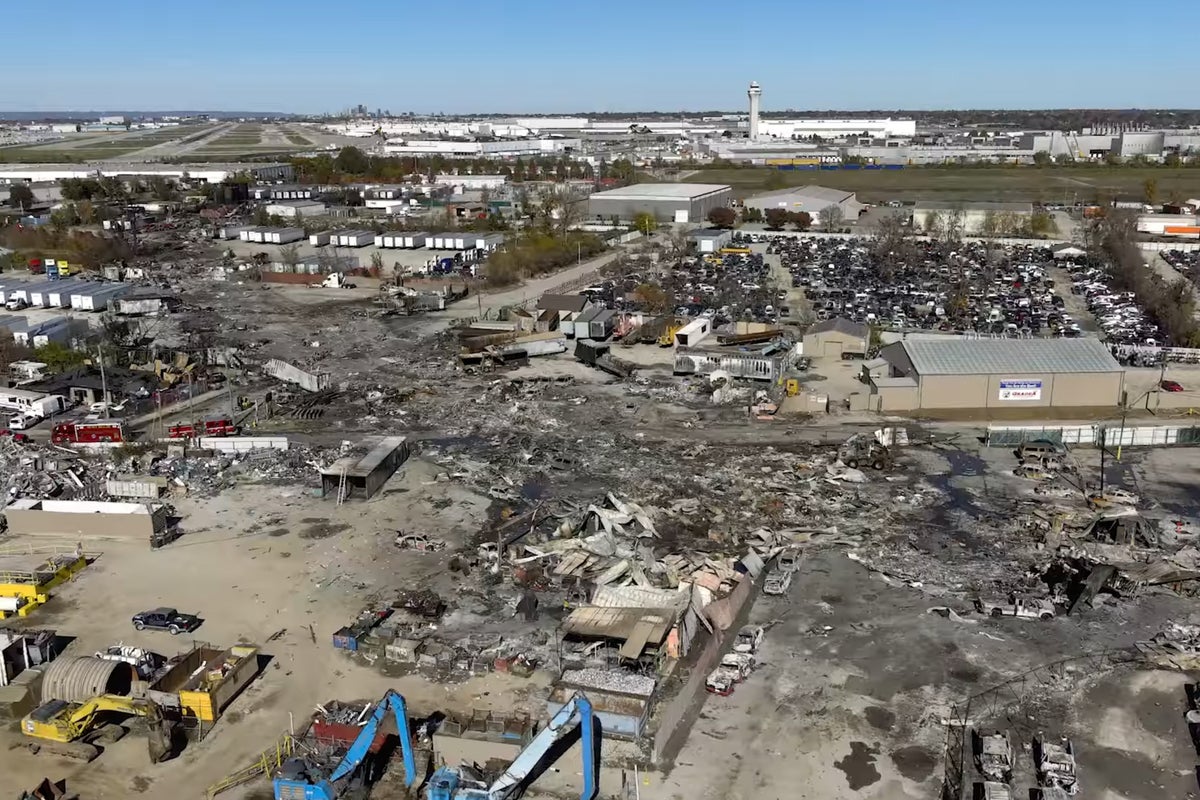
The catastrophic failure of UPS Flight 2976 at Louisville Muhammad Ali International Airport highlights a critical vulnerability in legacy widebody freighter operations: the economic and physical limits of structural life extension. When the left wing-mounted Pratt & Whitney PW4000 engine separated from the McDonnell Douglas MD-11F during its takeoff roll, it did not just cause a hull loss that claimed 15 lives. It exposed a systemic regulatory gap between manufacturer service bulletins and Federal Aviation Administration (FAA) Airworthiness Directives.
To evaluate this failure requires an understanding of the mechanical load paths that connect a 9,000-pound, high-bypass turbofan producing over 60,000 pounds of thrust to an aluminum wing box. The National Transportation Safety Board (NTSB) public hearings reveal that the primary mechanism of failure was not an acute operational overstress, but a predictable, long-term degradation of structural integrity within the pylon attachment hardware.
The Pylon Load Path Architecture
A commercial aircraft engine mount must isolate and transfer complex, multi-axis forces: forward aerodynamic thrust, vertical gravity loads, dynamic vertical loads from turbulence, and gyroscopic precession torques during aircraft rotation. On the MD-11F, this transfer relies on a pylon structure secured to the wing via forward and aft mount assemblies.
[Engine Core] ---> [Pylon Structure] ---> [Spherical Bearing Race] ---> [Wing Box Lugs]
The core component under NTSB scrutiny is the spherical bearing race within the aft pylon mount. This component acts as a knuckle, allowing minor structural deflection without inducing bending moments into the primary wing attach points. The load distribution operates under a precise stress equation:
$$\sigma = \frac{P}{A} + \frac{My}{I}$$
Where:
- $P$ is the axial load (thrust/drag)
- $A$ is the cross-sectional area of the bearing lug
- $M$ is the bending moment induced by asymmetric dynamic forces
- $y$ is the distance from the neutral axis
- $I$ is the area moment of inertia of the component section
Metallurgical analysis of the recovered debris confirmed the presence of micro-fissures matching classic fatigue progression profiles within this bearing race. The failure sequence began when high-cycle fatigue caused these cracks to propagate undetected through the component geometry. This reduction in effective cross-sectional area ($A$) exponentially increased the localized stress ($ \sigma $) under normal operating loads. During rotation, when the engine experiences peak aerodynamic thrust combined with vertical g-forces and gyroscopic resistance, the localized stress exceeded the ultimate tensile strength of the remaining metal. This caused a clean, catastrophic shear of the aft lug.
The Cascading Failure Dynamics of Tri-Engine Aerodynamics
Popular media accounts often mistakenly assume that losing a single engine on a three-engine aircraft leaves a 66% power reserve, which should be theoretically sufficient to maintain a positive rate of climb. The aerodynamics of an engine separation events reveal why this calculation is false.
The physical separation of the number one (left) engine altered the aircraft’s center of gravity and aerodynamic profile instantly. The sudden loss of structural weight on the left wing caused an immediate lift asymmetry, amplified by the fact that the separated engine was operating at maximum takeoff thrust. As the engine sheared forward and up over the wing, it severed critical hydraulic lines routed through the leading edge and destroyed the pneumatics powering the left wing's slats.
The loss of leading-edge slats on the left wing increased its stall speed instantly. The flight data recorder indicates that the aircraft achieved a maximum altitude of only 30 feet above ground level. This aerodynamic asymmetry generated a rolling moment to the left that exceeded the control authority of the remaining ailerons and spoilers.
Simultaneously, the physical trajectory of the escaping engine tore through the downstream airflow. Debris and uncontained kinetic energy entered the intake of the tail-mounted number two engine, causing immediate compressor stalls and total loss of thrust. The aircraft was left with only the right wing engine operating at maximum thrust. This created a severe, uncorrectable asymmetric thrust condition that drove the aircraft into an accelerated aerodynamic stall and subsequent impact with the ground.
Regulatory Deficits and the Risk Analysis Gap
The NTSB documentation reveals that the risk of this structural failure was known to both the manufacturer and regulators for well over a decade. In 2011, Boeing issued a service bulletin documenting four distinct failures of the engine-to-wing attachment hardware across three separate MD-11 aircraft.
The core breakdown occurred in the risk categorization framework applied to these historical events. The failure modes were classified using a standard Failure Modes and Effects Analysis (FMEA) matrix. The probability and severity values used in that matrix are detailed below:
| Variable | Definition | Historical Assessment (2011) | Current Forensic Reality (2026) |
|---|---|---|---|
| Probability | Frequency of occurrence over fleet operating hours | Low (Isolated material defects) | Medium (Fleet-wide aging/fatigue) |
| Severity | Impact of failure on aircraft controllability | Non-Hazardous (Assumed clean drop) | Catastrophic (Loss of control/Secondary engine damage) |
| Mitigation Path | Regulatory action required to ensure compliance | Voluntary Service Bulletin | Mandatory Airworthiness Directive |
By deeming the failure non-hazardous to flight safety, the manufacturer assumed that if an engine mount failed, the engine would separate cleanly downward and away from the airframe without damaging primary flight controls or secondary propulsion systems. This engineering assumption bypassed the requirement for the FAA to issue a mandatory Airworthiness Directive. Instead, operators were issued a voluntary service bulletin recommending the replacement of standard bearing races with a redesigned, fatigue-resistant variant during scheduled heavy maintenance intervals.
The Maintenance Interval Bottleneck
The maintenance protocol for the ill-fated aircraft highlights the limitations of flight-cycle-based inspection intervals for aging aircraft cargo fleets. The cargo air transport business model relies on low-utilization, high-cycle profiles. Aircraft frequently fly short legs between hubs, meaning they experience high structural stress frequency relative to total flight hours.
The specific pylon components that failed had last undergone non-destructive testing (NDT) inspection in October 2021. Under the carrier's approved continuous airworthiness maintenance program, the next comprehensive eddy-current or ultrasonic inspection of the pylon attachment structure was not scheduled for another 7,000 flight cycles.
This inspection cadence assumed a linear crack propagation model:
$$\frac{da}{dN} = C(\Delta K)^m$$
Where:
- $a$ is the crack length
- $N$ is the number of load cycles
- $\Delta K$ is the stress intensity factor range
- $C$ and $m$ are material constants
In practice, aging airframes do not always follow linear models. Environmental factors such as galvanic corrosion between dissimilar metals in the pylon assembly, combined with thermal cycling from high-altitude flight, accelerate the crack growth rate ($da/dN$). Micro-fissures that were below the detection threshold of the 2021 visual and ultrasonic inspections propagated to critical structural mass long before the 7,000-cycle threshold was reached.
The vulnerability was further exacerbated by operational logistics. The aircraft that crashed was pressed into service as a last-minute substitute for another freighter that had been grounded by a fuel leak. While the flight crew completed a standard pre-flight walkaround, visual inspections are fundamentally incapable of detecting subsurface fatigue cracks inside a sealed, structural spherical bearing race.
Fleet Management Strategy and Tactical Mandates
A critical evaluation of the MD-11F platform reveals that localized parts replacement is no longer an acceptable strategy for keeping these older planes safe. The cost-benefit equation of running heavy logistics networks on 30-plus-year-old tri-jet airframes has shifted permanently. Carriers can no longer rely on voluntary compliance with manufacturer service bulletins for flight-critical structural components.
Fleet operators must immediately execute a two-pronged structural risk mitigation strategy:
Mandatory NDT Inspection Acceleration: All remaining operational MD-11F airframes, regardless of operator or geographic location, must immediately pause flight operations to undergo high-frequency eddy-current inspections of both forward and aft pylon attach points. The inspection threshold must be decoupled from long-term heavy maintenance intervals and indexed to a maximum of 250 flight cycles or six calendar months, whichever occurs first. Any bearing race showing structural anomalies or surface scoring must be replaced with the updated, reinforced components detailed in the 2011 service bulletin before the aircraft can fly again.
Accelerated Fleet Decommissioning: Logistics providers must accelerate the retirement timelines for their remaining tri-engine widebody aircraft. The unexpected involvement of downstream engine damage from an engine separation event invalidates the historical redundancy models used to certify these airframes. Capital expenditure must be redirected toward acquiring newer twin-engine freighters featuring modern engine health monitoring systems and simplified, redundant pylon architectures. Managing an aging fleet through increasingly frequent inspections provides diminishing returns and exposes the operator to severe regulatory and liability risks.
NTSB Animation - Engine-to-Wing Attachment Design Overview and Findings
This technical animation provided by the NTSB visualizes the mechanical load paths, the exact location of the bearing race failures, and the physical breakdown of the pylon architecture discussed in this analysis.


