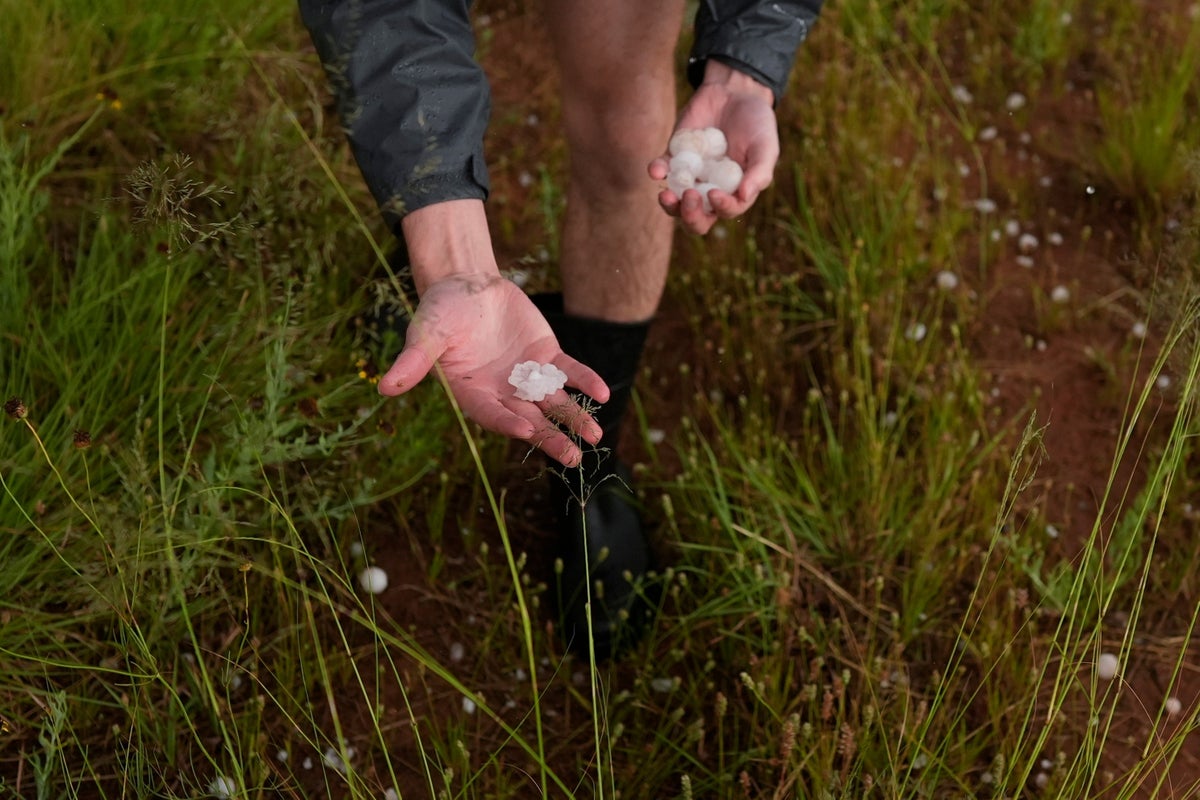
The economic and structural risk profile of hailstorms is undergoing a fundamental phase shift driven by increased vertical instability and moisture availability. While frequency trends remain regionally heterogeneous, the physics of a warming atmosphere dictates a specific outcome: a higher probability of "gorilla hail"—stones exceeding 5 centimeters in diameter—capable of penetrating building envelopes and destroying solar infrastructure. This is not a linear increase in storm frequency but a structural change in the tail-end risk of convective events.
The Mechanics of Hail Growth in a High-Energy Atmosphere
To understand why a warmer world produces more destructive hail, one must analyze the vertical structure of the atmosphere. Hail formation is a function of the balance between gravity and the upward force of an updraft. The growth of a hailstone is governed by the time it spends in the "hail growth zone," typically defined as the region of a cloud where temperatures range from -10°C to -30°C.
The Updraft Velocity Threshold
The maximum size of a hailstone is limited by the peak vertical velocity of the storm's updraft. For a stone to reach the size of a grapefruit, the updraft must exceed 45 meters per second (roughly 100 mph). In a warming climate, the Convective Available Potential Energy (CAPE) increases. CAPE is the integrated amount of work that the upward buoyancy force would perform on a given mass of air.
As the planet warms, the lower atmosphere holds more water vapor. When this air rises and condenses, it releases latent heat, which further fuels the buoyancy of the parcel. This creates a feedback loop that increases the terminal velocity of the updraft. A faster updraft supports heavier stones for longer durations, allowing for more "accretion"—the process of supercooled water droplets freezing onto the hailstone's surface.
The Shift in the Freezing Level
A competing mechanism in a warmer climate is the rising melting level (the height of the 0°C isotherm). As the atmosphere warms, the distance a hailstone must fall through warm air increases. This induces melting and shedding. Small and medium-sized hailstones are frequently liquidated before they reach the ground. However, large hailstones possess a lower surface-area-to-volume ratio, making them more resilient to melting. This creates a survival-of-the-largest effect: the total number of hailstorms may decrease or stay flat, but the proportion of storms producing catastrophic hail increases.
The Three Pillars of Hail Severity
The transition from a standard convective event to a damaging hailstorm depends on three distinct atmospheric variables:
- Vertical Wind Shear: This organizes the storm. Without shear, the rain and hail fall back into the updraft, choking the storm. High shear tilts the storm, allowing the updraft to remain separate from the downdraft, leading to long-lived "supercells" that can process massive amounts of water into ice.
- The Capping Inversion: A layer of warm air aloft can prevent small storms from firing. In a warmer climate, "caps" often become stronger. While this prevents weak storms, it allows energy to build up near the surface. When the cap finally breaks, the resulting storm is explosive and more likely to produce extreme hail.
- Low-Level Moisture Flux: The Clausius-Clapeyron relationship dictates that the atmosphere holds approximately 7% more moisture for every 1°C of warming. This moisture provides the raw material for hail accretion.
Quantifying the Damage Function
The relationship between hail size and damage is non-linear. The kinetic energy ($E_k$) of a falling hailstone is defined by the equation:
$$E_k = \frac{1}{2}mv^2$$
Where $m$ is the mass and $v$ is the terminal velocity. Because the terminal velocity of a hailstone also increases with its mass ($v \propto \sqrt{r}$, where $r$ is the radius), the energy delivered upon impact scales to the power of four or five relative to the stone's radius.
A 5-centimeter hailstone does not do twice as much damage as a 2.5-centimeter stone; it carries significantly more kinetic energy, often exceeding the impact resistance thresholds of standard asphalt shingles and automotive glass.
Vulnerability of the Green Energy Transition
The shift toward renewable energy has inadvertently increased the global "target" for hail. Large-scale solar farms are often located in regions with high convective activity. Standard photovoltaic (PV) modules are typically tested to withstand 25-millimeter hail at terminal velocity. When storms produce 50-millimeter or 75-millimeter stones, the failure rate of solar arrays approaches 100%. This represents a systemic risk to the stability of power grids and the insurability of renewable energy projects.
Regional Divergence and Predictability
Climate models indicate that the "Hail Alley" of the United States is shifting eastward and northward. Traditionally centered over the Great Plains, the environment supportive of large hail is expanding into the more densely populated Midwest and Southeast.
In Europe, the warming of the Mediterranean Sea provides an enhanced moisture source for storms crossing the Alps and the Pyrenees. These regions are seeing a measurable uptick in "giant hail" (stones > 10 cm). The predictability of these events remains a bottleneck. While we can forecast the potential for large hail based on CAPE and shear 24–48 hours in advance, the exact location of a supercell is often only determined 30 to 60 minutes before impact.
The Insurability Crisis and Structural Mitigation
The insurance industry is currently recalibrating its risk models to account for the "severe convective storm" (SCS) peril, which now rivals hurricanes and wildfires in terms of annual aggregate losses. The primary challenge is that hail damage is often widespread and involves hundreds of thousands of individual claims per event.
Engineering Resilience
The mitigation of hail risk requires a transition from reactive recovery to proactive hardening of the built environment. This involves:
- Impact-Rated Roofing: Transitioning building codes to require Class 4 impact resistance.
- Active Solar Positioning: Implementing "hail stow" logic in solar trackers. This involves tilting panels to a high angle (50-60 degrees) during a storm to reduce the impact energy by ensuring stones strike at an oblique angle rather than a perpendicular one.
- Material Science: Developing polymer-modified bitumens and reinforced glazing that can dissipate kinetic energy without fracturing.
Strategic Forecast
As atmospheric instability increases, the frequency of "nuisance" hail (small stones) will likely decline due to increased melting in a deeper warm-cloud layer. However, the intensity of "extreme" hail events is locked into an upward trajectory. We are moving toward a bifurcated climate reality where storm frequency may remain stable, but the severity of peak events exceeds current engineering tolerances.
Asset managers and urban planners must treat hail not as a random "act of God," but as a predictable physical consequence of a high-enthalpy atmosphere. Investment in structural resilience is no longer an optional upgrade; it is a prerequisite for maintaining the viability of physical assets in mid-latitude regions. The focus must shift immediately to the "stow and shield" protocols for infrastructure, as the current pace of atmospheric warming is outstripping the replacement cycle of the modern built environment.


