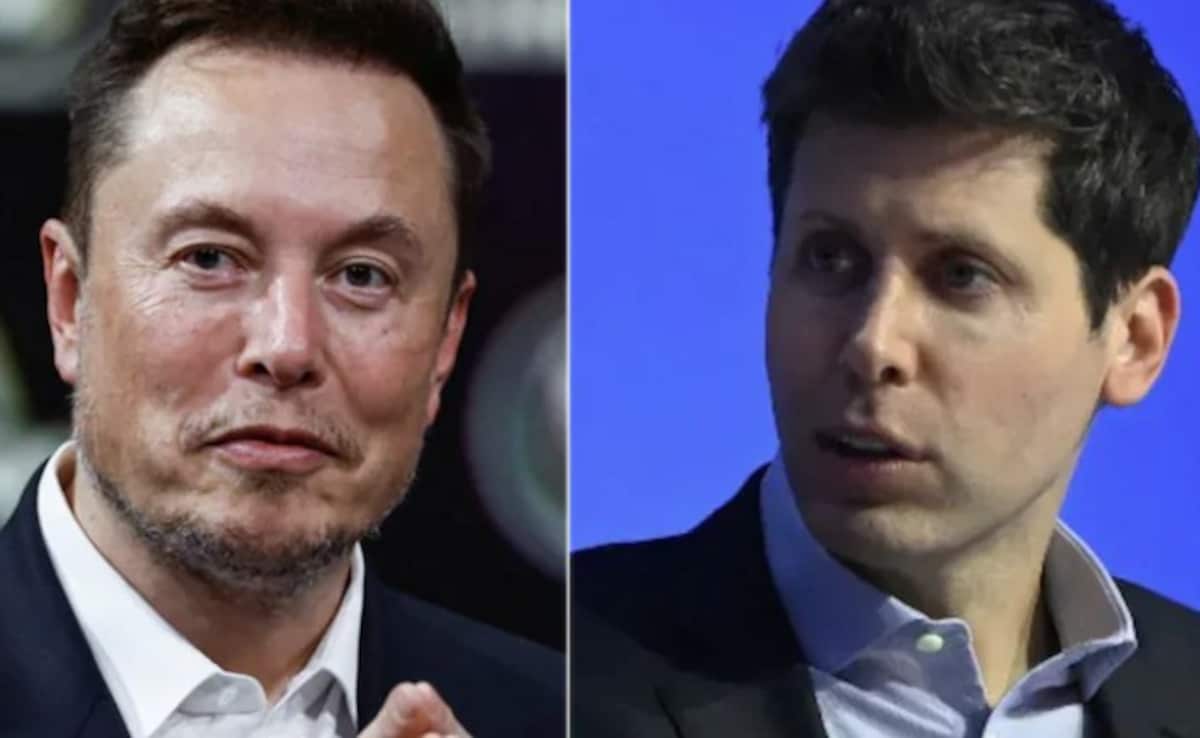
Sam Altman took the witness stand with the practiced composure of a man who has spent years navigating the crosswinds of Silicon Valley power politics. The testimony he delivered paints a picture of the early days of OpenAI that looks less like a non-profit mission to save humanity and more like a standard, high-stakes boardroom brawl. At the heart of his account is a staggering claim that Elon Musk demanded a 90% stake in the entity, a move that would have effectively turned a collective research effort into a personal fiefdom. This revelation isn't just about bruised egos or historical trivia. It explains the fundamental fracture between the world’s most famous billionaire and the company that currently leads the generative AI race.
The trial brings to light a friction that existed long before ChatGPT became a household name. According to Altman, Musk’s vision for OpenAI was never truly about a decentralized, open-source collective. Instead, it was about dominance. When Musk realized he could not fold the project into Tesla or maintain a crushing majority of the equity, he walked away. He left a hole in the budget that nearly sank the venture before it truly began.
The Myth of the Open Source Martyr
For years, Elon Musk has positioned himself as the guardian of AI safety, frequently attacking OpenAI for transitioning from a non-profit into a "capped-profit" juggernaut backed by Microsoft. He frames his lawsuit as a crusade for the original mission. However, Altman’s testimony suggests the "Open" in OpenAI was the first thing Musk was willing to sacrifice.
The 90% equity demand represents more than just greed. In the venture capital world, a founder or investor holding that much of a company effectively owns the roadmap, the intellectual property, and the kill switch. If Altman’s account holds up, Musk wasn't looking to protect a non-profit. He was looking to consolidate a monopoly on the most important technology of the century.
Musk’s departure in 2018 is often cited as a disagreement over AI safety or the pace of development. The reality appears much more pragmatic. OpenAI needed billions of dollars to build the compute clusters required for large language models. Musk reportedly refused to provide the necessary funding unless he had total control. When the board said no, he cut the cord.
Why the 90 Percent Figure Matters
Control in a tech company isn't just about money. It is about the data. By demanding 90% of OpenAI, Musk would have integrated the research directly into the Tesla ecosystem. We see the remnants of this ambition today with xAI and Grok, which leverage data from X (formerly Twitter) to train models.
Altman described a period of intense "desperation" following Musk's exit. The company had no clear path to the massive amounts of capital required for GPUs and electricity. This pressure is what ultimately forced the transition to the current hybrid structure. It wasn't a betrayal of the mission, as Musk claims, but a survival tactic necessitated by his withdrawal.
The Microsoft Pivot as a Countermove
When Musk left, he didn't just take his money; he took the perceived stability of the project. This created the vacuum that Microsoft eventually filled. Satya Nadella saw an opportunity that Musk missed: the chance to be the "foundry" for AI without needing to own every single share of the laboratory.
The partnership with Microsoft gave OpenAI the infrastructure it needed, but it also provided Musk with his primary talking point. He argues that OpenAI is now a closed-source subsidiary of a tech giant. Altman’s testimony flips the script. It suggests that if Musk had stayed, OpenAI wouldn't be a Microsoft subsidiary; it would be a Tesla department.
The Silicon Valley Power Play
The trial reveals the inherent contradictions in how these leaders talk about "the mission." In the valley, "saving the world" is often used as a convenient shorthand for "disrupting my competitors."
Altman's defense relies on the idea that the company had to evolve to stay relevant. He argues that a pure non-profit could never have built GPT-4. The sheer cost of the hardware makes that impossible. If you are playing a game that costs $10 billion to enter, you cannot rely on the kindness of donors who might change their minds if they don't get 90% of the credit.
The Diverging Roads of Safety and Profit
Musk’s legal team continues to push the narrative that OpenAI is rushing dangerous products to market to satisfy investors. This is a potent argument because it taps into a genuine public fear. But Altman’s testimony provides a counter-narrative: safety research also costs money.
If the company had remained a small, underfunded research lab, it might have been "safer" in the sense that it wouldn't have produced anything powerful enough to be dangerous. But it also would have been irrelevant. The industry would have been dominated by Google or Meta, companies that were never non-profits to begin with.
The Evidence in the Emails
One of the most damaging aspects of this trial for Musk is the paper trail. Emails from the 2015-2018 era show a man who was deeply involved in the strategic planning of the company’s commercial future.
In these exchanges, the "non-profit" status is often discussed as a temporary branding exercise or a way to attract talent that wouldn't normally work for a big tech firm. Altman is using these records to show that Musk was fully aware—and supportive—of the shift toward a more aggressive, well-funded model, provided he was the one at the helm.
The Problem with Capped Profit
The "capped-profit" model is a strange beast. It attempts to serve two masters: the idealistic researchers who want to benefit humanity and the investors who want a return. It is an unstable equilibrium.
Critics of Altman suggest that even if Musk’s 90% demand was real, the current structure is equally problematic. Microsoft doesn't own 90%, but they have a "first look" at every piece of technology OpenAI develops. They have integrated the models into every corner of their software suite. To the outside observer, the difference between "Musk-owned" and "Microsoft-aligned" might seem like a distinction without a difference.
The Human Element of the Feud
Beyond the legal technicalities, there is a clear personal animosity that drives this conflict. Musk and Altman were once allies. They shared a vision of an AGI that wouldn't be controlled by a single entity like Google.
The irony is that their fight for control has created exactly what they feared: a polarized landscape where AI development is concentrated in the hands of a few warring factions. The trial isn't just about who said what in 2017. It is about who gets to define what "Open" means for the next decade of human progress.
The Technical Reality of Scaling
The hardware requirements for modern AI are the silent third party in this courtroom. You cannot train a state-of-the-art model on a shoestring budget.
- Compute Costs: Training a model like GPT-4 requires tens of thousands of H100 GPUs.
- Talent War: Top AI researchers command seven-figure salaries.
- Data Acquisition: Legal and licensing fees for high-quality training data are skyrocketing.
When Musk demanded 90%, he was likely calculating the massive personal capital he would have to inject to cover these costs. In his mind, the equity was the price of the risk. From Altman’s perspective, that price was an attempt to buy the future and lock the door behind him.
The Strategy of the Lawsuit
Musk is a master of using the legal system as a PR tool. Even if he loses the case, he wins the narrative battle by forcing OpenAI’s internal laundry into the public eye. By making Altman testify about equity splits and secret negotiations, Musk is trying to strip away the "savior" image that OpenAI has carefully cultivated.
Altman, conversely, is using the stand to portray Musk as a hypocrite. Every time he mentions the 90% figure, he is reminding the world that Musk’s "principled" stand is a relatively recent invention that only appeared after he lost control of the board.
The Impact on the Industry
Other AI startups are watching this trial with a mix of dread and fascination. Anthropic, Mistral, and others are all grappling with the same dilemma: how do you stay independent when you need billions from the giants?
The "Musk vs. Altman" saga serves as a cautionary tale. It suggests that in the world of AGI, there is no such thing as a clean partnership. Every dollar of investment comes with a string attached, and every "non-profit" mission is one board meeting away from a corporate takeover.
The Verdict on Transparency
The biggest takeaway from Altman’s testimony is that OpenAI was never the transparent, purely altruistic entity the public was led to believe. It was always a high-stakes play. The disagreement between the founders wasn't about whether to commercialize, but who would profit and who would lead.
The 90% demand, if true, reveals a level of ambition that is characteristic of Musk’s other ventures. He doesn't do "partnerships" in the traditional sense; he does missions where he is the commander. OpenAI’s board decided they didn't want a commander; they wanted a collaborator. That decision led them to Microsoft, a company that was willing to play the long game of influence rather than immediate total ownership.
As the trial continues, more documents will likely surface that complicate the narrative for both sides. But the core conflict is now clear. This is a battle over the definition of the word "Open." For Musk, it seems it meant "Open to me." For Altman, it meant "Open for business."
The future of AI will not be decided by a researcher in a lab, but by the outcome of these power struggles in the courtroom and the boardroom. The mission to create safe AGI has been inextricably linked to the ego and equity of the men who claim to be its creators. If you want to understand where AI is going, stop looking at the code and start looking at the cap table.