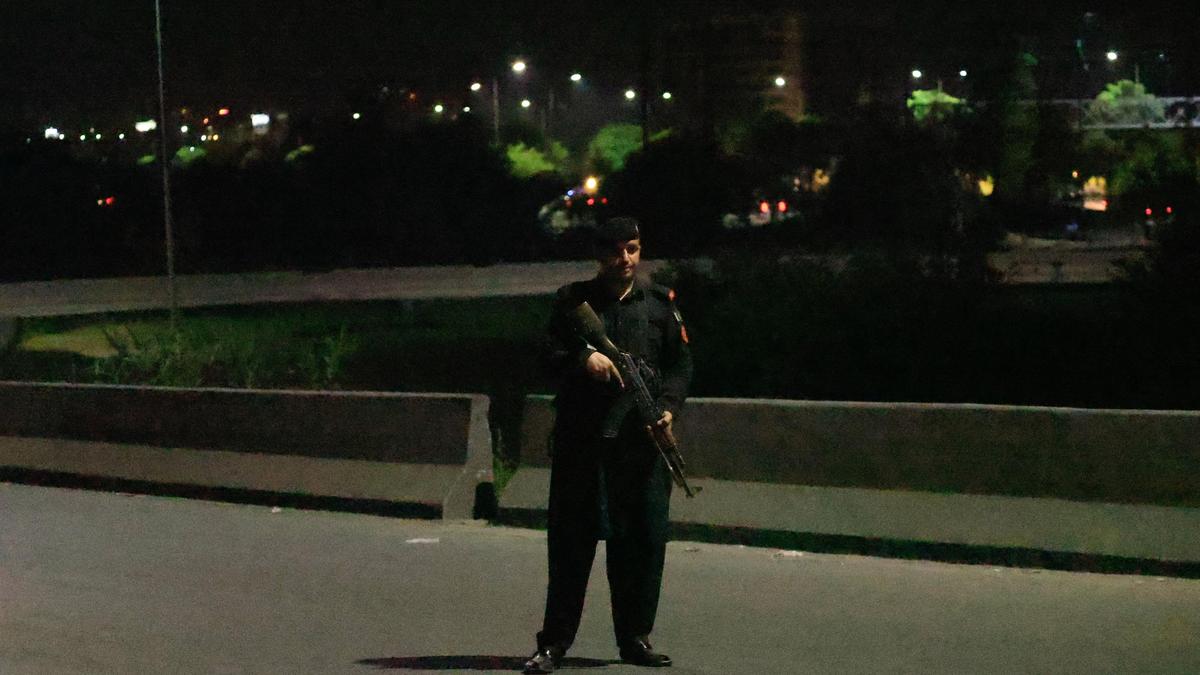
The press release is predictable. Five terrorists eliminated in a "high-intensity intelligence-based operation" in Khyber Pakhtunkhwa. The official narrative paints a picture of clinical precision and eroding insurgent capabilities. Standard news outlets swallow the bait, printing the body count as if it were a score in a cricket match.
They are measuring the wrong thing.
If you believe that killing five militants in North Waziristan or Dera Ismail Khan changes the structural reality of the borderlands, you are falling for the oldest trick in the counter-insurgency playbook. Tactical wins are often the loudest signals of a failing strategy. We are stuck in a loop of kinetic obsession while the ideological and logistical foundations of groups like the TTP (Tehrik-i-Taliban Pakistan) remain untouched.
The Body Count Delusion
Military history is littered with the corpses of "tactical successes" that led to strategic defeats. General William Westmoreland in Vietnam became the patron saint of this fallacy. He focused on attrition—on stacking bodies—until he realized that the enemy’s will to recruit was faster than his ability to kill.
Pakistan is currently running the same flawed script.
When the Inter-Services Public Relations (ISPR) reports five kills, the media treats it as a net reduction in threat. It isn't. In the tribal dynamics of Khyber Pakhtunkhwa (KP), every kinetic strike carries a heavy tax. If those five men have brothers, cousins, or tribesmen who perceive the operation as heavy-handed or civilian-adjacent, you haven't removed five threats. You have potentially planted the seeds for fifty more.
Insurgency is a renewable resource. Unless the "kill" is coupled with a total disruption of the recruitment pipeline, you are just pruning a hedge that grows back thicker.
The Afghan Paradox No One Admits
The mainstream analysis suggests that the primary issue is "sanctuaries" across the border in Afghanistan. While the Afghan Taliban's refusal to rein in their ideological brothers is a massive headache, focusing solely on the "cross-border" element is a convenient excuse for internal policy failure.
The hard truth? The TTP is not an external invader. It is a homegrown byproduct of decades of inconsistent state presence and the "Good Taliban vs. Bad Taliban" binary that finally imploded.
We talk about border fencing as if it’s a magic shield. It’s a fence. It doesn't stop the flow of ideas, digital radicalization, or the deep-seated local grievances regarding the FATA merger’s failed promises. When we celebrate five kills, we ignore the fact that the insurgency has morphed. It is no longer just about holding territory; it is about "urban contagion"—the ability to strike at the heart of the police and security apparatus in cities like Peshawar and beyond.
The Intelligence-Based Operation (IBO) Echo Chamber
The term "Intelligence-Based Operation" has become a rhetorical shield. It suggests a level of surgical accuracy that rarely exists in the chaotic terrain of KP.
True intelligence isn't just knowing which compound holds a militant. It’s knowing why that militant was welcomed into the compound in the first place. Pakistan’s security apparatus is excellent at the former and increasingly disconnected from the latter.
By prioritizing "Kinetic IBOs" over "Social IBOs," the state is signaling that it only cares about the region when there is a target to hit. This reinforces the "garrison state" perception among the local populace. If the only time a young man in South Waziristan sees the state’s power is through the barrel of a gun—even if that gun is pointed at a "terrorist"—the state remains an outsider.
The Economics of the AK-47
Why does the recruitment continue despite the high kill rates? Because for a significant portion of the youth in the merged districts, the insurgency is the only "industry" that is hiring.
The competitor's article likely ignored the economic vacuum. When the state fails to provide a viable alternative to the war economy, the militant groups fill the gap. They provide identity, a paycheck (however meager), and a sense of agency. Killing five militants does nothing to devalue the "career path" of militancy in a region where the civilian administration is a ghost.
Imagine a scenario where for every one dollar spent on kinetic operations, only five cents are spent on the actual judicial and civil infrastructure of the merged districts. That isn’t a hypothetical. That is the current imbalance. We are trying to shoot our way out of a problem that requires a courthouse and a functional local council.
Why "Stability" is a Lie
The word "stability" is thrown around by analysts who haven't stepped foot in the Khyber Pass in a decade. They see a week without a major bombing and call it progress.
Real stability is the absence of the need for constant military operations. If the security forces have to kill five terrorists every few days, the area is not stable. It is a high-fever patient being kept alive on ice packs. You are treating the symptom, not the infection.
The current approach is a holding pattern. It’s "mowing the grass." But eventually, the mower runs out of fuel, or the grass evolves to grow faster than the blades can spin.
The Actionable Pivot
Stop asking how many militants were killed. Start asking these three questions instead:
- What is the "Replacement Rate"? If the military kills 100 militants in a quarter, but 120 new recruits join the ranks in that same period, the military is losing. We need transparent metrics on recruitment trends, not just elimination stats.
- Where is the Civilian Oversight? The police (KP Police) are the front line. They are the ones being targeted in mosques and checkpoints. Yet, they remain under-equipped and politically sidelined compared to the paramilitary and military units. A state that relies on its army for domestic policing is a state in permanent crisis.
- Is the "Nizam-e-Adl" Still a Threat? The demand for Sharia-based justice in Malakand and other regions wasn't just about religion; it was about the total failure of the British-era legal system to provide quick, uncorrupted decisions. If the state doesn't fix the courts, the militants will always have a "justice" platform to run on.
The Cost of the Counter-Intuitive
The contrarian view is painful because it demands more than just brave soldiers. It demands a functional, boring, and accountable civilian state. It’s much easier to celebrate a successful raid and put out a press release than it is to build a tax-paying, law-abiding civil society in a war zone.
We are addicted to the "heroic kinetic" because the "mundane administrative" is too hard.
But as long as we define victory by the number of bodies left in the dust of Khyber Pakhtunkhwa, we are not winning. We are just participating in a high-stakes cycle of violence that the enemy is perfectly happy to continue. They have nothing but time. We have a country to run.
The next time you see a headline about "5 Terrorists Killed," don't cheer. Ask yourself why there were five more to kill in the first place, and where the next five are currently being recruited.
The body count isn't the solution. It's the ledger of our failure to solve the actual problem.
Stop counting. Start governing.