The air inside Madison Square Garden does not circulate; it heavy-packs itself into a collective, stale lungful of beer foam, expensive cologne, and forty years of ancestral anxiety. When the whistle blows, thirty-three thousand knees stop shaking simultaneously.
There is a specific frequency of sound that occurs only when a metropolitan area realizes its basketball team might actually be mean enough to win a championship. It is not a cheer. It is a low, guttural rumble that starts in the shins of the plumbers and hedge-fund analysts sitting three rows back from the floor and ends somewhere in the rafters where the old championship banners gather dust.
On this night, the Cleveland Cavaliers did not just lose a basketball game. They were disassembled like a cheap watch on a kitchen table.
The box score will tell you the New York Knicks moved within two victories of the NBA Finals. It will give you percentages, point differentials, and rebounding margins. It will state that the blowout was decisive, efficient, and mathematically insurmountable by the middle of the third quarter. But the box score is a skeleton. It tells you that the body died; it does not tell you about the knife.
To understand how a team from Ohio with a statistically superior defense became a footnote in Manhattan, you have to look at the floorboards. Specifically, you have to look at the mud on them.
The Geography of Bruises
Basketball at this level is often marketed as an aerial ballet—a series of high-flying, gravity-defying maneuvers executed by men who seem to have bypassed the laws of physics entirely. That is a lie sold to television networks. The postseason is played on the ground, in the dirt, where teeth get loosened and ribs turn the color of an overripe plum.
Consider Josh Hart.
He does not possess the smooth, silk-spun jumper of an All-Star shooting guard. He does not glide. When he runs, he looks like a man trying to catch a departing bus while carrying two heavy suitcases. Yet, three minutes into the second quarter, with the Knicks leading by seven, a loose ball squirted toward the sideline.
An average millionaire athlete calculates the physics of that ball. They weigh the contract incentives against the hardwood friction. Hart did not calculate. He launched his frame horizontally, his hip meeting the varnished oak with a sound like a wet sack of flour hitting a loading dock. He didn't just retrieve the ball; he tore it away from two Cleveland jerseys with a feral, possessive jerk of his shoulders.
That single possession did not show up on the highlight reels. It didn't make the morning talk shows. But on the Cleveland bench, three players looked down at their sneakers. They knew.
The Cavaliers came into the series with a blueprint built on elegance. They had length, they had youthful exuberance, and they had Jarrett Allen anchoring a paint that looked, during the regular season, like an impenetrable forest. But New York doesn't play basketball; they conduct a two-hour audit of your chest cavity.
Every screen set by Isaiah Hartenstein felt less like a basketball play and more like an insurance claim. By the time Mitchell Robinson entered the game to secure the offensive rebounds—thirteen of them, an absurd, gluttonous number that borders on statistical bullying—the Cavaliers were no longer looking at the rim. They were looking for exits.
The Ghost in the Pinstripe Suit
Every franchise has a haunting. In Boston, it is the green leprechaun of expectation. In Los Angeles, it is the glitz that curdles into apathy when the wins stop coming. In New York, the ghost wears a double-breasted suit and carries a clipboard from 1973.
For five decades, the city has chased the ghost of Willis Reed’s limp and Walt Frazier’s mink coats. Every savior who arrived at Penn Station—from Carmelo to Starbury—was asked to carry that weight. They all eventually buckled under it, their knees giving out under the sheer mass of a city that demands excellence but specializes in cynicism.
The current iteration of this team succeeds because they are entirely immune to the romance of their own environment.
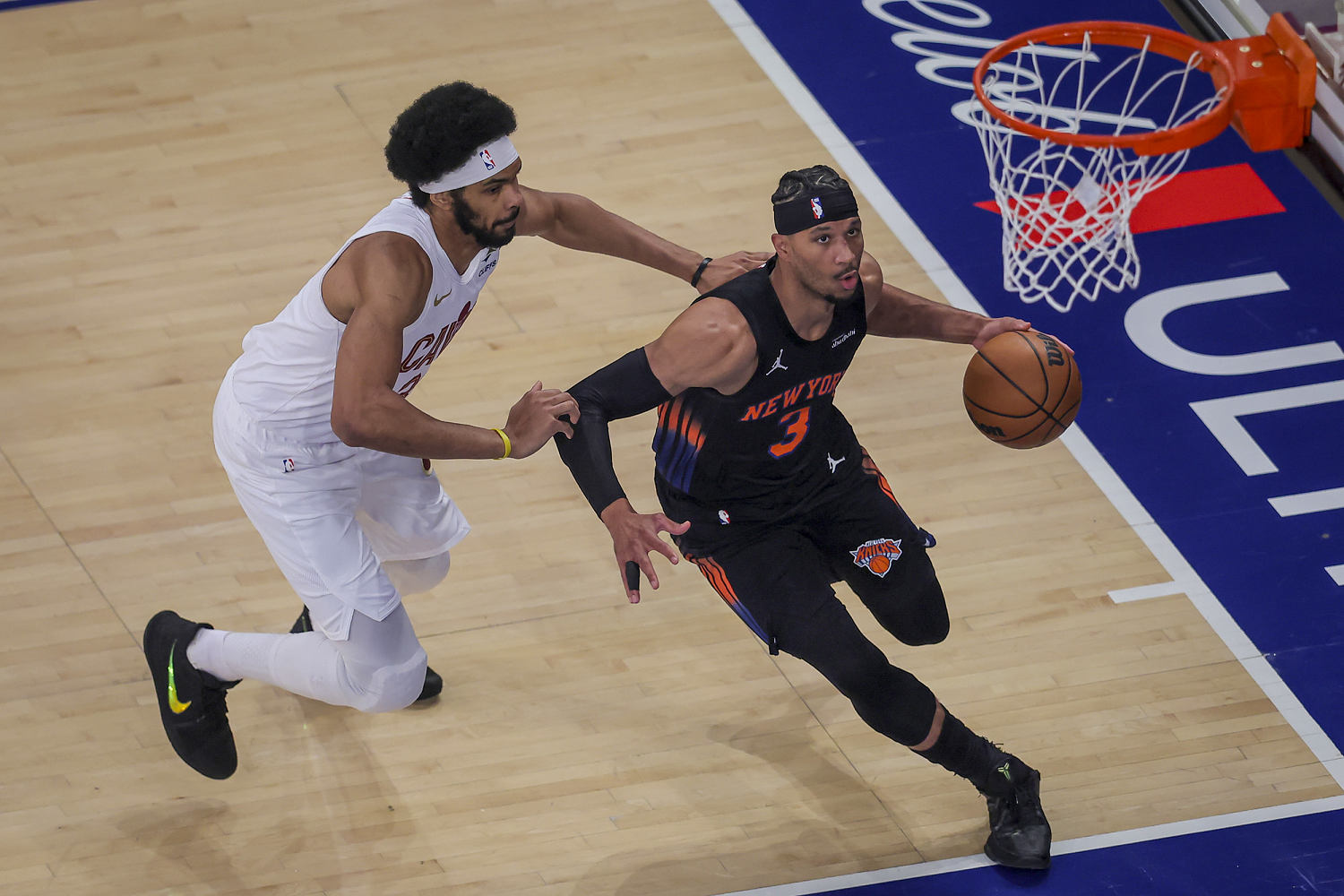
Jalen Brunson doesn't look like a savior. He looks like an accountant who happens to have a devastating crossover and a lower center of gravity than an anvil. When he operates in the mid-post, it isn't pretty. It is a slow, methodical grinding down of his defender's patience. He uses his backside like a shield, bumping, probing, creating three inches of daylight where none existed, and then flipping a shot off the glass that looks like it was thrown from a moving vehicle.
It is ugly. It is beautiful. It is precisely what the city is when you take away the neon.
During the third-quarter run that turned a competitive contest into an eviction notice, Brunson scored twelve consecutive points. He didn't do it with transition dunks or transition threes that sent the crowd into a frenzy. He did it by drawing fouls. He did it by stepping into the lane, taking the contact from Evan Mobley—a man six inches taller and thirty pounds lighter—and finishing through the whistle.
On the sideline, Tom Thibodeau did not crack a smile. He stood with his arms crossed, his voice already a hoarse, gravelly rasp that sounded like it had been dragged through a rock quarry. He looked like a man who had found a flaw in the universe and was determined to exploit it until someone stopped him.
The Illusion of the Cleveland Renewal
There is an old scouting adage that states you cannot truly evaluate a team until they have been hit in the mouth on the road. Cleveland came into the Garden believing their regular-season metrics would protect them. They believed their spacing would save them.
But metrics assume a sterile environment. They assume the referees will call every micro-aggression under the basket. They do not account for the thirty thousand people screaming about someone's mother from the second tier.
Donovan Mitchell, a native of the tri-state area who knows the geometry of the Garden better than most, tried to hold the levy broke. He spun, he attacked, he hit difficult, contested runners over the outstretched arms of New York's rotating defense. But he was an island.
Every time Mitchell passed the ball, it felt like a capitulation. His teammates received the rock with a visible hesitation, a split-second delay where they looked at the closing speed of OG Anunoby and decided that maybe, just maybe, they didn't want to see what happened if they drove to the lane.
Anunoby’s presence on the floor is a quiet, terrifying metric of its own. He does not celebrate. He does not pound his chest. He simply occupies space that you previously thought belonged to you. When Darius Garland attempted to turn the corner in the pick-and-roll during the crucial stretch of the third, Anunoby didn't just slide his feet; he absorbed Garland's entire momentum, stripping the ball with a clinical, surgical precision that left the young guard looking at his hands as if they had betrayed him.
By the time the fourth quarter arrived, the game had ceased to be a contest of strategy. It had become a psychological study in submission.
The Cavaliers' bench sat in a neat, orderly row, their white towels draped over their shoulders like shrouds. They looked like tourists who had taken a wrong turn into a neighborhood where the streetlights had been shot out. They were two wins away from the offseason, and from the expression on their faces, the beach could not come soon enough.
The Unwritten Contract
The people who pay three weeks' rent for a seat in the 200-level of the Garden do not do so because they like basketball. They do so because they want to see something that mirrors their own survival.
New York is a city where every interaction is a negotiation for territory. You fight for six inches on the subway platform; you fight for a table at the diner; you fight to keep your head above water in an economy designed to drown you. When they see five men in white jerseys treating a leather ball like it’s the last loaf of bread on earth, something connects.
It is a covenant.
That covenant was fulfilled with six minutes left in the fourth. The game was effectively over—the lead had ballooned to twenty-two—but Miles McBride was still full-court pressing Garland. He didn't have to. The coaches wouldn't have blamed him if he had dropped back into a soft zone to conserve energy for Game Five.
But McBride stayed in Garland's jersey, his feet pattering against the floor like a snare drum. He forced a turnover at mid-court, dove for the ball, and while still on his knees, flipped it to a trailing Precious Achiuwa for a transition dunk that nearly took the rim off its bolts.
The stadium didn't just cheer. They roared with a primitive, vindictive joy.
It wasn't about the two points. It was about the refusal to let up. It was about the realization that after decades of being the punchline of the league, the joke had finally turned around, and the guy holding the microphone was wearing blue and orange.
The series now moves back across the river, or down the highway, or wherever it is these teams go when they need to lick their wounds. The Cleveland papers will talk about adjustments. They will talk about switching the pick-and-roll coverage, about getting more touches for Allen, about finding a way to slow down the New York transition game.
They are missing the point.
You cannot adjust your way out of an identity crisis. You cannot draw up a play that teaches a man how to want a rebound more than the giant standing next to him.
As the fans poured out into the damp Manhattan night, past the hot dog carts and the guys selling bootleg t-shirts with Brunson’s face screen-printed on the front, there was no talk of the Finals. No one was mentioning the trophy. They were just talking about the bruises. They were talking about the way the floor shook when Hart hit the wood.
The Knicks are two wins away from the grandest stage in the sport, but the victory didn't feel like a step toward a destination. It felt like an eviction notice served to anyone who thought they could come into this building and leave with their dignity intact.