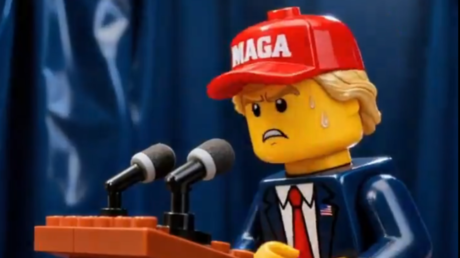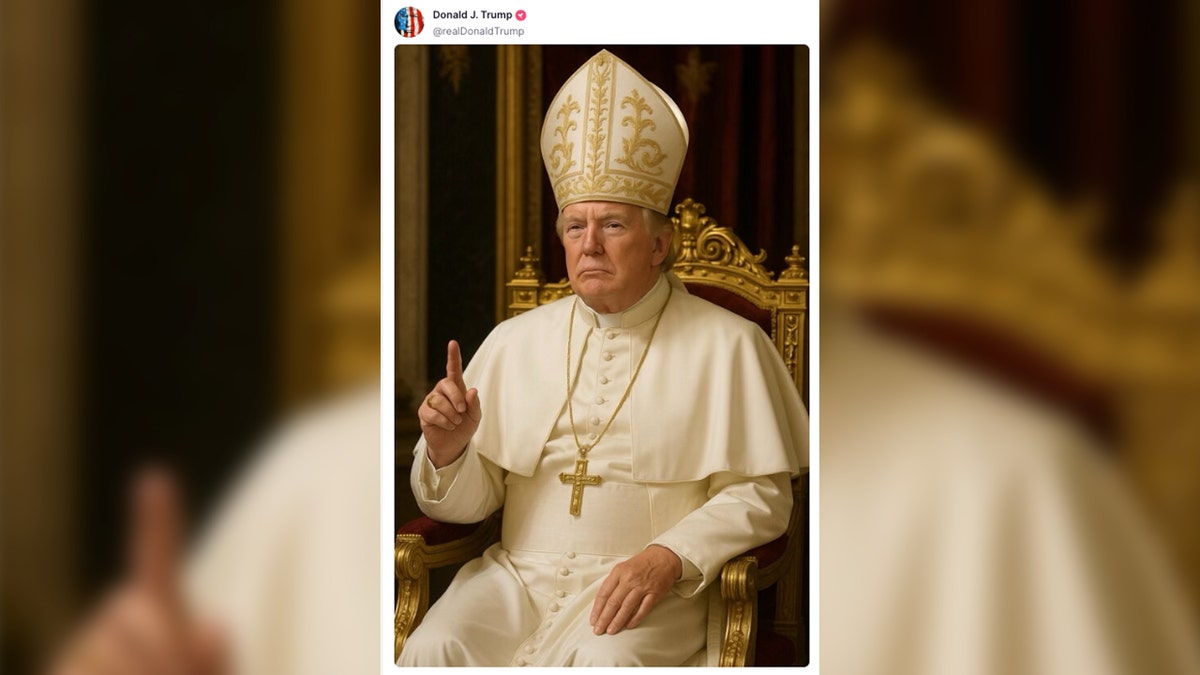
Donald Trump’s recent circulation of an AI-generated image depicting himself as a Christ-adjacent martyr is not a random act of social media vanity. It is a calculated deployment of computational propaganda. By leaning into a visual language that blends religious iconography with high-resolution synthetic realism, the Trump campaign is bypassing traditional gatekeepers of information and speaking directly to the lizard brain of his base. This isn't just about drawing outrage from critics. It is about hardening the loyalty of believers through a medium that is increasingly difficult to distinguish from reality.
The outrage is the fuel. Every time a legacy media outlet or a secular critic decries the "blasphemy" or the "deception" of these images, they inadvertently amplify the message to the target audience. To the MAGA faithful, the outrage of the "elite" confirms the validity of the image’s emotional truth, regardless of its literal falsehood. This is the new front of political warfare, where the goal isn't to convince the undecided, but to radicalize the converted using tools that can manufacture any reality on demand.
The Architecture of the Synthetic Cult of Personality
Politics has always relied on imagery. We remember the stoic portraits of Lincoln and the carefully staged fireside chats of FDR. But those were physical captures of real moments or intentional paintings. The shift to AI-generated content represents a fundamental break from the historical record. When a machine can render the former president in a pose of divine suffering or heroic triumph with a few keystrokes, the barrier to creating a mythological narrative vanishes.
These images function as digital icons. In the Orthodox tradition, icons were never meant to be photographs; they were windows into a spiritual reality. Trump’s team—or the decentralized network of creators who feed his ecosystem—understands this perfectly. They aren't trying to trick you into thinking Jesus actually sat in a courtroom with Trump. They are using the visual shorthand of Western Christianity to frame his legal battles as a metaphysical struggle between good and evil.
The technology behind this, primarily diffusion models like Midjourney or DALL-E, works by predicting pixels based on vast datasets of existing art and photography. Because the internet is saturated with centuries of Christian art, the AI is remarkably "good" at replicating the lighting, the somber expressions, and the ethereal glow associated with divinity. This creates a psychological "halo effect" that is almost impossible to counter with mere facts or fact-checking.
The Death of the Fact Check
We are entering an era where the "fact-check" is an obsolete weapon. For decades, journalists operated on the assumption that if you pointed out a lie, the lie would lose its power. That era ended with the democratization of AI. When a supporter sees Trump-as-Messiah, their reaction is emotional, not analytical. You cannot "fact-check" a feeling.
The strategy relies on a concept known as "illusory truth," where repeated exposure to a specific visual theme makes it feel more "true" over time. If a voter sees 50 images of Trump as a savior, a warrior, or a victim of a corrupt system, those images form a composite reality. The individual pixels don't matter. The cumulative weight of the aesthetic does. This is how you build a movement that is immune to evidence.
The technical ease of this process is the real story. Five years ago, creating a convincing image of this nature required professional Photoshop skills and hours of labor. Today, a teenager in a basement can generate a thousand variations in an afternoon. This flood of content creates a "censorship by noise" effect. The public becomes so overwhelmed by synthetic imagery that they eventually stop trying to discern what is real and simply gravitate toward what feels right.
The Strategic Benefit of Provocation
Why post an image that is so obviously fake? Because it forces the opposition to engage on the creator’s terms. When critics spend three days debating the ethics of AI and the boundaries of religious imagery, they are not talking about policy, inflation, or foreign affairs. They are trapped in a cultural skirmish that Trump has already won by virtue of being the center of attention.
This is a classic attention-hacking maneuver. In the attention economy, the most valuable currency is the "angry click." The more "blasphemous" the image, the more shares it gets from people who hate it. Those shares, in turn, push the image into the feeds of people who love it. The algorithms of platforms like X and Truth Social are designed to reward this exact type of polarization. They don't care if the content is true; they care if it generates "engagement."
The Feedback Loop of Digital Tribalism
- Generation: A low-cost, high-impact AI image is created.
- Deployment: The image is shared on niche platforms to test reactions.
- Amplification: The candidate or a high-level surrogate reposts the image to millions.
- Reaction: Mainstream media reports on the "controversy," giving the image oxygen.
- Solidification: The base views the media's anger as an attack on their values, further bonding them to the candidate.
The Technical Vulnerability of the Electorate
The average voter is not equipped to handle this. While younger generations may have a cynical "internet-first" perspective, older demographics—the ones who actually vote in the highest numbers—are historically more susceptible to visual misinformation. They grew up in a world where "seeing is believing." That cognitive hardwiring is being exploited.
Moreover, the AI models themselves have built-in biases toward the dramatic. They are trained to produce images that are aesthetically pleasing and emotionally resonant. They don't do "boring." Consequently, political discourse is being dragged into a permanent state of cinematic hyper-reality. If the opponent isn't just a political rival but a literal demon in a generated image, then compromise becomes impossible. You don't negotiate with demons. You don't vote against a Messiah.
The companies building these tools, from OpenAI to Google, have attempted to install "guardrails." They try to block the generation of specific political figures or "sensitive" religious content. But these walls are porous. Open-source models like Stable Diffusion allow anyone to bypass these filters on their own hardware. The genie is out of the bottle, and it is wearing a campaign hat.
Beyond the Image: The Total Synthetic Environment
The "Jesus" image is just the tip of the spear. We are moving toward a total synthetic environment where audio, video, and text are all generated to create a personalized propaganda bubble for every individual voter. Imagine a world where the campaign doesn't just send out one image, but a thousand different versions of the same message, each tailored to the specific anxieties and religious leanings of the person viewing it.
This is the micro-targeting of the 2010s on steroids. Instead of just targeting you with an ad based on your zip code, they target you with a visual reality based on your deepest psychological profile. If you are a devout Christian, you see the Messiah imagery. If you are a veteran, you see the heroic commander. If you are a blue-collar worker, you see the man on the assembly line. None of it happened. All of it is "true" to the viewer.
The danger here isn't just that people will believe lies. The danger is that the very concept of a "shared reality" will dissolve. When we can no longer agree on what a person looked like, what they said, or where they were, we cannot have a functioning democracy. Democracy requires a common baseline of facts from which to argue. AI-generated imagery is a deliberate strike against that baseline.
The Weaponization of the Sacred
Using religious imagery in politics is a tale as old as time, but the velocity of AI changes the nature of the act. In the past, a campaign might produce one iconic poster for an entire cycle. Now, they can produce a new "miracle" every hour. This creates a constant stream of religious validation for a political movement. It turns a political choice into a test of faith.
This is particularly effective in the United States, where the "prosperity gospel" and American exceptionalism have already blurred the lines between church and state for many. By placing himself in the center of this iconographic tradition, Trump isn't just running for office; he is claiming a seat in the pantheon of American civil religion. The AI just makes the seat look more convincing.
The legacy media's obsession with the "outrage" of these posts is a tactical error. They treat it as a gaffe or a lapse in judgment. It is neither. It is a feature of a new type of political communication that values aesthetic dominance over rhetorical consistency. The more the media analyzes the "accuracy" of the AI, the more they miss the point. The point is the power to define reality for one's followers, completely independent of the physical world.
The Future of Visual Sovereignty
We are currently in the "primitive" stage of this technology. The images are still slightly too smooth, the hands occasionally have six fingers, and the lighting is a bit too "perfect." But those flaws will vanish within the next twenty-four months. We are approaching a point of visual parity, where a generated image and a photographed image are indistinguishable at a forensic level.
When that happens, the advantage goes to the person with the loudest platform and the least regard for the truth. In a world of infinite fakes, the only thing that matters is who you trust. If you trust the person posting the image, the image is "real" to you. This is the ultimate goal of the "fake news" rhetoric—to destroy trust in all external institutions so that the only source of truth is the leader himself.
The Christ-like imagery is a test of this system. It is a way to see how much the audience will accept and how much the opposition will scream. Every scream is a data point. Every share is a victory. The digital messiah isn't just a picture on a screen; it’s a blueprint for a future where the truth is whatever the most powerful computer says it is.
Stop looking for the "lie" in the image. The image itself is the new truth.