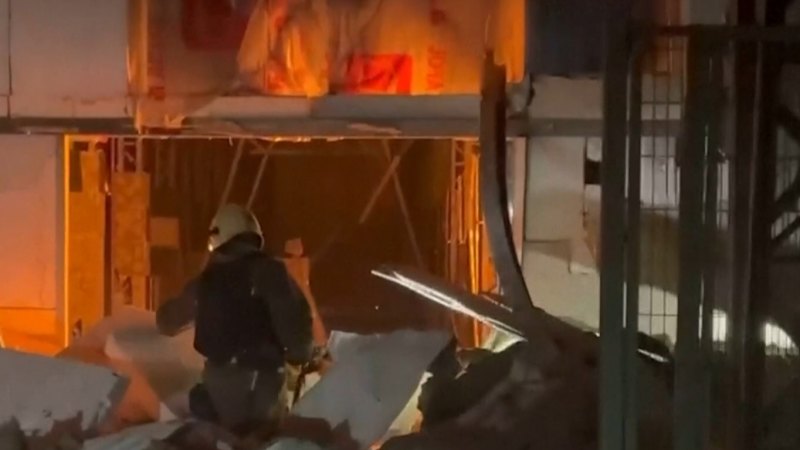
The latest mass drone strike against Ukrainian urban centers has claimed at least ten lives, marking another grim milestone in a conflict where the cost of hardware is rapidly decoupling from the scale of human devastation. While news tickers focus on the casualty count, the underlying reality is more clinical and more terrifying. Russia has moved beyond experimental sorties into a phase of sustained, industrialized aerial bombardment designed to bankrupt Ukraine’s air defense stocks. This isn't just about the ten people lost today. It is about a calculated strategy to make the defense of Ukrainian cities mathematically impossible.
Russia’s reliance on low-cost loitering munitions, primarily the Shahed-136 and its domestic variants, creates a persistent dilemma for Kyiv. Each drone costs approximately $20,000 to produce. In contrast, the sophisticated Western interceptors used to bring them down, such as those fired by IRIS-T or NASAMS batteries, can cost between $400,000 and $2 million per shot. The math is brutal. When Moscow launches a swarm of fifty drones, they aren't just aiming for power plants or apartment blocks. They are baiting a trap. They want Ukraine to spend $50 million in high-end missiles to stop $1 million worth of lawn-mower-engined flying bombs.
The Industrialization of Terror
The shift from sporadic attacks to nightly incursions reveals a significant ramp-up in Russian domestic manufacturing. Reports from the Alabuga Special Economic Zone indicate that production lines are now churning out these airframes at a pace that suggests a permanent state of siege. This is no longer a supply-chain-constrained operation. It is an assembly line of attrition. By saturating the radar screens of major cities like Odesa, Kharkiv, and Kyiv, Russia forces Ukrainian commanders to make impossible choices. Do they protect a thermal power plant, a hospital, or a residential district?
Western intelligence has long tracked the evolution of these drones. They are becoming harder to track. Recent wreckage shows that Russian engineers are applying radar-absorbent coatings and integrating basic electronic warfare modules to jam local GPS signals. These aren't "smart" weapons in the traditional sense, but they are smart enough to find a city-sized target. Their simplicity is their greatest strength. They fly low, hug the terrain, and arrive in waves that overwhelm the automated logic of modern defense systems.
The Architecture of Defense Failure
Ukraine’s air defense is a patchwork quilt of Cold War relics and state-of-the-art NATO tech. While the Patriot systems and German-made Flakpanzer Gepards have been remarkably effective, they cannot be everywhere at once. The Gepard, a mobile anti-aircraft gun, is perhaps the most efficient counter because it uses programmable 35mm shells rather than million-dollar missiles. However, there aren't enough of them to ring every city.
When a drone manages to slip through, the results are rarely about precision military strikes. These weapons are inherently inaccurate over long distances. They are "area-effect" tools of psychological warfare. When one hits a high-rise apartment complex, it isn't necessarily because that building was a target. It is because the drone was either malfunctioning, diverted by electronic jamming, or simply programmed to hit a general coordinate and let gravity do the rest. The randomness of the death is part of the tactic. It ensures that no one, in any district, feels truly safe.
The Role of Civilian Spotters
Kyiv has turned to its citizenry to plug the gaps in its radar net. An app called "ePPO" allows civilians to report the sound or sight of a drone in real-time. This crowdsourced intelligence feeds into a central command that directs mobile fire groups—teams of soldiers in pickup trucks equipped with thermal optics and heavy machine guns. It is a 21st-century version of the Battle of Britain’s Observer Corps.
This human-centric defense is a desperate necessity. Traditional radar struggles with "slow and low" targets that blend into the ground clutter. A human with a pair of binoculars and a smartphone often provides a better early warning than a multi-million dollar sensor. But as the number of drones increases, the human element reaches its breaking point. Fatigue sets in. Mistakes are made. In the most recent strike, several drones were reportedly spotted but not engaged until they were already over densely populated neighborhoods, leading to the debris-fall that caused several of the ten confirmed fatalities.
A Global Proving Ground
What we are witnessing in Ukraine is the ultimate laboratory for future global conflict. The "democratization" of precision strike capability means that any nation—or even non-state actor—with a basic industrial base can now challenge a superior air force. The era of total air superiority is over. Even the most advanced stealth fighters cannot effectively counter a swarm of 500 cheap drones.
Defense contractors in the United States and Europe are watching these strikes with intense scrutiny. The focus is shifting toward "soft kill" measures—high-powered microwaves and lasers that can fry a drone’s electronics for the cost of a few cents' worth of electricity. But these technologies are still in the prototype phase or deployed in such small numbers that they are irrelevant to the current fight in Ukraine. For now, the defense remains tethered to the expensive reality of kinetic interceptors.
The Strategic Silence of the West
The escalation in drone warfare highlights a uncomfortable gap in Western support. While air defense missiles are supplied, they are never enough. The "red lines" regarding long-range strikes into Russian territory—the sites where these drones are launched and stored—remain a point of contention. Ukraine argues that it is being forced to fight a boxing match where it can only block punches but never throw them.
Military analysts point out that the most effective way to stop a drone strike is to destroy the launcher on the ground. However, many of these launch sites are located deep within Russian borders, protected by the diplomatic hesitation of Washington and Brussels. This sanctuary allows the Russian military to maintain a consistent launch tempo, refining their flight paths and tactics with every mission. They are learning which corridors are blind spots in the Ukrainian radar net and exploiting them with increasing frequency.
The Human Toll Beyond the Headlines
The death of ten civilians is a tragedy that will be processed as a statistic by the end of the week. But the long-term impact is the erosion of the Ukrainian psyche. The constant hum of the Shahed engine, which sounds like a moped in the sky, has become a permanent feature of the Ukrainian night. Sleep deprivation, chronic stress, and the "alert fatigue" of constant sirens are invisible casualties.
In cities like Odesa, the port infrastructure is a primary target. By hitting these areas, Russia isn't just killing people; it is strangling the economy. The drones target grain silos and shipping terminals, attempting to do via the air what the Russian Navy cannot do via the sea. Every successful hit on a warehouse or a dock is a blow to the global food supply chain, echoing far beyond the borders of Eastern Europe.
The Problem of Debris
Even a "successful" interception is often a lethal event. When a drone is hit by an anti-aircraft missile over a city, the kinetic energy doesn't just disappear. Hundreds of pounds of burning fuel, metal, and unexploded ordnance rain down on the streets below. In many cases, the casualties reported in these strikes are not caused by the drone reaching its target, but by the interception itself. This creates a horrific Catch-22 for defenders. If you don't shoot, the drone hits its target. If you do shoot, the wreckage might kill the people you are trying to protect.
Modern urban warfare was never designed for this. Building codes and emergency services are built around the idea of discrete accidents or traditional artillery. They are not equipped for the sustained rain of "interception debris" that defines the current conflict.
The Evolution of the Swarm
Intelligence suggests that the next phase of this campaign will involve AI-directed swarming. Currently, drones are programmed with a set flight path. Future iterations, already in testing, may allow drones to communicate with each other in flight. If one drone is shot down, the others could automatically reroute to find a gap in the defense. This would move the conflict from a battle of logistics to a battle of algorithms.
Ukraine is countering with its own drone programs, but the scale is different. While Kyiv focuses on high-precision FPV (First Person View) drones for the front lines, Moscow is focused on the strategic bombing of the hinterland. It is a divergence in military philosophy: tactical excellence versus strategic volume.
The international community's response has been largely reactive. Sanctions on the components found in these drones—often simple dual-use electronics like hobbyist GPS chips and Western-made microcontrollers—have proven difficult to enforce. These parts are smuggled through third-party countries, making the "technological blockade" of Russia look like a sieve. As long as the components are available on the global market, the drones will continue to fly.
The ten lives lost in this latest attack are a testament to a world that was unprepared for the commoditization of aerial terror. We have entered an era where a mid-tier power can hold an entire nation hostage using the same technology found in a high-end RC plane. The defense systems of the future won't just need to be more powerful; they will need to be cheaper. Until the cost of defense drops below the cost of the attack, the sky over Ukraine will remain a site of calculated, systematic slaughter.
The sirens will sound again tonight. The pickup trucks with machine guns will head into the dark. And somewhere in a factory hundreds of miles away, another drone is being boxed for delivery.