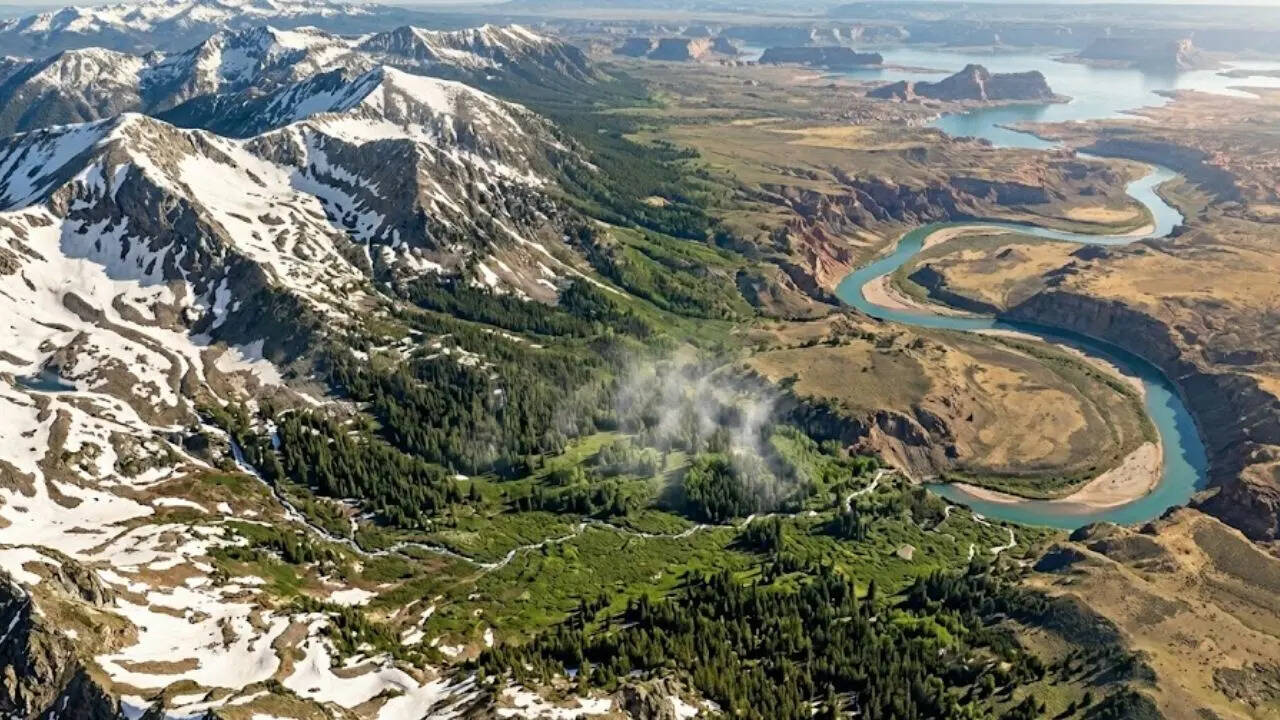
The Colorado River is a plumbing system in a state of advanced failure. While headlines often fixate on the visible bathtub rings of Lake Mead or the political bickering between basin states, a more quiet and more lethal phenomenon is draining the river before it ever touches a dam. For years, hydrologists noticed a disturbing gap between the snowpack measured in the mountains and the actual water flowing into reservoirs. Billions of liters of water are simply vanishing. This is not a mystery of theft or hidden leaks, but a brutal transformation of the physical environment driven by a process known as aridification.
The math no longer adds up. Historically, a certain amount of snow in the Rockies translated to a predictable amount of runoff. Today, that ratio is broken. We are seeing years where the snowpack is nearly 100% of the average, yet the actual streamflow into the reservoirs struggles to reach 70%. The water is being intercepted by a thirsty atmosphere and a parched landscape long before it can satisfy the legal compacts of the West. Learn more on a related topic: this related article.
The Invisible Thief in the Soil
The primary culprit is a shift in soil moisture that has turned the ground into a massive, underground sponge. When snow melts in the spring, it is supposed to saturate the top layer of earth and then slide over it, feeding the creeks that eventually form the Colorado River. But decades of rising temperatures have fundamentally altered the basement of the basin.
The soil has become so chronically dry that it now demands a "tax" on every drop of meltwater. Before a single gallon can flow downstream, it must first satisfy the deficit in the dirt. In many areas of the Upper Basin, the soil is so depleted that the first several weeks of the spring melt are entirely absorbed by the ground. This water never reaches the river. It stays locked in the subsurface or is pulled back into the sky. More journalism by BBC News highlights related views on this issue.
Thirsty Air and Sublimation
Beyond the soil, the atmosphere itself has become more aggressive. As temperatures climb, the air’s capacity to hold moisture increases. This creates a vacuum effect. We are seeing a massive increase in sublimation, where snow turns directly into water vapor without ever melting into liquid. On wind-swept ridges in Colorado and Wyoming, a significant portion of the winter’s accumulation is being breathed back into the atmosphere.
Warmer springs also mean that plants wake up earlier. This lengthened growing season allows vegetation to begin pumping water out of the ground through evapotranspiration weeks ahead of schedule. By the time the peak runoff should be occurring, the local ecosystem has already taken its cut, leaving the downstream reservoirs with the leftovers.
The Failure of Mid-Century Models
The crisis is compounded by the fact that the entire management structure of the Colorado River is built on a lie. The 1922 Colorado River Compact was drafted during one of the wettest periods in the last millennium. The "normal" flow the law assumes simply does not exist in a modern context.
Water managers have long relied on historical data to predict future yields. This approach, known as stationarity, assumes that the future will look like the past. That principle is dead. We are now operating in a non-stationary world where the baseline is constantly shifting downward. Using 20th-century statistics to manage 21st-century drought is like trying to navigate a minefield with a map of a different country.
The Dust Problem
A less discussed but equally potent factor is the darkening of the snowpack. Dust from the increasingly dry Great Basin and the Colorado Plateau is being blown onto the mountain peaks. This layer of grime decreases the albedo—the reflectivity—of the snow.
Instead of bouncing sunlight back into space, the dirty snow absorbs heat. This causes the snow to melt much faster and much earlier than it should. Rapid melting doesn't lead to better runoff; it leads to more evaporation and more absorption by the dry soil. It forces the water to move at a time when the environment is least prepared to transport it efficiently to the reservoirs.
The Infrastructure Trap
We have built a system of massive concrete buckets—Powell and Mead—designed to catch the bounty of the mountains. However, these structures are becoming liabilities in an era of extreme heat. The surface area of these reservoirs is enormous, creating a massive footprint for evaporation.
On Lake Mead alone, hundreds of billions of liters are lost to the air every year. This is water that has already "survived" the journey from the mountains, only to be cooked off the surface of a man-made lake. There is a growing argument among radical hydrologists that the only way to save the river is to decommission one of the major dams and move the water into underground aquifers where it is shielded from the sun.
Inaccurate Forecasting
Our technology is also struggling to keep up. The SNOTEL (Snow Telemetry) sites used to measure snowpack are often located in sheltered, high-altitude areas that don't always represent the reality of the entire watershed. If the sensors show a healthy snowpack but the lower-elevation transit zones are bone-dry, the forecast will be wildly optimistic.
Farmers and city planners make decisions based on these early-season forecasts. When the water fails to materialize in June, the economic shocks ripple through the entire Southwest. We are essentially flying a multi-billion dollar economy on instruments that haven't been calibrated for a desertifying climate.
Agriculture and the Efficiency Paradox
The vast majority of the Colorado River's water—roughly 80%—goes to agriculture, specifically to thirsty crops like alfalfa and cotton grown in the middle of the desert. There is a frequent push for "more efficient" irrigation, such as switching from flood irrigation to drip systems. However, this often creates a phenomenon known as the efficiency paradox.
When a farmer becomes more efficient with water, they don't necessarily leave the "saved" water in the river. Often, they use that surplus to plant more crops or switch to more water-intensive varieties. On a systemic level, efficiency doesn't reduce total consumption; it just hardens the demand. If every drop is accounted for and utilized, there is no buffer left for the river itself.
The Salinity Crisis
As the volume of the river drops, the concentration of salts and minerals increases. The Colorado is naturally a salty river, but with less freshwater to dilute the runoff from agricultural fields, the water quality is degrading. By the time the river nears the Mexican border, it is often too salty for many uses without expensive treatment. This adds a massive hidden cost to every liter that actually manages to make it downstream. The "vanishing" water is not just a quantity problem; it is a quality problem that threatens the long-term viability of the Imperial Valley and other crucial food-growing regions.
Relinquishing the Myth of the Drought
The word "drought" implies a temporary state—a dry spell that will eventually be followed by a return to "normal." What the data shows is not a drought, but a permanent aridification of the West. The moisture levels we once considered standard are gone.
The billions of liters vanishing are the result of a landscape that is fundamentally retooling itself for a hotter, drier reality. Policy makers continue to negotiate over percentages of a pie that is shrinking faster than they can type the agreements. If the goal is to keep the reservoirs from hitting dead pool—the point where water can no longer flow through the dam outlets—the focus must shift away from managing the "mystery" of the loss and toward an immediate, drastic reduction in total demand.
We are currently witnessing the sunset of the American West as it was envisioned by 20th-century engineers. The river is not being stolen; it is being reclaimed by a changing climate that no longer has any interest in sustaining the status quo.
The only viable path forward is a brutal honesty regarding the river's capacity. We must stop pretending that a lucky winter will save the system. The missing water is a permanent loss, a structural deficit that requires a total reimagining of how 40 million people live in a desert that has finally run out of patience.