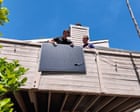
Residential electricity rates across major US metropolitan areas are decoupling from core inflation, driven by grid modernization surcharges, climate mitigation costs, and capacity constraints. While traditional residential solar requires property ownership, structural engineering sign-offs, and multi-thousand-dollar capital expenditures, a friction point has emerged at the intersection of urban density and energy insecurity. Tenant-led micro-generation—commonly stylized as "balcony solar"—represents a decentralized shift in asset ownership. However, evaluating this technology requires moving past consumer optimism and analyzing the raw thermodynamic, regulatory, and financial mechanics that govern its viability.
The structural limitation of urban apartments has historically isolated tenants from the renewable energy transition. By analyzing balcony solar through a strict capital expenditure (CapEx) to operational expenditure (OpEx) framework, we can determine whether plug-and-play photovoltaic (PV) systems offer a legitimate hedge against utility rate hikes or merely serve as low-yield consumer novelties.
The Micro-Generation Structural Framework
To understand the viability of balcony solar, the system must be deconstructed into three interdependent variables: spatial constraints, electrical integration mechanics, and regulatory classification.
1. Spatial Constraints and Irradiance Mechanics
Unlike rooftop solar arrays optimized for azimuth and tilt, balcony systems are bound by the architectural orientation of the host building. This introduces severe thermodynamic penalties.
- Verticality and Tilt Penalties: Roof systems are typically pitched between 15° and 35° to maximize annual solar irradiance. Balcony systems are frequently mounted vertically (90°) due to structural safety rules or rental lease constraints. A vertical orientation reduces winter yield penalties but severely degrades summer peak production when the sun is high in the sky.
- Shading and Horizon Blockage: Urban environments introduce macro-shading from adjacent structures. A mere 10% shading on a standard series-connected solar string can reduce power output by over 50% if the system lacks intelligent bypass diodes or individual microinverters.
- Orientation Determinism: A rooftop array can be oriented true south. A balcony system is locked into the building's facade. A north-facing balcony in the Northern Hemisphere yields negligible energy, rendering any investment mathematically unviable.
2. Electrical Integration Mechanics
The defining feature of balcony solar is the "plug-and-play" architecture. This relies on a specialized microinverter that converts the direct current (DC) generated by one or two panels into alternating current (AC) synchronized with the grid's frequency.
[Solar Panel (DC)] ──> [Microinverter (AC)] ──> [Standard Wall Outlet] ──> [Home Appliances]
The system connects directly to a standard household electrical outlet. When the PV panels generate power, the microinverter raises the voltage slightly above the incoming utility grid voltage. This physics-based pressure differential forces the locally produced electrons to flow to the nearest load within the apartment—such as a refrigerator or Wi-Fi router—before drawing power from the external grid.
3. Regulatory and Interconnection Barriers
In Europe, particularly Germany, the regulatory framework has been streamlined via standardizing the "Balkonkraftwerk" (up to 800 watts). In the United States, the regulatory environment is fragmented across thousands of independent utilities and municipal jurisdictions.
The primary friction point is the National Electrical Code (NEC) and local utility interconnection policies. Most US utilities require formal interconnection agreements for any device that feeds power back into the grid. Standard standard meters may lack bidirectional measurement capability; if a balcony system backfeeds power through an old analog meter, the meter may register that exported energy as consumption, perversely charging the tenant for the power they generate.
The Financial Calculus: Quantifying the Levelized Cost of Energy
Evaluating balcony solar requires calculating its Levelized Cost of Energy (LCOE) and comparing it against the local utility's marginal retail rate.
The LCOE formula for a micro-solar asset can be expressed as:
$$LCOE = \frac{\text{Initial CapEx} + \sum_{t=1}^{n} \frac{\text{OpEx}t}{(1 + r)^t}}{\sum{t=1}^{n} \frac{\text{Energy Yield}_t}{(1 + r)^t}}$$
Where:
- Initial CapEx includes the panels, microinverter, mounting hardware, and specialized safety cables.
- OpEx represents minimal cleaning or potential microinverter replacement at year 10.
- Energy Yield is the annual kilowatt-hour (kWh) generation, adjusted for annual degradation (typically 0.5% per year).
- r is the discount rate (opportunity cost of capital).
Capital Expenditure Metrics
A standard 400-watt balcony kit costs approximately $600 to $800 out-of-the-box in the US market. Because these systems are self-installed, labor costs are zero, representing a massive divergence from traditional residential solar where soft costs (permitting, labor, customer acquisition) comprise up to 60% of the total invoice.
Yield Depreciation in Real-World Scenarios
Consider a optimal scenario: a south-facing balcony in Southern California (high solar insolation) versus a south-facing balcony in New York City.
| Variable | High-Insolation Region (e.g., LA) | Mid-Insolation Region (e.g., NYC) |
|---|---|---|
| System Size | 400 W (1 x Panel) | 400 W (1 x Panel) |
| Orientation / Tilt | South / 90° (Vertical) | South / 90° (Vertical) |
| Annual Solar Insolation | ~4.5 kWh/m²/day | ~3.2 kWh/m²/day |
| System Efficiency Losses | 20% (Inverter, Dust, Temperature) | 20% (Inverter, Dust, Temperature) |
| Estimated Annual Output | ~460 kWh | ~330 kWh |
| Average Utility Rate | $0.28 per kWh | $0.23 per kWh |
| Annual Financial Yield | $128.80 | $75.90 |
| Simple Payback Period | ~5.4 Years | ~9.2 Years |
This matrix illustrates that balcony solar is highly dependent on regional utility pricing structures. In regions with low retail electricity costs (e.g., the US Pacific Northwest at $0.11/kWh), the simple payback period extends past the expected 10-year warranty period of the microinverter, rendering the asset financially unviable.
Operational Bottlenecks and Structural Risks
The deployment of decentralized energy generation inside multi-family housing units introduces distinct operational risks that are absent from controlled industrial or single-family residential environments.
The Baseload Conundrum
Balcony solar systems lack grid-scale storage unless paired with expensive lithium-iron-phosphate (LFP) battery packs, which double or triple the initial CapEx. Consequently, any power generated must be consumed instantly.
Urban tenants are frequently away from their residences during peak solar production hours (10:00 AM to 2:00 PM). If the apartment's baseload consumption (fridge, phantom appliance loads) is only 150 watts, a system producing 400 watts will export the remaining 250 watts into the building's electrical infrastructure. Without favorable net metering policies for tenants, this excess energy is gifted to the utility provider for zero financial return, depressing the system's actualized return on investment (ROI).
Structural Liability and Wind Loading
A 400-watt solar panel measures roughly 70 by 40 inches and weighs approximately 45 pounds. When mounted vertically on a balcony balcony rail at elevation, it acts as a sail.
High-velocity wind events generate substantial lift and shear forces on the mounting brackets. Standard consumer-grade zip ties or rudimentary clamping mechanisms present a critical risk of structural failure. If a panel detaches from a high-rise balcony, the liability exposure for the tenant and the property owner is severe. This structural risk explains the widespread resistance from Homeowner Associations (HOAs) and commercial landlords.
Thermal Efficiency Degradation
Solar panels require airflow behind them to dissipate heat. The temperature coefficient of a standard monocrystalline silicon cell is roughly -0.35% per degree Celsius above 25°C. When a panel is mounted flush against a solid balcony wall or balcony backing, heat accumulates in the air gap. This thermal buildup lowers the operating voltage and reduces the instantaneous power output precisely during peak summer afternoons.
The Strategic Path Forward for Urban Micro-Generation
For plug-and-play solar to scale efficiently in the US and transition from an enthusiast hobby to a meaningful grid-edge resource, three structural transformations must occur.
Interconnection Standardization via UL 1741 SB
The scaling of this market depends on the universal adoption of smart microinverters certified under UL 1741 SB. This standard guarantees that the inverter features advanced grid-support functions, including "anti-islanding" protection. If the utility grid loses power, the microinverter must shut down within milliseconds to prevent backfeeding electricity into lines where utility technicians may be working. Once utilities trust that consumer kits cannot energize dead lines, the requirement for complex interconnection permits can be eliminated.
Landlord-Tenant Alignment Models
The classic split-incentive problem persists: landlords have no motivation to upgrade infrastructure for tenant utility savings, and tenants are hesitant to invest in permanent upgrades to properties they do not own. Balcony solar circumvents this because the asset is entirely portable.
To accelerate adoption, property management firms must shift from outright bans to standardized leasing addendums. By specifying approved, engineered mounting hardware and setting clear parameters for maximum wattage allowances, landlords can mitigate insurance risks while enhancing property appeal for climate-conscious tenants.
Integration of Dynamic Storage Architectures
The integration of compact, indoor-rated LFP batteries equipped with pass-through power management represents the next logical step in micro-generation asset optimization. These localized storage units sit between the panel and the microinverter. Instead of dumping uncompensated energy into the grid during mid-day peak generation, the battery captures the excess capacity. It then discharges that energy during the evening peak windows (5:00 PM to 9:00 PM), when time-of-use (TOU) utility rates are at their highest. This operational shift moves the technology from a basic solar generator to a sophisticated, dispatchable demand-side management tool.