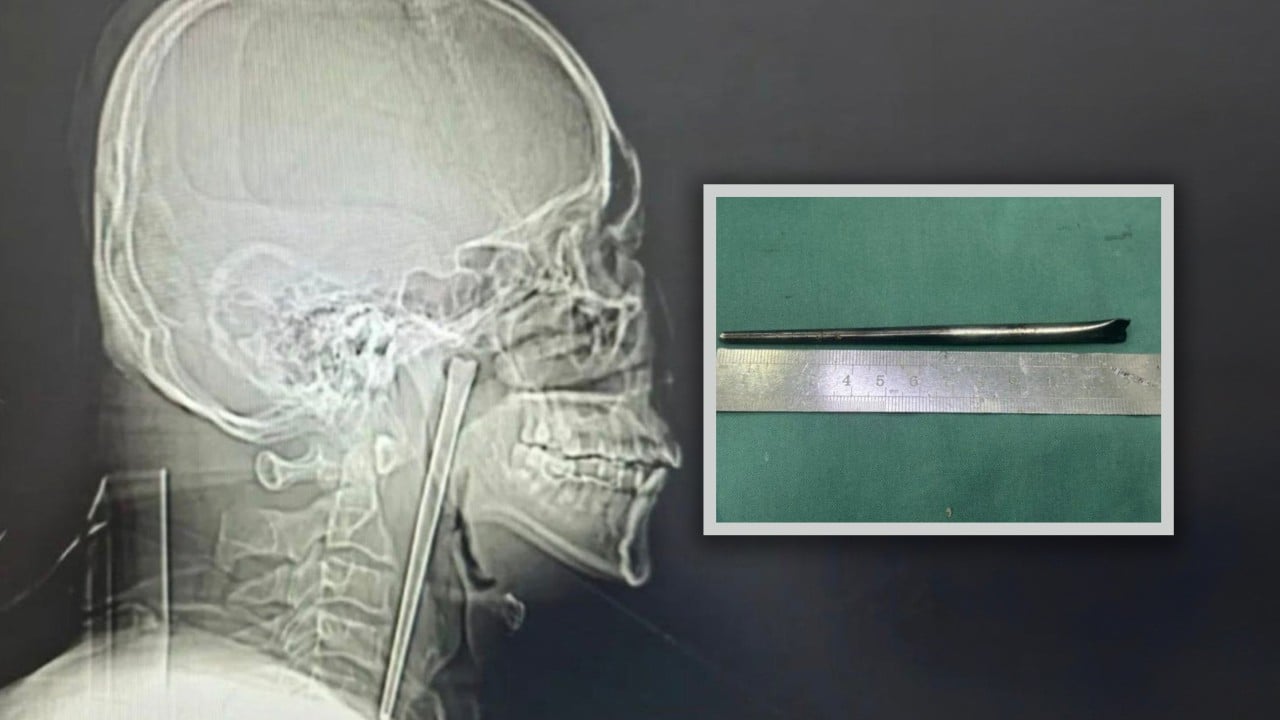
A man in China recently underwent a medical procedure that defies standard biological expectations and psychiatric norms. For eight years, a wooden chopstick remained lodged in his posterior pharynx, the space behind the oral cavity that leads to the esophagus. He did not forget it was there. He did not suffer from a lack of access to medical care. He chose the pain over the cure.
The patient, identified in medical reports as a 50-year-old man from Henan province, reportedly swallowed the object during a domestic accident nearly a decade ago. While the initial trauma was severe, the long-term survival of such a foreign body is a case study in both the resilience of human tissue and the paralyzing power of iatrophobia, the irrational fear of doctors or medical intervention. This is not just a story of a bizarre X-ray. It is an indictment of the psychological barriers that prevent life-saving intervention in modern medicine.
The Mechanics of a Living Impalement
When a rigid object like a chopstick enters the throat with enough force to become lodged, the body usually responds with immediate, violent rejection. The gag reflex, controlled by the glossopharyngeal nerve, is designed to prevent exactly this scenario. If the object bypasses the reflex and pierces the soft tissue, the risks escalate to a lethal level within minutes.
The primary danger is mediastinitis, an infection of the space between the lungs. This area contains the heart, the great vessels, and the esophagus. An infection here has a mortality rate that remains staggeringly high even with modern antibiotics. The chopstick in this case managed to miss the carotid arteries and the jugular vein, carving a niche for itself in the soft tissues of the neck.
Over time, the body attempted to wall off the intruder. This process, known as fibrosis, involves the creation of dense scar tissue around the object. The chopstick became a permanent part of his internal anatomy. Every swallow, every turn of the head, and every breath was a reminder of its presence. He lived in a state of chronic inflammation, a low-grade biological war that lasted nearly 3,000 days.
Why Fear Trumps Survival
The technical success of the eventual surgery is less interesting than the eight-year delay. We often assume that physical pain is the ultimate motivator for seeking help. This case proves otherwise.
Iatrophobia is frequently dismissed as simple "white coat nerves," but in its extreme form, it is a debilitating psychological condition. For this patient, the perceived trauma of a surgical knife was greater than the daily reality of a splintered piece of wood in his neck. This fear is often rooted in a lack of trust in the medical system or a prior traumatic experience. In many rural or developing regions, the "hospital" is viewed not as a place of healing, but as a place of finality.
The patient only sought help when the pain became truly unbearable, likely due to a secondary infection or the shifting of the object as the wooden material began to degrade. Wood is porous. Unlike metal or plastic, it absorbs bodily fluids and serves as a breeding ground for bacteria. The fact that he avoided a systemic blood infection (sepsis) for eight years is a statistical anomaly.
The Hidden Costs of Medical Avoidance
We see this pattern globally, though rarely with such a literal "smoking gun" in the throat. People avoid screenings, ignore lumps, and mask chronic pain because the alternative—confronting a diagnosis—is too heavy to bear.
- Delayed Diagnosis: By the time this patient arrived, the surgery was significantly more complex than it would have been eight years prior. The scar tissue had fused with the wood.
- Psychological Erosion: Living with a secret medical crisis creates a state of perpetual hyper-vigilance. The mental energy required to hide a physical deformity or a chronic injury from family and friends is immense.
- Resource Strain: Emergency extractions of long-term foreign bodies require specialized surgical teams, including otolaryngologists and vascular surgeons, whereas an immediate post-accident removal might have been a routine procedure.
The Surgical Reality
When the medical team finally intervened, they faced a nightmare of anatomy. The chopstick had not remained pristine. It was coated in biofilm and surrounded by a "granuloma," a mass of granulation tissue produced in response to infection.
The extraction required precision to ensure that the removal of the object did not trigger a massive hemorrhage. When an object sits against a major vessel for years, the vessel wall can thin or become "tethered" to the object. Pulling the chopstick out could have easily torn a hole in his throat.
They succeeded. The man is now recovering, but the physical wound is the easy part to heal. The underlying issue—the terror that kept him away from the hospital for nearly a decade—is rarely addressed in the discharge papers.
Beyond the Bizarre
This case is being circulated as a "freak show" news item, but that misses the point entirely. It is a mirror. We look at a man with a chopstick in his throat and wonder how he could be so foolish, yet millions of people live with the metaphorical equivalent. They live with untreated hypertension, escalating chest pain, or suspicious moles, all because the fear of the "fix" outweighs the fear of the "ailment."
The healthcare industry focuses heavily on technology and pharmaceutical breakthroughs. We have better imaging, sharper scalpels, and stronger drugs than at any point in history. But we have failed to solve the most basic component of the system: the human being's willingness to walk through the door.
If a man can walk around with a piece of dining utensils embedded in his neck for eight years, the problem isn't the lack of medical technology. The problem is a profound failure of medical communication and trust.
Addressing iatrophobia is not a "soft" science. It is a critical component of public health. Until we treat the fear with the same urgency as we treat the infection, we will continue to see patients who prefer the slow burn of a chronic injury to the swift intervention of a professional.
Ask yourself what "chopstick" you are currently ignoring because the doctor's office feels like a battlefield.