The stitching had to be invisible. When you are rebuilding a piece of childhood for the sake of international diplomacy, the margin for error is measured in millimeters of felt. Most people look at a stuffed toy and see acrylic fur and polyester stuffing. But for a restorer, a toy is a vessel for memory. It is a physical manifestation of a time before the world grew complicated.
In early 2024, as Queen Camilla prepared for a high-profile visit to the United States, a curious problem emerged within the archives of the world’s most famous bear. Winnie-the-Pooh, that "silly old bear" created by A.A. Milne, has long been a symbol of British heritage. The original toys—the actual ones owned by Christopher Robin Milne—live behind glass at the New York Public Library. They are secular relics. Tigger, Eeyore, Kanga, and Piglet all sit there, slightly worn, looking out at a city that never sleeps.
But Kanga was lonely. Her pouch was empty.
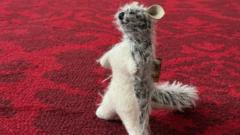
Roo, the tiny, energetic joey who defined the dynamic of the Hundred Acre Wood, was gone. He had been lost in a literal woods in the 1930s, vanished into the undergrowth of history long before the rest of the troupe was donated to the library in 1987. To bring the set to life for a Royal visit, the missing piece had to be resurrected. This wasn't a job for a factory. It was a job for the artisans at Merrythought, the last remaining teddy bear factory in Great Britain.
The Weight of a Ghost
Walking through the Merrythought workshop in Ironbridge is like stepping back into the Industrial Revolution, but with more mohair. The floors creak. The air smells of cut fabric and machine oil. Sarah Holmes, the fourth-generation director of the family business, understood the stakes immediately. They weren't just making a toy. They were recreating a ghost.
Consider the technical nightmare of "authenticity." You cannot simply use modern materials to replace a toy from 1921. Modern plush is too soft, too perfect. It lacks the grit and character of the early 20th-century craftsmanship. The team had to reverse-engineer a character that hadn't been seen in nearly a century, using only grainy black-and-white photographs and the scale of the surviving Kanga as a guide.
The process began with a search for the right texture. The original toys were made of alpha plush—a blend of silk and wool that has a specific "hand" or feel. If the new Roo looked too new, he would look like an impostor sitting next to the weathered, beloved originals. He had to look like he had been living in a pocket for ninety years, just waiting to hop out.
The Architecture of Nostalgia
Designers spent weeks sketching. They looked at the way Christopher Robin’s original toys were constructed—the simple seams, the glass eyes that seemed to track you across the room, the specific stuffing density that gave them a slumped, soulful posture.
The struggle with Roo was his size. He is diminutive. In the world of high-end toy making, smaller is often harder. Every stitch on a three-inch limb is a monumental effort. If the needle slips by a fraction, the arm looks mangled rather than miniature. The craftsmen worked with tweezers and magnifying glasses, treating the mohair like precious lace.
There is a specific psychology at play here. When we look at Pooh and his friends, we aren't looking at characters from a book; we are looking at the survivors of a vanished era. A.A. Milne wrote those stories as a way to freeze time for his son, a boy who would eventually grow up and find the fame of his fictional counterpart to be a heavy burden. To recreate Roo is to attempt to fix a broken timeline. It is an act of restoration that borders on the spiritual.
Diplomacy in a Dust Bag
When the day finally came for Queen Camilla to visit the New York Public Library, the atmosphere was thick with the kind of practiced calm that defines Royal engagements. Security was tight. The media was hushed. But the heart of the event wasn't the cameras or the protocol. It was a small, brown, stitched creature tucked into a pocket.
The moment the new Roo was placed into Kanga’s pouch, the narrative shifted. For decades, Kanga had stood as a symbol of maternal loss—a mother with an empty space. By reuniting them, the curators and the Queen weren't just showing off a British export. They were completing a family.
The Queen’s reaction was one of genuine warmth. It is easy to forget that the Royals are often the primary custodians of these national myths. They live in a world of symbols. A crown is a symbol, but so is a bear. One represents power; the other represents the vulnerability that power is supposed to protect.
The Invisible Threads
Why does this matter? Why spend thousands of pounds and hundreds of man-hours on a few inches of fabric?
Because we live in a disposable age. We are surrounded by things designed to break, to be updated, or to be deleted. The Winnie-the-Pooh toys represent the opposite impulse. They are the things we keep. They are the things we pass down until the fur is rubbed away and the stuffing leaks out.
The creation of the "New Roo" serves as a reminder that craftsmanship is a form of storytelling. The people at Merrythought didn't just use needles and thread; they used history. They looked at the gaps in our cultural memory and decided to fill them.
The original Roo is still out there somewhere, presumably returned to the earth in a corner of an English garden. He has long since become part of the soil. But his replacement now sits in a climate-controlled case in Manhattan, a testament to the fact that some things are too important to stay lost.
He sits there, small and defiant. His ears are perked. His stitching is flawless. He is a bridge between a workshop in Shropshire and a library in New York, between a Queen and a fictional forest. He is a reminder that even when a story has a missing chapter, there is always someone willing to pick up a pen—or a needle—and write it back into existence.
The light in the library reflects off his glass eyes. He looks ready to jump. After nearly a century of silence, the Hundred Acre Wood is finally whole again.