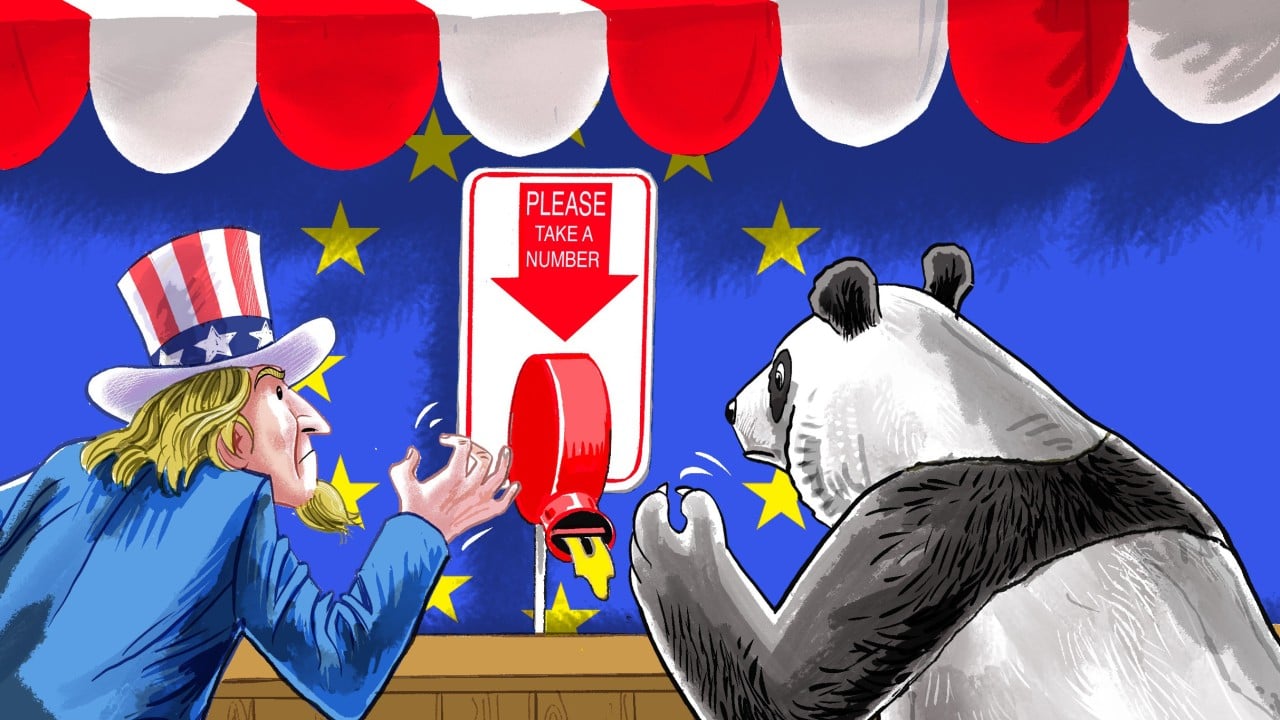
Europe is stuck in a vice. On one side, you've got Washington turning inward and using massive subsidies to lure away European factories. On the other, Beijing is flooding the market with cheap electric vehicles and high-tech goods backed by state cash. If Brussels doesn't change its approach right now, the European Union risks becoming little more than a giant open-air museum—pretty to look at but economically irrelevant.
The old world order is dead. For decades, Europe thrived on a simple formula: export high-quality machines to China and rely on the US for a security umbrella. That's over. Today, trade is a weapon. The US Inflation Reduction Act (IRA) isn't just about climate change; it's a "Buy American" magnet that's pulling investment across the Atlantic. Meanwhile, China isn't just a partner anymore—it's a systemic rival that plays by a different set of rules.
To survive, the EU has to forge its own strategy. It can't just react to what happens in DC or Beijing. It needs to find its own teeth.
The myth of the level playing field
We've been obsessed with "fair play" for too long. While EU regulators spend years debating competition rules to ensure no single European company gets too big, the rest of the world is building giants. Look at the solar industry. Europe used to lead the world in solar panel production. Then China stepped in with massive state support, crashed the prices, and wiped out the European competition. We watched it happen because we were too afraid to "distort the market."
That mindset is a relic.
You can't win a game where you're the only one following the rules. China's "Made in China 2025" initiative is a clear roadmap for global dominance in sectors like robotics, green energy, and chips. They aren't waiting for market forces. They're forcing the market. If the EU wants to keep its industrial base, it has to stop being the world’s referee and start being a player.
Why Washington is no longer a safe bet
Don't think a change in the White House fixes this. Whether it's a Democrat or a Republican in charge, the US is shifting toward protectionism. The IRA proved that. By offering $369 billion in incentives for green tech—provided it's made in North America—the US effectively told European carmakers and battery producers to move or lose out.
It's a wake-up call. We've relied on the US for security and followed their lead on trade for 80 years. But now, their interests are diverging from ours. When the US pressures Europe to cut off all high-tech trade with China, they aren't just thinking about security. They're thinking about their own economic edge. Europe has far more to lose from a total trade war with China than the US does. Our supply chains are deeply integrated. If we blindly follow Washington's lead, we might find ourselves isolated and impoverished.
Taking economic sovereignty seriously
So, what does a real European strategy look like? It starts with "Strategic Autonomy," but not just as a buzzword. It means having the guts to protect our own interests.
First, we need to rethink our stance on state aid. The EU has always been allergic to subsidies because they can hurt the single market. But if we don't allow European countries to support their own industries, those companies will simply leave for South Carolina or Guangdong. We need a "European Sovereignty Fund" that actually has money in it. It should fund the massive leaps in tech that individual companies can't afford on their own.
Second, we need to diversify. Fast. "De-risking" is the word of the day in Brussels, and for good reason. Being 90% dependent on China for rare earth elements or certain pharmaceutical ingredients is a massive security flaw. We don't need to cut China off entirely—that's impossible—but we do need to find new partners in Latin America, Africa, and Southeast Asia. We've been too slow to sign trade deals. While we dither over environmental clauses, China is building infrastructure and locking down resources across the Global South.
The defense dilemma
You can't have an independent economic policy if you're totally dependent on someone else for your physical safety. Russia’s invasion of Ukraine laid this bare. Europe realized it didn't have the stocks of ammunition, the tanks, or the logistics to defend itself without heavy US lifting.
If we want to stand up to US pressure on trade, we have to be able to stand on our own two feet regarding defense. This doesn't mean leaving NATO. It means the European pillar of NATO has to be strong enough that we aren't terrified every time an American election rolls around. We spend plenty on defense in total, but we spend it badly. We have too many different types of tanks, planes, and communication systems. Integrating European defense procurement isn't just about military power; it's about industrial survival.
Dealing with the dragon
China isn't going away. They’re the biggest market for many of our flagship companies, from Volkswagen to ASML. But the relationship is becoming increasingly one-sided.
We need to use our biggest asset: the Single Market. It’s the largest high-income market in the world. If China wants access to it, they have to allow European companies the same access to theirs. No more forced tech transfers. No more discriminatory regulations in Shanghai. If they block us, we block them. It sounds harsh, but it's the only language that works. The EU recently started an anti-subsidy probe into Chinese EVs. That’s a start. It’s about time we used the tools we have.
The internal struggle
The biggest threat to a unified EU strategy isn't actually in Washington or Beijing. It's in Paris, Berlin, and Budapest. Europe is often its own worst enemy.
Germany is terrified of losing its car exports to China. France wants more protectionism. Smaller nations worry that "European strategy" is just a code word for "French and German strategy." If we can't get on the same page, we'll be picked off one by one. China is already very good at this—offering bilateral deals to individual EU members to break the common front.
We have to realize that no European country, not even Germany, is big enough to handle the US or China alone. In a world of giants, you either act as a bloc or you become a satellite.
Real steps to take now
Forget the long-winded white papers. Here is what actually needs to happen to move the needle.
- Slash the red tape for green tech. It takes way too long to get a permit for a battery factory or a wind farm in Europe. If we can't beat the US on the sheer amount of cash, we have to beat them on speed and ease of doing business.
- Complete the Capital Markets Union. European startups often move to the US because they can't find the scale of investment they need here. We have plenty of savings in Europe, but it's trapped behind national borders. Fix this, and we stop the brain drain.
- Get aggressive on raw materials. We need to sign deals for lithium, cobalt, and nickel yesterday. This means being more pragmatic and less preachy with our potential partners.
- Screen every major investment. If a foreign state-backed company wants to buy a piece of critical European infrastructure or a high-tech firm, the answer should be "no" unless it clearly benefits our long-term sovereignty.
The era of being a "soft power" is over. The world is getting harder, and Europe needs to grow a shell. We have the talent, the wealth, and the history. What we lack is the will to act as a single, powerful entity. If we don't find that will soon, we'll find ourselves living in a world designed by others, for others. Stop waiting for permission from Washington or cooperation from Beijing. Build the European strategy today.