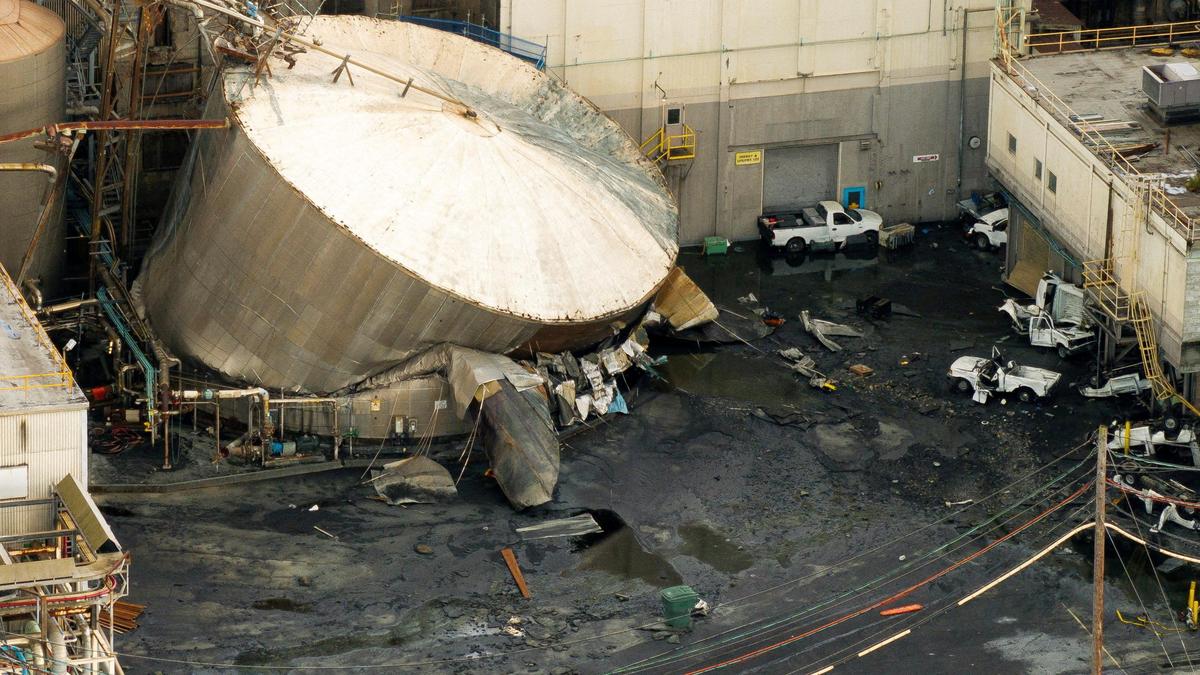
Eleven people are dead.
The media is doing its usual dance. The headlines focus entirely on the immediate horror: the body count, the plumes of toxic smoke, and the frantic scramble of local first responders. Politicians are already standing in front of microphones promising aggressive investigations and demanding harsher fines for the chemical plant operators.
They are missing the entire point.
Focusing on the death toll of a chemical spill is a trailing indicator. It tells you what went wrong yesterday, but it does absolutely nothing to prevent the next eleven people from dying tomorrow. The standard narrative treats these disasters as isolated incidents of corporate greed or freak mechanical failure.
The reality is far more uncomfortable. The current U.S. regulatory framework and corporate compliance playbook practically guarantee these exact outcomes. By prioritizing paper-thin compliance metrics over raw operational resilience, the chemical industry has built a system where disasters are not anomalies—they are mathematically inevitable.
The Compliance Illusion
I have spent twenty years auditing high-hazard industrial facilities. I have walked the floors of petrochemical plants, refineries, and manufacturing hubs. Here is the open secret nobody in the C-suite wants to admit: a facility can be 100% compliant with every single OSHA and EPA regulation on the books and still be a ticking time bomb.
Regulations are reactive. They are written in the blood of past accidents. When a regulatory body mandates a new valve inspection schedule or a updated safety data sheet protocol, they are solving yesterday's problem.
Companies spend millions of dollars every year hiring consultants to check boxes. They build massive binders filled with standardized operating procedures. They track "Total Recordable Incident Rates" (TRIR) and celebrate when the office staff goes 500 days without a paper cut.
It is a dangerous pacifier.
While executives point to their pristine safety metrics during shareholder calls, the actual physical infrastructure is degrading. TRIR is a useless metric for predicting catastrophic events. A plant can have a stellar TRIR because nobody tripped on a loose carpet tile, while simultaneously ignoring a vibrating pump that is about to suffer a catastrophic seal failure and release a cloud of lethal gas.
We are measuring the wrong things because the right things are expensive, difficult, and require actual engineering expertise rather than administrative box-checking.
The Real Culprit: The Death of Institutional Memory
When a chemical release turns fatal, the immediate reaction is to blame the control room operator who pushed the wrong button or the technician who skipped a maintenance step. This is lazy analysis.
The root cause almost always traces back to a quiet, systemic crisis ripping through the industrial sector: the aggressive purging of institutional knowledge.
Over the last decade, the chemical industry has faced a massive wave of retirements. The senior engineers and operators who knew the quirks of specific reactors—the ones who could tell a compressor was failing just by the pitch of its hum—have left the building. In their place, companies have brought in younger, cheaper, less experienced workers, or worse, they rely heavily on transient contract labor to cut costs.
To compensate for this brain drain, companies lean even harder on automation and digital dashboards. They assume that if a computer is monitoring the pressure gradients, the human element becomes secondary.
This is a fatal assumption.
Automation increases system complexity. When a complex system fails, it does not fail linearly; it fails catastrophically. An inexperienced operator faced with a cascade of digital alarms during an upset condition will almost always experience cognitive overload. They cannot diagnose the root cause because they do not understand the underlying physics of the plant—they only know how to read the software interface.
Imagine a scenario where a pressure relief valve sticks open. The automated system reports a drop in pressure downstream, so it automatically cranks up a feed pump to compensate. The operator, trusting the screen, doesn't realize the fluid is actually venting into an uncontained area until the vapor cloud finds an ignition source. That isn't an operator error. That is a systemic failure to maintain human competency.
The Myth of the "Freak Accident"
Every time an incident like this occurs, industry spokespeople trot out the phrase "unprecedented combination of factors."
Charles Perrow, a sociologist who revolutionized our understanding of industrial accidents, dismantled this excuse decades ago with his Normal Accident Theory. Perrow argued that in high-risk, tightly coupled systems—like a chemical plant or a nuclear power facility—unexpected interactions are an inherent characteristic of the system itself.
In a tightly coupled system, there is no slack. Step A immediately impacts Step B. There is no time to pause, think, or isolate the failure.
Tight vs. Loose Coupling in Industrial Systems
| System Characteristic | Tightly Coupled (Chemical Plants) | Loosely Coupled (Traditional Manufacturing) |
|---|---|---|
| Process Speed | Fast, immediate chemical reactions | Slower, batch-processed assembly |
| Buffer Capacity | Minimal; storage tanks fill rapidly | High; parts can sit in inventory |
| Failure Spread | Rapid, cascading across units | Contained to a single workstation |
| Recovery Window | Seconds to minutes | Hours to days |
Because these systems are tightly coupled, adding more safety devices actually increases the risk of an accident. Every new sensor, automated shutoff valve, and redundant redundant system adds a new layer of complexity. These safety devices can fail on their own, send false signals, or interact with the main process in ways the original designers never anticipated.
The competitor article lamented the failure of the facility's backup scrubbing system. They treated it as a maintenance failure. The more brutal reality is that the backup system itself likely introduced the very vulnerability that caused the primary containment to fail in the first place.
Dismantling the "People Also Ask" False Premises
When news of a disaster breaks, the public turns to search engines with predictable questions. The answers they get are usually comforting lies. Let's correct the record.
Why don't we just move chemical plants away from populated areas?
This question assumes that geography is the primary risk factor. It completely ignores supply chain physics. Chemical plants require access to deepwater ports, major rail lines, and massive electrical grids. You cannot build a modern petrochemical complex in the middle of an empty desert without building a massive, thousands-of-miles-long network of pipelines to transport the raw materials and finished products.
Moving the plant doesn't eliminate the risk; it merely distributes it across thousands of miles of railways and highways, passing through hundreds of other communities along the way. Furthermore, communities almost always grow around the plants over decades because the facilities provide high-paying jobs and stimulate the local economy. Zoning reform, not geographic isolation, is the only viable lever.
Why aren't chemical companies forced to use safer chemicals?
The push for "Inherently Safer Technology" (IST) is a favorite talking point for environmental activists. The premise is simple: replace toxic or volatile chemicals with benign alternatives.
It is a beautiful theory that collapses under the weight of basic chemistry. You cannot make plastics, pharmaceuticals, semiconductors, or agricultural fertilizers out of baking soda and vinegar. The very utility of these industrial chemicals stems from their reactivity. If a chemical is highly reactive, it is inherently dangerous. There is no magical substitute for chlorine gas or ethylene oxide that yields the same industrial output without the associated hazard. The goal cannot be elimination; it must be ruthless containment.
The Hard Truth About Risk Mitigation
If we want to stop reading about rising death tolls, we have to stop treating safety as a moral crusade and start treating it as a cold, hard engineering discipline.
This requires a fundamental shift in how capital is allocated.
First, companies must stop outsourcing core maintenance operations. The use of third-party contractors for critical mechanical integrity inspections must be severely curtailed. Internal maintenance teams take ownership of a facility; contractors are incentivized to finish the job quickly and move to the next contract.
Second, the regulatory focus must shift from paperwork verification to physical validation. Regulators shouldn't care if a company has a beautifully formatted digital logbook. They should care about the physical thickness of the pipe walls and the real-world performance of emergency isolation valves under stress testing.
The downside to this approach is obvious: it will drive up the cost of chemical production. It will slow down project timelines. It will squeeze corporate margins. Consumers will feel it at the pump and in the supermarket.
That is the trade-off. You can have cheap, rapidly produced chemical products, or you can have ultra-resilient facilities. You cannot have both.
Stop looking at the death toll as a random tragedy. It is the price of the current system. Until the financial penalty of a catastrophic failure vastly exceeds the massive ongoing cost of true operational resilience, companies will continue to manage risk on a spreadsheet, check their regulatory boxes, and wait for the next inevitable explosion.