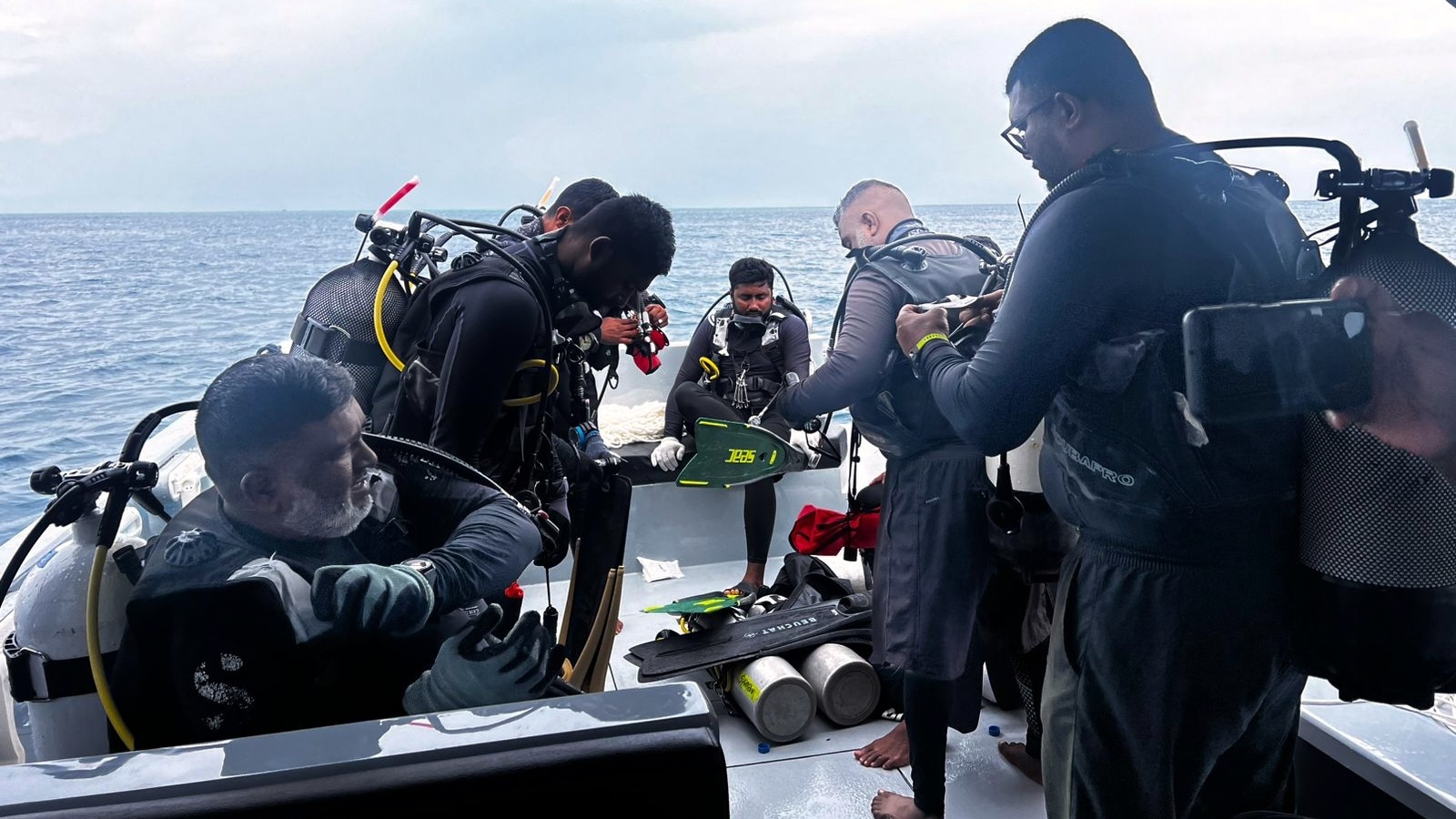
Five highly experienced divers, standard recreational scuba gear, and an underwater maze sitting 50 meters beneath the Indian Ocean. When the University of Genoa research team descended past the Maldives' legal sport diving limit of 30 meters on Thursday, they entered a high-risk environment that swiftly claimed their lives. The tragedy in the Vaavu Atoll has now escalated into the worst scuba disaster in the nation's history, a catastrophic failure of risk management that has also claimed the life of a Maldivian military rescuer.
Three Finnish cave-diving specialists have arrived in Malé to orchestrate a grim recovery plan with the Maldives Coastguard. The bodies of marine ecology professor Monica Montefalcone, her daughter Giorgia Sommacal, researcher Muriel Oddenino, and graduate Federico Gualtieri remain trapped deep inside the third, most spacious chamber of a complex coral tunnel system near Alimathaa island. The body of their diving instructor, Gianluca Benedetti, was pulled from the cave’s mouth shortly after the disaster. The unfolding investigation exposes a disturbing disconnect between scientific discipline and the dangerous allure of extreme underwater exploration.
The Physics of the Fatal Descent
Recreational diving operates on a strict margin of safety. In the Maldives, that margin is codified by law at 30 meters. When the five divers pushed past this threshold to reach the cave opening at 50 meters, they did not just break a rule. They dramatically altered the physiology of their breathing gases.
The group was diving from the luxury liveaboard vessel Duke of York using standard recreational scuba equipment rather than technical gear like rebreathers or specialized mixed gases. At 50 meters, breathing ordinary atmospheric air becomes an intoxicating hazard. The partial pressure of nitrogen skyrockets, inducing nitrogen narcosis. The effect is often compared to drinking multiple martinis on an empty stomach. Judgment blurs. Motor skills degrade. Anxiety can spike into blind panic, or conversely, lull a diver into a false sense of security.
Worse still is the threat of oxygen toxicity. While essential for life, oxygen becomes lethal under extreme pressure. At depths approaching 60 meters, breathing standard air pushes the partial pressure of oxygen to levels that can trigger violent, unheralded grand mal seizures. If a diver convulses underwater, their regulator falls out. Drowning is instantaneous. Because all five divers perished in the same location, investigators are scrutinizing whether a shared vulnerability to gas toxicity or a sudden environmental trigger sealed their fate simultaneously.
The Labyrinth Under the Reef
Coral atoll caves are structurally distinct from the inland limestone karst tunnels found in Florida or Mexico. These are formed by the growth patterns of the reef and tectonic shifts, creating a jagged, unpredictable network of overhangs, swim-throughs, and dead ends. The cave system at Vaavu Atoll is a known but highly hazardous formation divided into three distinct chambers linked by restrictive, narrow choke points.
Entering such a system without specialized cave training and equipment is an invitation to disaster.
- Siltation: The floors of these chambers are blanketed in fine, powdery coral sediment. A single improper kick of a fin can instantly stir up this silt, reducing pristine visibility to absolute zero in seconds.
- The Overhead Environment: Unlike open-water diving, where an emergency requires only a direct ascent to the surface, a cave creates a physical ceiling. To escape, a diver must navigate backward through the darkness.
- Currents: The deep channels of the Vaavu Atoll are famous for fierce, shifting tidal currents. A sudden influx of water can trap divers inside a chamber, pinning them against the rock or exhausting their limited air supplies as they fight the flow.
When the group failed to return to the Duke of York, the Maldivian National Defense Force initiated a high-stakes search. The extreme depth meant that rescue teams could only spend minutes on the bottom before facing lengthy, dangerous decompression stops on the way up. The volatility of the site was laid bare when Staff Sergeant Mohamed Mahudhee, a dedicated military diver, suffered severe decompression sickness during a recovery attempt. Despite swift transport to a hospital in Malé, he could not be saved. The tragedy had claimed its sixth victim.
A Private Excursion with Permanent Consequences
The University of Genoa quickly clarified that while Montefalcone and Oddenino were in the Maldives on an official scientific campaign to monitor coral reef biodiversity and climate impacts, this specific dive was entirely unauthorized. It was a private excursion undertaken on a rest day. The Italian tour operator managing the cruise, Albatros Top Boat, has maintained through legal counsel that they had no knowledge of the group’s intention to violate the 30-meter depth limit.
This leaves a lingering, uncomfortable question for the global diving community. How did a group of disciplined scientists, including an associate professor of underwater science known for her meticulous approach to risk, decide to breach standard safety protocols?
The answer often lies in the psychological phenomenon of complacency. Experienced divers who have logged thousands of successful hours underwater can develop a sense of safety that blinds them to cumulative risks. A deep dive on standard air is dangerous. A cave penetration is dangerous. Combining the two on standard recreational gear, far from hyperbaric infrastructure, removes any safety buffer.
The Maldivian Ministry of Tourism and Civil Aviation has suspended the operating license of the Duke of York indefinitely while the investigation proceeds. The arrival of the Finnish technical team underscores the grim reality of the situation. This is no longer a rescue mission; it is an intricate, perilous engineering problem to retrieve the remaining bodies without losing anyone else to the depths.
The Alimathaa cave tragedy serves as a stark reminder of the ocean's unforgiving nature. The line between an exhilarating exploration and a fatal trap is measured in meters, minutes, and the pressure of the air we breathe.


