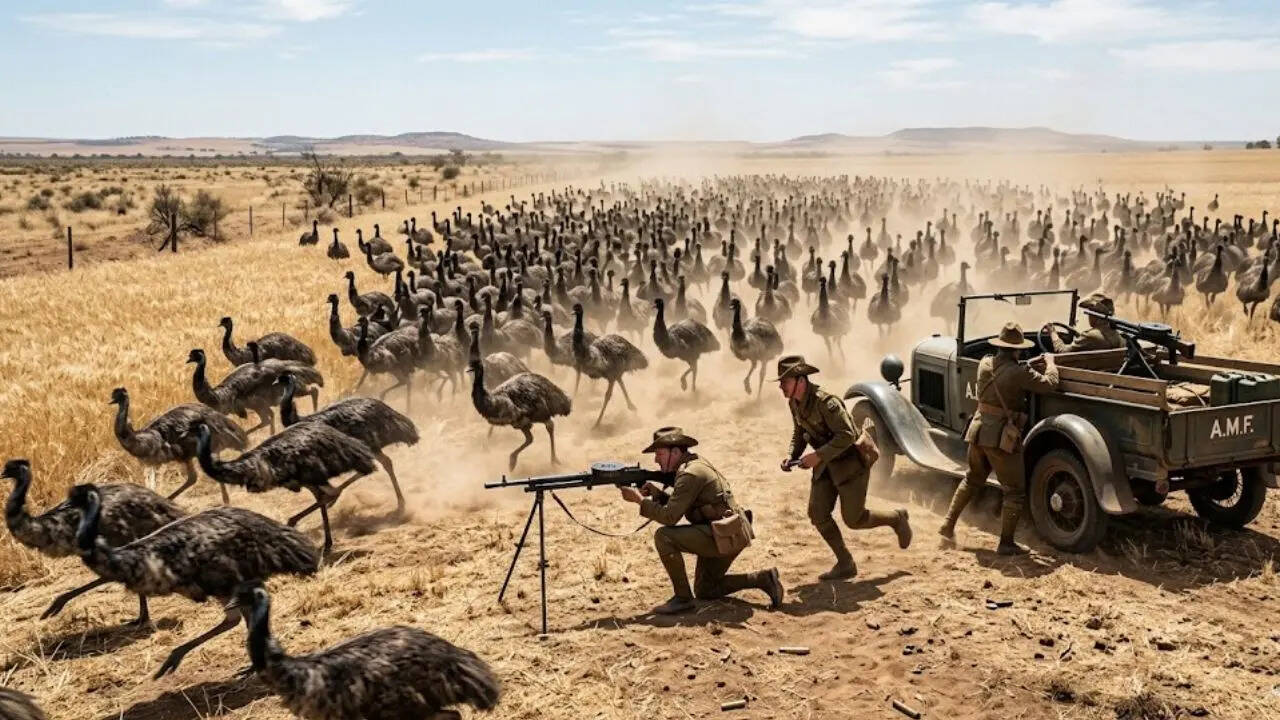
The dust in the Campion district of Western Australia doesn't just sit on the ground. It gets into your teeth. It coats the back of your throat with a dry, metallic tang that tastes like old pennies and failed dreams. For the men standing on the edge of those wheat fields in 1932, the dust was the smell of a promise being broken by twenty thousand pairs of scaly legs.
These weren't just any men. They were veterans. They had survived the mud of the Somme and the nightmare of the Great War, only to return home to a government that offered them a "Soldier Settlement Scheme." The deal was simple: take this patch of scrubland, turn it into a farm, and we will help you survive. But by the early thirties, the Great Depression had arrived, the price of wheat had cratered, and the promised subsidies were nowhere to be found.
Then came the emus.
Every year, these flightless giants migrate from the coast to the interior after breeding. Usually, the vast Australian outback swallows them whole. But the veterans had done too good a job. They had cleared the land. They had dug wells. They had created an oasis of lush, golden grain in a desert of saltbush. To an emu, the veteran farms weren't just a snack; they were a structural invitation to a banquet.
The General and the Machine Gun
Major G.P.W. Meredith of the Seventh Heavy Battery of the Royal Australian Artillery was not a man who expected to be humiliated by a bird. When the farmers, desperate and seeing their livelihoods trampled into the dirt, bypassed the Minister of Agriculture and went straight to the Minister of Defence, George Pearce, they found a sympathetic ear. Pearce saw a golden opportunity for target practice and a chance to look like a hero to the struggling settlers.
Meredith was dispatched with two Lewis guns and ten thousand rounds of ammunition. He had a small detachment of soldiers and a clear objective: cull the population.
It seemed like a slaughter in the making. A Lewis gun can fire five hundred rounds a minute. An emu is a six-foot-tall bird that cannot fly. On paper, this was not a war; it was an execution.
But paper doesn't account for the chaotic intelligence of a creature that has survived for millions of years in the harshest environment on earth. On November 2, 1932, the troops sighted their first group near Campion. The birds were out of range, so the locals tried to herd them into an ambush. The emus didn't play along. They split into small groups and ran in every direction, their long necks bobbing like erratic pistons. The soldiers fired. A few birds fell. The rest vanished into the scrub.
The Guerilla Warfare of the Scrub
Two days later, the "army" thought they had the perfect trap. Over a thousand emus were spotted moving toward a local dam. Meredith set up the guns in silence, waiting until the birds were nearly on top of them before opening fire.
The guns jammed.
In the frantic seconds it took to clear the feed, the birds did something remarkable. They didn't panic and huddle together. They organized. Observers noted that each pack of emus appeared to have a "leader"—a large, dark-feathered male who stood six feet high, watching the soldiers with unblinking eyes while his companions continued to wreck the fences. As soon as the soldiers moved, the sentry gave a signal, and the flock dispersed before a single effective shot could be leveled.
Meredith was stunned. He was used to enemies who wore uniforms and followed a chain of command. He was now facing an adversary that practiced a brand of asymmetric warfare that would have made Lawrence of Arabia proud.
"If we had a military division with the bullet-carrying capacity of these birds," Meredith later remarked with a mix of awe and frustration, "it would face any army in the world."
The soldiers tried to get creative. They mounted a Lewis gun on a truck and chased the birds across the bumpy terrain. It was a disaster. The ride was so rough that the gunner couldn't aim, and the one bird they did manage to get close to became entangled in the steering wheel, causing the truck to veer off into a fence.
Ten thousand rounds of ammunition were being spent for a handful of kills. The ratio was absurd. It was like trying to stop a flood with a handgun.
The Invisible Stakes of the Mallee
To understand why this mattered, you have to look past the comedy of soldiers chasing birds. You have to look at the hands of the farmers. These were men who had seen their friends die in trenches, who had come home hoping for peace, and who were now watching their children go hungry because they couldn't protect a fence.
The emus weren't just eating the wheat. They were destroying the fences that kept the rabbits out. In Australia, the rabbit is the true harbinger of the apocalypse. Once the emus punched holes in the wire, the rabbits flooded in like a gray tide, stripping the land bare until there was nothing left but sand and sorrow.
The "war" was a desperate attempt to maintain a sense of order in a world that felt increasingly chaotic. If the government couldn't even defeat a bird, what hope was there for the economy? What hope was there for the "Soldier Settlement"?
The media caught wind of the failure. The Northam Advertiser and other papers began to mock the "Emu War." Questions were raised in the House of Representatives. Was the Australian Army really being defeated by a bunch of oversized poultry? The embarrassment became too much to bear. On November 8, after less than a week of active "combat," the troops were withdrawn.
The Return to the Front
The withdrawal didn't last. The emus, sensing victory or perhaps just hungry for more wheat, returned in even greater numbers. The farmers pleaded again. Meredith was sent back into the fray.
This second attempt, which lasted through November and into December, was technically more "successful" in terms of numbers. Meredith claimed nearly a thousand kills. But even by his own admission, the effort was a drop in the bucket. The birds had learned. They stayed further away from the roads. They moved in smaller groups. They became shadows.
When the final tally was made, the government realized they had spent more on ammunition and logistics than the wheat was worth. The mission was scrapped. The emus won. Not because they fought back with claws and beaks, but because they simply refused to die at a rate that made sense for the budget.
The Cost of Hubris
We often think of history as a series of grand movements—revolutions, treaties, and the rise of empires. But sometimes, history is just a man in a dusty coat, holding an empty gun, watching a bird run fifty miles an hour into the sunset.
The Great Emu War is frequently cited as a "fun fact" or a quirk of history. Yet, it serves as a profound lesson in the limits of technology against the raw, uncoordinated power of nature. The Australian government tried to solve a complex ecological and social problem with a machine gun. They treated a symptom as if it were an invading army.
Nature, however, doesn't recognize our declarations of war. It doesn't surrender. It only adapts.
The veterans eventually got their fences repaired, not through the army, but through a bounty system that rewarded the farmers themselves for doing what the soldiers couldn't. It was a quiet, un-cinematic solution to a loud, ridiculous problem.
Years later, a visitor to those same Western Australian fields might see a lone emu standing near the ruins of an old farmhouse. The bird stands tall, its feathers ruffled by the hot wind, looking out over a landscape that was once a battlefield. The Lewis guns are long gone, rusted away in museums or melted down for scrap. The soldiers are gone, too.
The bird remains. It dips its head, takes a beakful of grain, and continues its walk across the red earth, a silent victor in a war it never even knew it was fighting.