Sending humans back to the moon isn't a matter of if, but a matter of how much risk we are willing to stomach. For the first time in over fifty years, NASA is preparing to place four individuals—Reid Wiseman, Victor Glover, Christina Koch, and Jeremy Hansen—inside a capsule atop a pillar of controlled fire to loop around the lunar far side. This mission, Artemis II, is the ultimate stress test of the Orion spacecraft and the Space Launch System (SLS). It serves as the bridge between empty-cabin test flights and the actual boots-on-the-ground landing scheduled for later this decade.
The Heavy Weight of the Flight Test Label
We often hear NASA officials refer to Artemis II as a "flight test." That phrasing is a deliberate piece of linguistic engineering designed to manage expectations. In reality, it is a high-stakes gamble on a life-support system that has never been vetted with human lungs breathing its air for ten days straight. While Artemis I proved the heat shield could survive a screaming atmospheric reentry, Artemis II has to prove the machinery can keep humans alive through the Van Allen radiation belts and the vacuum of deep space.
The crew isn't just along for the ride. Unlike the Apollo missions, which relied on a series of incremental "jumps" through Earth's orbit, Artemis II will use a High Earth Orbit (HEO) strategy. The crew will spend the first 24 hours orbiting Earth to ensure every oxygen scrubber and cooling loop is functioning perfectly before they commit to the Trans-Lunar Injection. Once they burn that engine to head for the moon, there is no turning back. They are on a free-return trajectory, a gravitational slingshot that dictates their path regardless of what breaks on board.
Reid Wiseman and the Burden of Command
Every mission needs a steady hand, and Reid Wiseman represents the traditional backbone of the Naval aviator pipeline that has fueled NASA since the Mercury days. As the commander, Wiseman carries the ultimate responsibility for the safety of the crew and the integrity of the multi-billion-dollar hardware. He isn't a stranger to long-duration isolation, having spent 165 days on the International Space Station (ISS), but the moon is a different beast entirely.
On the ISS, you are 250 miles up. If something goes wrong, you can be home in hours. At the moon, you are 240,000 miles away. Wiseman’s role involves managing the psychological transition from "Earth-dependent" to "Moon-independent." He has been vocal about the technical hurdles, specifically the manual handling of the Orion capsule. During the mission, he will perform a proximity operations demonstration, manually flying the spacecraft near the spent upper stage of the rocket to test how the ship handles in close quarters—a skill necessary for future dockings with the Lunar Gateway.
Victor Glover and the Pilot's Seat
Victor Glover is the pilot for Artemis II, but the title is somewhat of a misnomer in the age of automated flight computers. His real job is to be the systems expert, the man who understands the millions of lines of code and the redundant electrical pathways that keep Orion from becoming a tomb. Glover was the first Black astronaut to serve a long-duration mission on the ISS, and his selection for Artemis II reinforces his status as one of the most capable aviators in the current corps.
The cockpit of the Orion is a radical departure from the toggle-switch forests of the 1960s. It is a "glass cockpit," dominated by screens and software-driven interfaces. Glover’s challenge lies in the "dark" moments—those seconds during the burn or the transit where the automation might fail and human intuition must override the silicon. He has to balance the role of a modern systems manager with the primal instincts of a test pilot.
Christina Koch and the Science of Survival
If Wiseman is the commander and Glover is the pilot, Christina Koch is the mission's primary engine of endurance. Koch holds the record for the longest single spaceflight by a woman, totaling 328 days. That experience is invaluable because the Artemis II mission is effectively a biological experiment. NASA needs to know how the human body reacts to deep-space radiation without the protection of Earth’s magnetic field.
Koch's role as a Mission Specialist involves overseeing the complex science payloads and the critical life-support interfaces. She represents the shift in NASA’s philosophy: moving away from "flags and footprints" toward sustainable presence. Her background in electrical engineering and her time at the South Pole and the ISS make her the most seasoned "operator" in the group. She understands how systems degrade over time, a perspective that will be vital when the crew is four days into a ten-day mission and the cabin air starts to feel a little thin.
Jeremy Hansen and the International Equation
The inclusion of Jeremy Hansen, a Canadian Space Agency (CSA) astronaut, is a masterstroke of geopolitical strategy. For decades, the moon was a bilateral race between two superpowers. Today, it is an international coalition. By giving Canada a seat on the first crewed lunar mission in half a century, the United States is securing long-term funding and technical contributions, such as the Canadarm3.
Hansen is a rookie in terms of actual spaceflight, but he is a veteran in the eyes of the astronaut office. He has managed crews on the ground for years and has been a central figure in astronaut training. His presence on the flight isn't just about Canadian pride; it is a signal that the Artemis program is built on a foundation of international interdependence. This isn't just America’s rocket; it’s the Western world’s bridgehead to the lunar surface.
The Hardware That Could Kill Them
We cannot discuss the crew without discussing the SLS rocket. It is the most powerful rocket ever built, yet it is also a Frankenstein’s monster of Space Shuttle-era technology. The RS-25 engines lifting the Artemis II crew are the same engines that flew on the Shuttle for thirty years. They are proven, yes, but the SLS architecture itself is incredibly complex and expensive.
The primary concern for this mission isn't the launch, but the Heat Shield. During the Artemis I uncrewed mission, the heat shield experienced more "charring" and material loss than expected. While NASA deemed it safe for the specific parameters of that flight, the Artemis II crew will be hitting the atmosphere at roughly 25,000 miles per hour. At those speeds, the friction creates a plasma field reaching 5,000 degrees Fahrenheit. If the shield doesn't ablate exactly as designed, the structural integrity of the capsule is compromised.
Living in a Tin Can
The Orion capsule provides about 330 cubic feet of habitable volume. Divide that by four adults, and you realize they are spending ten days in a space roughly the size of a small SUV. There are no private cabins. There is one toilet.
The psychological toll of this environment is often downplayed in official press releases. The crew will be dealing with "The Overview Effect" in reverse—seeing the Earth shrink to a marble while the lunar surface, a scarred and desolate wasteland, grows to fill their windows. They will be the first humans to see the lunar far side with their own eyes since 1972. This isn't a vacation; it is a grueling marathon of monitoring gauges, managing CO2 levels, and sleeping in shifts while strapped to a wall.
The Reality of the Schedule
NASA currently targets a launch in late 2025, but that date is soft. Industry insiders and GAO reports suggest that the technical hurdles with the Orion life support and the heat shield analysis could push the mission into 2026. This creates a friction point. Every delay in Artemis II pushes the Artemis III landing further back, potentially allowing competitors like China to close the gap in the new "Moon Race."
The crew knows this. They are operating under the pressure of a deadline that is as much about politics as it is about physics. They aren't just test pilots; they are symbols of a national ambition that has been dormant for two generations. When they sit on top of that rocket at Launch Complex 39B, they are carrying the weight of a $90 billion program.
The Van Allen Radiation Challenge
Most people don't realize that the International Space Station sits safely within the Earth's protective magnetic bubble. Artemis II will punch through that bubble. The crew will pass through the Van Allen radiation belts, zones of high-energy charged particles that can wreak havoc on both electronics and human DNA.
The Orion spacecraft is outfitted with shielding and a dedicated "storm shelter" area where the crew can huddle if a solar flare occurs during transit. However, shielding adds weight, and weight is the enemy of rocketry. The mission planners have to find the "sweet spot"—enough protection to keep the crew from getting sick, but light enough to actually reach the moon. This mission will provide the most comprehensive data yet on how modern shielding holds up against the barrage of deep-space cosmic rays.
Re-Entry and the Final Minutes
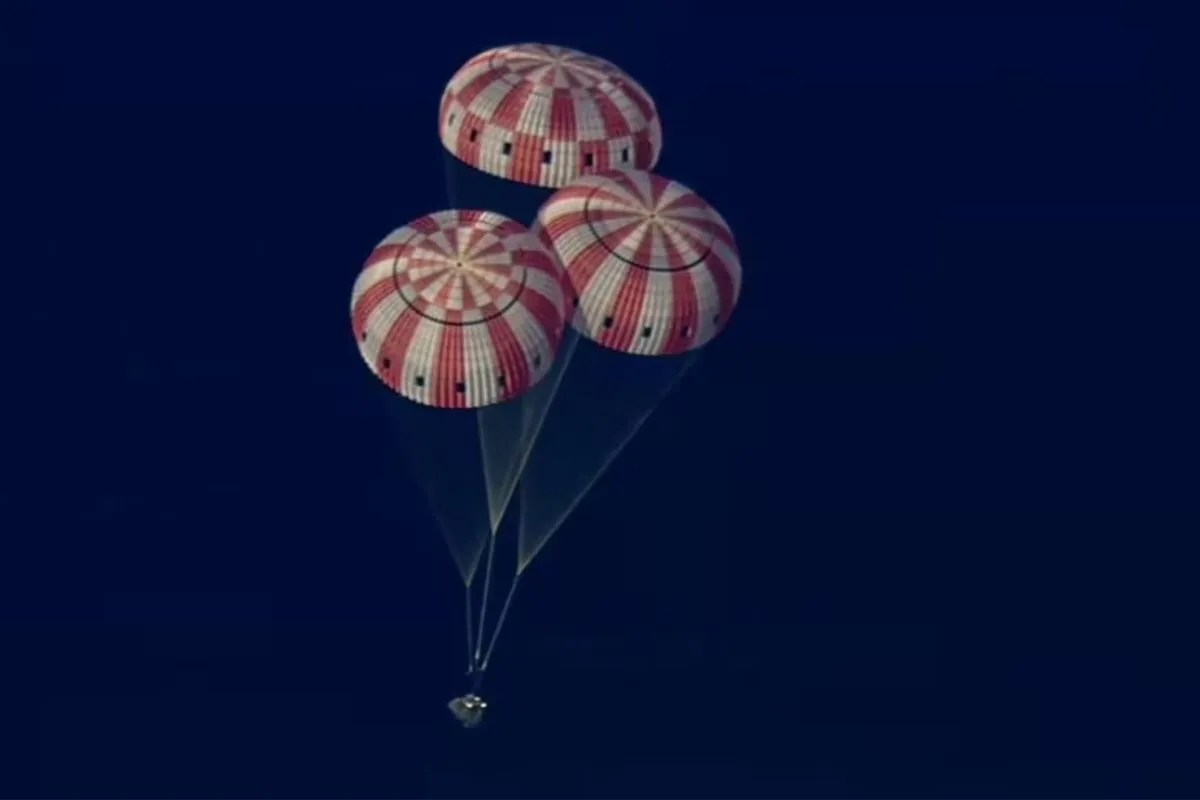
The most dangerous part of the mission is the final fifteen minutes. After ten days in space, the crew will be physically exhausted. They will hit the atmosphere, experience upwards of 7Gs of deceleration, and rely on a sequence of eleven parachutes to slow the capsule down for a splashdown in the Pacific.
The parachute system is a mechanical ballet. Two drogue chutes deploy first to stabilize the craft, followed by three pilot chutes that pull out the three massive main chutes. If one main parachute fails, the crew survives. If two fail, the outcome is catastrophic. There is no backup plan for a parachute failure at 10,000 feet. It is a moment of pure, unadulterated physics where the crew's lives are entirely in the hands of the engineers who rigged the nylon cords.
Artemis II is the ultimate proof of concept. If these four individuals return safely, the door to the moon stays open. If they don't, the future of human deep-space exploration could be set back by another fifty years. The stakes are not merely scientific; they are existential for the agency.
The lunar far side is a place of absolute silence and shadow. As Wiseman, Glover, Koch, and Hansen pass behind the moon, they will lose all contact with Earth. For those minutes, they will be the most isolated humans in history, staring out into a blackness that hasn't seen a human face in half a century. They are the scouts for a species that has spent too long looking at the ground.
Keep your eyes on the heat shield data.