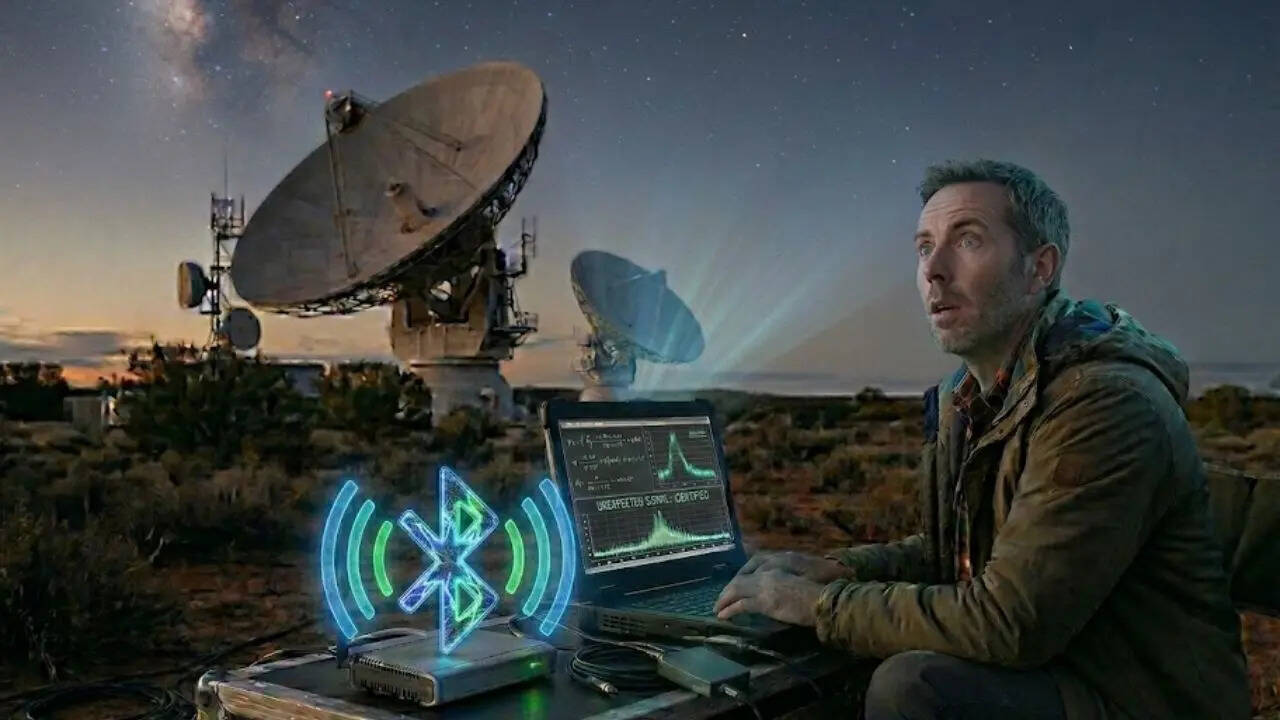
John O’Sullivan was looking for the ghosts of exploding black holes, not a way to browse the internet from a couch. In the late 1970s, the Australian engineer and his team at CSIRO (Commonwealth Scientific and Industrial Research Organisation) spent their nights staring at the deep reaches of space, trying to catch the faint, smeared radio signals predicted by Stephen Hawking. They failed. They found nothing but noise and cosmic interference. But in that failure, they cracked the code for multi-path distortion—the very physics problem that made wireless networking impossible in an indoor environment. Today, every device in your pocket runs on the math born from that celestial dead end.
The Indoor Echo Chamber
Before the 1990s, the idea of high-speed wireless data inside a building was a mathematical nightmare. If you send a radio signal in an open field, it travels in a straight line. Easy. But inside an office or a home, that signal hits walls, desks, and people. It bounces.
This creates "multi-path interference." The receiver gets the same signal multiple times, arriving at slightly different intervals. These echoes overlap and cancel each other out, turning a clean stream of data into a garbled mess of electronic static. For years, the industry thought the only solution was to slow down the data so the echoes had time to die out, or to use wires. Neither was acceptable for a world moving toward mobile computing.
O’Sullivan’s team had already dealt with this. In radio astronomy, signals from distant stars are distorted by the interstellar medium. To see through the haze, they developed a complex mathematical process involving Fast Fourier Transforms (FFT). They built a custom chip that could process these signals in real-time, effectively "untangling" the smeared radio waves. When the black hole hunt turned up dry, they realized they had a solution looking for a problem. They didn't need to fix the stars; they needed to fix the office.
How the CSIRO Broke the Physics Barrier
The breakthrough wasn't just a better antenna. It was a fundamental shift in how we transmit information. The CSIRO team applied a technique known as Orthogonal Frequency Division Multiplexing (OFDM).
Instead of trying to shove a massive amount of data through one wide, vulnerable frequency, they broke the data into thousands of small, slow pieces and sent them simultaneously across many different sub-channels. If one channel hit a wall and echoed, the others remained clear. The receiver then used the astronomers' FFT math to stitch the pieces back together into a coherent whole.
It was an elegant, brutal fix. It turned the "noise" of a cluttered room into an advantage. By the time they filed the patent in 1992, the team had created the backbone of what we now know as 802.11a, the first truly fast version of Wi-Fi.
The Patent War That Silicon Valley Lost
You might expect that the tech giants of the 1990s—Intel, Dell, Microsoft, Apple—would have hailed the Australian scientists as heroes. Instead, they tried to starve them. As Wi-Fi began to explode in the early 2000s, almost every major hardware company ignored the CSIRO patent. They assumed a small research agency in Australia wouldn't have the teeth to take on the entire American tech sector.
They were wrong.
CSIRO spent nearly a decade in a series of grueling legal battles. They weren't just fighting for money; they were fighting for the principle that foundational research matters. The tech industry argued that the patent was too broad or that they had "independently" come up with similar math.
The courts didn't buy it. By 2009, the industry started to buckle. Hewlett-Packard was the first to settle, followed by a domino effect of settlements from Apple, Intel, and Dell. Eventually, CSIRO hauled in over $430 million in royalties.
This wasn't just a win for Australia. It was a rare moment where a government-funded lab successfully defended its intellectual property against the most powerful corporations on earth. It proved that the "useless" pursuit of pure science—like looking for black holes—could yield the most profitable practical applications in history.
The Myth of the Lone Genius
The story of Wi-Fi is often told as a "eureka" moment, but that is a convenient lie. It was a slog. The team included Terry Percival, Diet Ostry, Graham Daniels, and John Deane. Each brought a different piece of the puzzle: one understood the hardware, one mastered the coding, and another handled the radio physics.
They also had to fight internal battles. CSIRO is a government body, and government bodies aren't known for their high-risk tolerance. There were plenty of bureaucrats who wanted to pull the plug on the "wireless office" project because it seemed like a distraction from more traditional engineering.
If the team hadn't been allowed to fail at radio astronomy first, they never would have had the tools to succeed at networking. We often try to force innovation into a straight line—a direct path from a problem to a solution. But the history of Wi-Fi shows that innovation is a messy, circular process. The tools we use to navigate the internet today are essentially repurposed telescopes.
Why We Still Use Astronomer Math
Even as we move into the era of Wi-Fi 7 and 6G cellular networks, the core principles established by the CSIRO team remain. We are still using multi-carrier modulation. We are still using the Fourier transforms that O’Sullivan used to look for Hawking radiation.
The complexity has increased. We now use MIMO (Multiple Input Multiple Output), which uses multiple antennas to play even more tricks with signal bounces. But the fundamental logic—that you can't beat the echoes, so you must use them—is the same.
The irony is that the team never did find those exploding black holes. The signals they were looking for might not even exist, or they might be too faint for any current technology to detect. In the world of pure science, the project was a dud. In the world of business and technology, it was the ultimate jackpot.
This is the reality of research and development that modern venture capital often forgets. You cannot pre-order a breakthrough. You have to fund the curiosity, accept the failure, and be smart enough to recognize when a failed star-map is actually a roadmap for the future.
Next time your signal drops in the back corner of your house, remember that the math trying to find your router is the same math that tried to find the edge of the universe. It was built to traverse light-years. It can handle your drywall.
Take a look at your router's settings. Look for the "802.11" designation. That string of numbers is a monument to a group of astronomers who stopped looking up and started looking at the walls.