The rain in Berlin doesn’t just fall. It clings. It’s a gray, heavy mist that smells of damp stone and cold iron, the kind of weather that makes you want to pull your collar up and look at your boots. I was standing near the Memorial to the Murdered Jews of Europe, watching a group of teenagers laugh as they played hide-and-seek among the concrete stelae. They didn't see the shadows. They saw a playground.
For seventy-five years, that has been the German miracle. Not just the BMWs or the precision engineering, but the luxury of forgetting. Germany had successfully resigned from history. It had traded its bayonets for bank statements and its marching bands for trade delegations.
Then, on a Sunday in February 2022, the music stopped.
Olaf Scholz stood before the Bundestag and uttered a word that sent a shiver through the continent: Zeitenwende. A turning point. A historical rupture. He pledged 100 billion euros to rebuild a military that had become, by all accounts, a hollowed-out shell. The world cheered. Washington breathed a sigh of relief. Warsaw nodded.
But as the gears of the German industrial machine begin to grind toward the production of Leopard tanks and IRIS-T systems, a quiet, suffocating tension is rising. It’s the sound of a sleeping giant hitting the "snooze" button for the last time.
Europe wants a strong Germany to protect it, but Europe is also terrified of what a strong Germany looks like.
The Museum of Broken Parts
To understand why the world is nervous, you first have to understand how broken the German military—the Bundeswehr—actually is. This isn't just about budget cuts. It’s about a deep-seated, cultural allergy to anything that shoots.
Consider a hypothetical sergeant named Lukas. Lukas joined the Bundeswehr because he wanted to serve, but his daily reality is a comedy of errors. When his unit goes to a NATO exercise, they often have to share equipment. Sometimes, they don't have enough warm jackets. There have been infamous reports of soldiers using broomsticks painted black because they lacked machine guns for their armored vehicles.
This wasn't an accident. It was a choice. For decades, the German public viewed their military as a necessary evil at best, and a shameful relic at worst. The goal was "parliamentary control," a polite way of saying "we will make it so bureaucratic that it can never actually do anything."
Now, suddenly, Lukas is being told he is the front line of Western civilization.
The 100 billion euros is a staggering sum of money, but money cannot buy a soul. You can buy an F-35 fighter jet from Lockheed Martin, but you cannot buy the cultural will to use it. Germany is currently a nation trying to perform a heart transplant on itself while running a marathon.
The Weight of the Neighbor’s Stare
Geopolitics is often discussed in terms of "spheres of influence" and "strategic autonomy," but in reality, it feels much more like a tense dinner party where everyone remembers who threw the first plate eighty years ago.
When Germany announces it will have the largest conventional army in Europe, the reaction is a kaleidoscope of conflicting trauma.
In Paris, the French elite look across the Rhine with a mixture of jealousy and dread. They have long dreamed of a "European Army," but they always assumed France would be the one leading it. If Germany becomes the continent's military powerhouse to match its economic dominance, the balance of the European Union shifts. Power follows the pike.
Then there is Poland.
The relationship between Berlin and Warsaw is a raw nerve. On one hand, Poland is the loudest voice demanding that Germany stop dragging its feet and send more tanks to Ukraine. They want the protection. But on the other hand, there is a deep, historical instinct that recoils at the sight of a militarized Germany. It is a paradox of security: they are only safe if Germany is strong, but they only feel safe if Germany is weak.
This isn't just "history." It is lived memory. It is the stories grandmothers tell. You can see it in the way the Polish government bristles at every German policy shift. They aren't just debating defense spending; they are debating the ghost of 1939.
The Pacifist’s Dilemma
Inside Germany, the struggle is even more intimate. It’s happening at kitchen tables in Munich and bars in Hamburg.
There is a generation of Germans—the "Baby Boomers" who grew up in the shadow of the Wall—for whom "Never Again" meant "Never Again a Soldier." To them, pacifism isn't just a policy; it’s their national identity. It’s the one thing they did right after doing everything so catastrophically wrong.
I spoke with an old teacher who told me that seeing the German cross on a tank makes his stomach turn, even if that tank is heading to defend a democracy. He knows the logic. He understands the threat from the East. But the emotional muscle memory is too strong. He spent his life believing that Germany’s greatest gift to the world was its refusal to fight.
Now, that refusal is being framed as cowardice.
The pressure is coming from every direction. The United States is tired of being Europe’s 24-hour security guard. They want Germany to grow up. The Baltic states—Estonia, Latvia, Lithuania—are terrified that if Germany doesn't lead, they will be the next to disappear into the maw of a new empire.
But can a nation be forced into leadership? Leadership requires a certain amount of arrogance. It requires the belief that your vision for the world is worth enforcing. Since 1945, Germany’s entire educational and political system has been designed to beat that arrogance out of its citizens.
The Industrial Trap
Then there is the cold, hard reality of the "Military-Industrial Complex."
Germany is a country built on exports. It sells cars, chemicals, and machine tools. For years, its defense industry was a quiet, slightly embarrassing side hustle. Companies like Rheinmetall and Krauss-Maffei Wegmann built world-class hardware, but the government made it incredibly difficult to sell that hardware to anyone outside of a very small circle of friends.
Rearmament changes the math.
If Germany is to spend 2% of its GDP on defense, as NATO requires, it isn't just buying gear. It is subsidizing a massive expansion of its arms industry. Production lines that have been dormant for decades are being restarted. This creates a new lobby, a new political force, and a new set of incentives.
Once you build a factory to churn out thousands of artillery shells, you need a market for them. You need a reason for them to exist. The world isn't ready for a Germany that is not only the bank of Europe but also its primary armorer.
The fear isn't that Germany will suddenly decide to march on its neighbors. That’s a cartoonish fantasy. The real fear is a slow, structural shift. It’s the "Vasa" problem—building a ship so heavy with cannons that it eventually tips over under its own weight.
The Missing Piece
What the policy papers and the "think tank" experts miss is the human psychological toll of this transition.
For the last thirty years, the "End of History" felt real in Berlin. You could live a whole life without ever thinking about hard power. You could believe that trade deals were more powerful than T-72s. That was the German Dream.
Waking up from that dream is painful.
The world is asking Germany to be "normal." But Germany isn't a normal country. It carries a burden of proof that no other nation on earth is expected to carry. If it doesn't lead, it’s called irresponsible. If it leads too forcefully, it’s called a threat. It is a narrow, treacherous path with a sheer drop on either side.
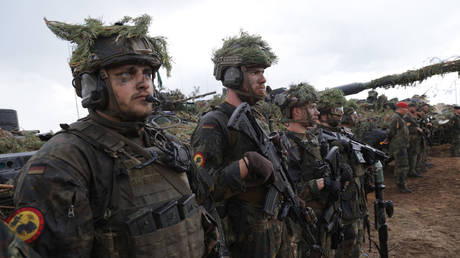
As the rain continued to fall over the Tiergarten, I saw a young man in a Bundeswehr uniform. He was standing alone, waiting for a train. He looked awkward, almost apologetic, in his camouflage. People walked past him without looking him in the eye.
In London or Washington, a soldier in uniform is often a symbol of pride, or at least a familiar part of the landscape. In Berlin, he is still a question mark. He is a reminder of a past everyone wants to escape and a future no one quite knows how to build.
The steel is being forged. The checks are being signed. The tanks are rolling off the assembly lines. But as the world watches Germany rearm, it isn't just looking at the weapons. It’s looking at the hands that hold them, wondering if they will be steady, or if the weight of the past will eventually make them tremble.
The ghost in the steel isn't gone. It’s just waiting to see what we do with the machines it left behind.
And for the first time in nearly a century, Germany doesn't have an answer. It only has an order for more ammunition.