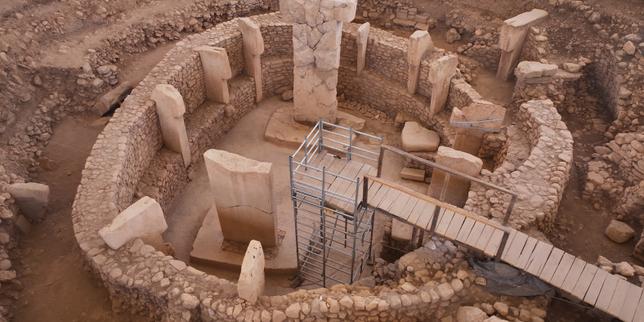
Archaeology isn't always about dusty pots or gold coins. Sometimes, it's about a discovery that hits you like a sledgehammer to the face of everything you thought you knew about history. That’s Göbeklitepe. Located in southeastern Turkey, near the city of Şanlıurfa, this site is roughly 12,000 years old. That makes it older than Stonehenge by six millennia. It’s older than the pyramids. It’s older than the concept of written language itself.
If you were taught that humans only started building massive stone monuments after we invented farming, you were taught wrong. Göbeklitepe proves it. For decades, the narrative was simple: we planted wheat, we stayed in one place, we grew a surplus of food, and then—only then—did we have the spare time to build temples.
Göbeklitepe flips that script. It suggests that the urge to worship, the need for a spiritual center, was actually the catalyst for civilization, not a byproduct of it. People weren't farmers when they hauled these 20-ton T-shaped pillars into place. They were hunter-gatherers. Think about that for a second. Without metal tools, without wheels, and without a steady supply of farmed grain, they organized a massive labor force to create a "nombril" or navel of the world.
The pillars that shouldn't exist
When Klaus Schmidt started digging here in the mid-1990s, he knew he’d found something weird. The site consists of several circular enclosures. In the middle of each circle stand two massive T-shaped limestone pillars, surrounded by smaller ones. These aren't just blocks of stone. They’re stylized human figures. Look closely at the sides and you’ll see arms, hands, and even loincloths carved in low relief.
The level of craftsmanship is staggering. These people weren't just "surviving." They were artists. You’ll see carvings of foxes, scorpions, lions, and vultures. It’s a prehistoric menagerie. Some of these animals are depicted in high relief, jumping off the stone. How does a society with no permanent housing or centralized government pull this off? It requires a level of social hierarchy and logistics that shouldn't have existed in the Pre-Pottery Neolithic period.
It’s easy to get lost in the "aliens" or "lost civilization" theories you see on late-night TV. Let’s be clear: humans did this. But we clearly underestimated what our ancestors were capable of. They didn't need a PhD in engineering to understand leverage and physics. They had a vision, and they had a reason to gather.
What we get wrong about the first temple
Calling Göbeklitepe a "temple" is a bit of a shortcut. It’s the easiest word we have, but it might not be accurate. While there’s no evidence of people living there permanently—no hearths, no trash heaps of daily life—it wasn't just a church. It was likely a site for seasonal gatherings, a place where different nomadic groups met to trade, find mates, and perform rituals.
Recent findings by the Göbeklitepe Culture and Karahantepe project have started to complicate the "temple-only" theory. Archaeologists are now finding similar sites across the region, part of a network called Taş Tepeler (Stone Hills). These include Karahantepe, Sayburç, and Harbetsuvan Tepesi. This tells us Göbeklitepe wasn't a lonely fluke. It was part of a widespread cultural explosion.
One of the most fascinating recent finds is a life-sized painted statue of a wild boar. It was found in Enclosure D, and it still has traces of red, white, and black pigment. Finding color on a 12,000-year-old statue is like finding a photograph from the Stone Age. It changes the vibe of the place entirely. It wasn't just cold, grey stone. It was vibrant. It was probably loud, chaotic, and maybe a bit terrifying.
The dark side of the navel
Let’s talk about the vultures. They appear everywhere at Göbeklitepe. In many ancient cultures, vultures are linked to "sky burials," where bodies are left out to be picked clean by birds. Some researchers believe this was a site for the dead. We’ve found fragments of human skulls with deliberate carvings on them.
This wasn't some peaceful garden of Eden. It was likely a site of intense, perhaps even violent, ritual activity. The carvings aren't just "pretty pictures." They’re symbols of power, protection, and maybe fear. The obsession with dangerous animals—snakes, spiders, scorpions—suggests a culture deeply concerned with the spirit world and the threats within it.
You also have to wonder why they buried it. This is the part that boggles the mind. Around 8000 BCE, the people who built these structures deliberately filled them in with dirt and rubble. They decommissioned the site. Why? Maybe the religion changed. Maybe the climate shifted. Whatever the reason, their act of burial preserved the site for us to find ten thousand years later.
Why the Taş Tepeler project matters now
The Turkish Ministry of Culture and Tourism has doubled down on excavations in the region. They aren't just looking for more pillars. They’re looking for the transition point. How did these people go from hunting gazelle to domesticating sheep? How did they go from gathering wild grasses to farming einkorn wheat?
The DNA of modern agriculture is right there in the hills surrounding the site. Geneticists have traced the origin of domestic wheat to the Karacadağ mountains nearby. It’s the smoking gun. We have the birthplace of farming and the birthplace of monumental architecture in the same geographic pocket.
If you’re planning to visit, don't just look at the stones. Look at the horizon. The site sits on a high point with a 360-degree view of the Harran Plain. You can see why they chose it. It’s a landmark. It commands the terrain. Even today, standing there feels heavy. You’re standing on the exact spot where the human story took a hard left turn toward what we now call "civilization."
Practical steps for the curious
If you want to understand this site beyond the headlines, you need to look at it as a piece of a larger puzzle. Don't just read about Göbeklitepe in isolation.
- Visit the Şanlıurfa Museum: It’s one of the best archaeological museums in the world. They’ve reconstructed the enclosures and house the original statues, like the "Urfa Man," the oldest life-sized human statue ever found.
- Follow the Taş Tepeler updates: This is an active project. New sites are being announced every few months. Karahantepe, in particular, is proving to be just as complex and perhaps even older in some aspects.
- Ignore the "Forbidden History" noise: The real science is far more interesting than the conspiracy theories. The fact that hunter-gatherers built this is a much bigger deal than some imaginary "advanced" ancient race doing it.
- Check the weather: If you go, spring or autumn is the only way to do it. The Harran Plain in mid-summer is a furnace.
The mystery of Göbeklitepe isn't that we don't know who built it—we do. The mystery is why we ever thought our ancestors were too "primitive" to dream this big. They were just like us. They had the same brains, the same hands, and clearly, the same need to build something that would outlast their own lives. They succeeded beyond their wildest imagination.
Stop thinking of history as a straight line from "dumb" to "smart." It’s more like a series of explosions. Göbeklitepe was the first big one. We’re still living in the fallout of that transition. It’s not just an old pile of rocks; it’s the blueprint of the modern world. The navel of the world is still tied to us.


