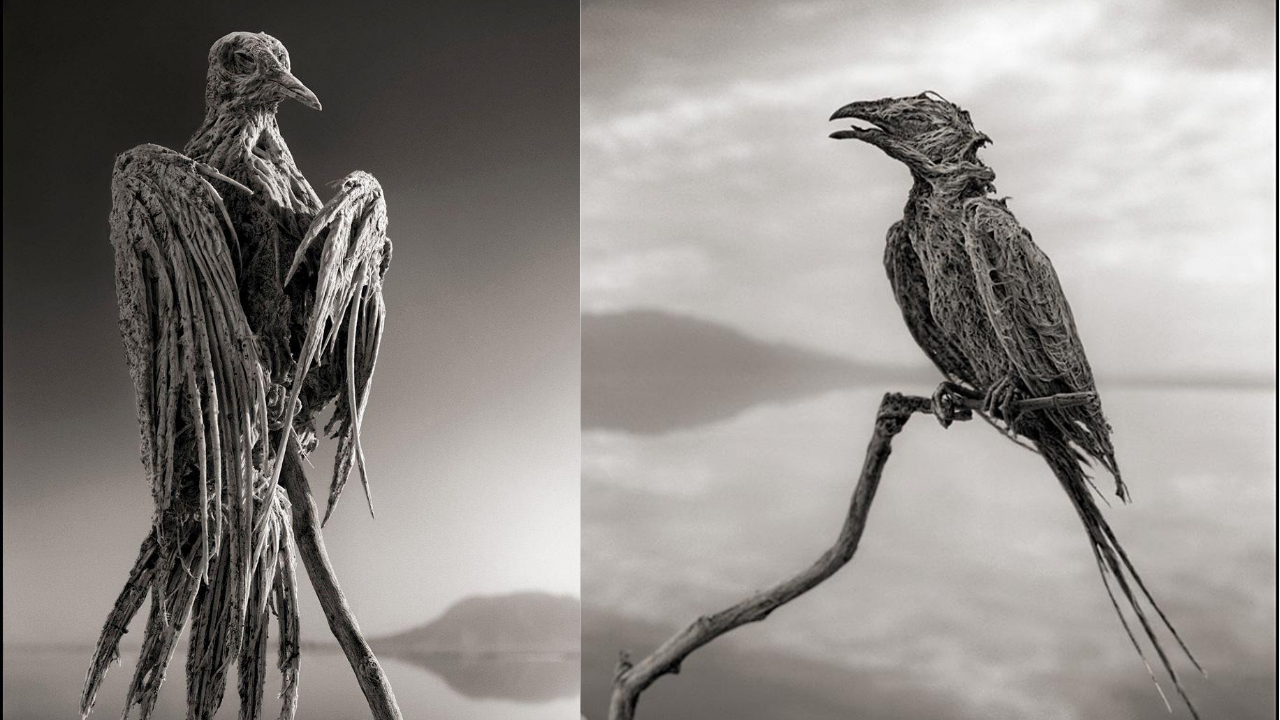
The internet loves a good monster story, especially when it involves a "lake of stone" that flash-freezes flamingos into macabre statues. You’ve seen the photos. You’ve read the sensationalist headlines claiming Lake Natron is a literal graveyard where animals touch the water and turn to granite.
It is a lie.
Lake Natron doesn’t turn animals into stone. It preserves them. There is a massive, fundamental difference between petrification and mummification, yet digital media outlets continue to pedal the "Medusa" myth because nuance doesn't get clicks. If you want the truth about this Tanzanian soda lake, you have to look past the staged photography and understand the chemistry of death.
The Staged Reality of Nick Brandt
Most of the "statue" photos you see circulating—birds perched on branches, bats frozen in flight—were staged. The photographer, Nick Brandt, found these carcasses washed up on the shore. They were already dead. They were already preserved. He picked them up and placed them in "living" positions to create an artistic statement.
Brandt never claimed they died that way, but the internet took those images and built a fictional narrative around them. The idea that a bird could fly into the water and instantly harden into a statue is physically impossible. It’s a fairy tale for people who skipped chemistry class.
The Chemistry of the Corpse
Lake Natron is an endorheic lake, meaning it has no outlets. It loses water only through evaporation, leaving behind concentrated minerals. The star of the show here is natron, a naturally occurring mixture of sodium carbonate decahydrate and sodium bicarbonate.
When an animal dies in or near the lake, the high alkalinity—often reaching a pH of 10.5 or 12—prevents decay. It’s the same stuff the Ancient Egyptians used to make mummies.
- The Process: The minerals strip the moisture out of the flesh.
- The Result: A dry, calcified husk.
- The Timeframe: This takes weeks or months, not seconds.
Calling this "turning to stone" is like calling a beef jerky stick a "cow statue." It is a biological preservation process, not a geological transformation.
Stop Blaming the Water for Every Death
The common narrative suggests the lake is a deathtrap that kills everything it touches. This ignores the fact that Lake Natron is the only regular breeding ground in East Africa for 2.5 million Lesser Flamingos.
If the lake were a caustic pit of instant death, the flamingo population would be extinct. Instead, they use the lake’s extreme environment as a fortress. The caustic water creates a literal moat that prevents predators like hyenas or lions from reaching their nests.
The birds that die there usually die of natural causes, exhaustion, or by crashing into the water because the lake’s mirror-like surface tricks their navigation. They don't die because the water is "poisonous"; they die because nature is harsh, and the lake happens to be the place where their bodies land.
Why the "Medusa" Myth Persists
We are obsessed with the idea of a vengeful nature. We want to believe there are places on Earth that defy the laws of biology. This sensationalism hides a much more interesting reality: Lake Natron is a thriving ecosystem of extremophiles.
There are Alcolapia latilabris, a species of alkaline tilapia, swimming in waters that would peel the skin off your hand. There are cyanobacteria that turn the lake a deep, bloody red. When you frame the lake as a "deadly graveyard," you miss the genius of evolutionary adaptation.
The Industrial Threat You Aren't Talking About
While you’re busy worrying about fictional stone birds, a real threat is looming. There have been ongoing plans to build a soda ash plant at Lake Natron. Soda ash (sodium carbonate) is used in everything from glassmaking to detergents.
Mining the lake would require massive amounts of fresh water, which would drop the water levels and destroy the nesting grounds of the Lesser Flamingo. The "scary lake" narrative actually makes it harder to protect. If people think the lake is a lifeless, haunted wasteland, they are less likely to care if a corporation drains it for profit.
Face the Brutal Reality
Nature doesn't need your myths to be terrifying or beautiful. Lake Natron is a hyper-saline, high-temperature, caustic environment that serves as a cradle for millions of lives. It is a biological marvel, not a supernatural curse.
Stop sharing the "statue" photos as if they are candid shots of a natural disaster. Start respecting the fact that life has found a way to thrive in a bowl of liquid lye.
The lake isn't turning animals to stone. It's keeping them exactly as they were, long after they're gone, to remind us that we don't understand half of what happens in the wild.
Put down the myths. Pick up a textbook.