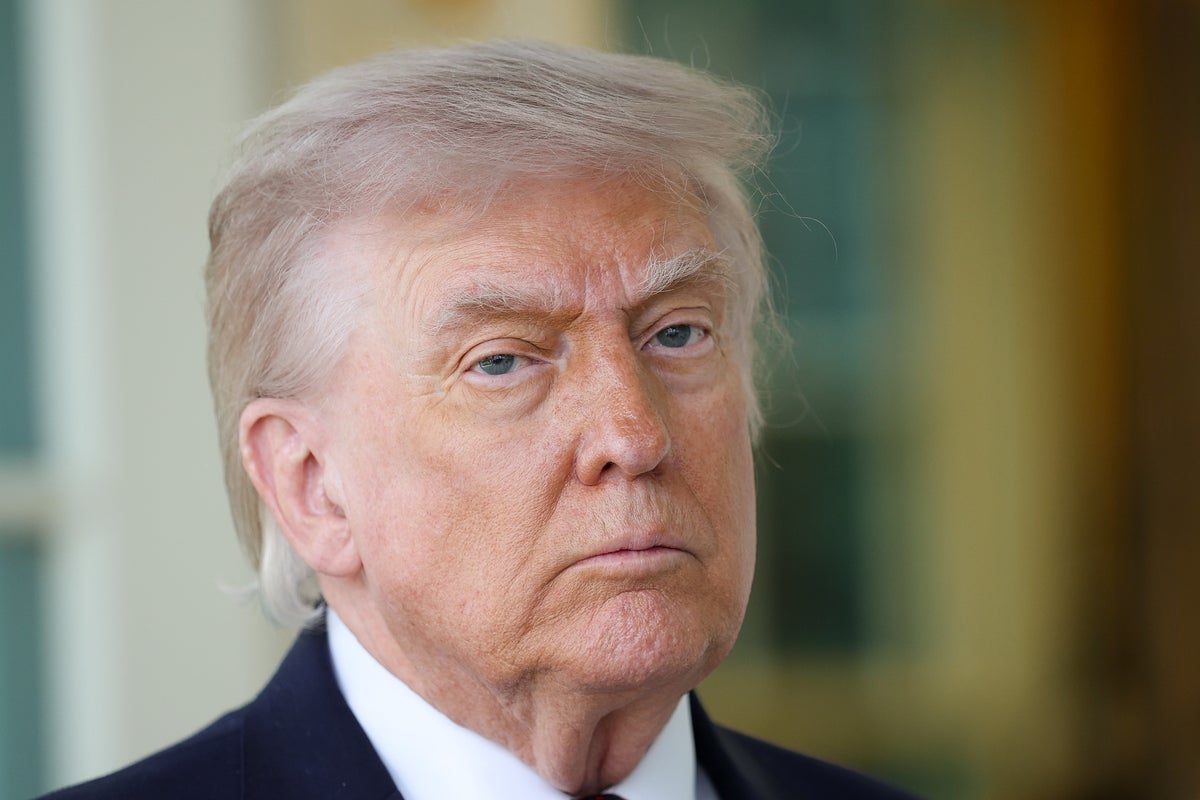
The screen glows with an unnatural light. It isn’t the soft flicker of a candle or the steady beam of a flashlight; it is the aggressive, hyper-real sheen of pixels arranged by an algorithm. In the image, a man stands tall, his features smoothed by artificial intelligence into something approaching the divine. He bears the likeness of a savior. This isn't just a campaign poster. It is a digital canonization.
When Donald Trump shared an AI-generated image of himself as a Christ-like figure, it wasn't a glitch in the news cycle. It was a calculated signal. Days later, he stood before a crowd and issued a warning that felt like a prophecy: without him, the world would be "torn to pieces."
We have moved beyond the era of simple policy debates. We are now living in a time of myth-making, where the tools of the future are being used to resurrect the icons of the past. To understand why this matters, we have to look past the political theater and into the machinery of belief itself.
The Architect of Chaos
Imagine a small-town voter—let’s call him Elias. Elias lives in a place where the main street is more plywood than glass. He feels the ground shifting under his feet every time he checks his bank balance or watches the evening news. For Elias, the world already feels like it’s being torn to pieces. The chaos isn't a threat; it’s his daily reality.
When a leader claims to be the only thing standing between order and total annihilation, he isn't talking to economists. He is talking to Elias’s nervous system. By positioning himself as a messianic figure, Trump creates a narrative where his presence is the literal glue of civilization. It’s a high-stakes psychological contract. If you believe the world is ending, you don’t look for a committee. You look for a miracle.
The use of AI to generate these images is a masterstroke of modern propaganda. AI doesn't just create pictures; it creates "perfect" versions of reality. It removes the wrinkles, the doubts, and the human frailties. It presents a version of a leader that is immune to time and criticism. It isn't a photo of a man. It’s a photo of an idea.
The Fragility of the Status Quo
The "torn to pieces" rhetoric relies on a specific type of fear. It suggests that the institutions we rely on—our banks, our courts, our international alliances—are not built on solid rock, but on a thin crust of glass. One wrong move, one different leader, and the whole thing shatters.
Is the world fragile? Yes. But there is a profound difference between acknowledging systemic risks and claiming to be the sole guardian of the gate.
Consider the mechanics of global stability. It’s a web of thousands of invisible threads: trade agreements, military treaties, and diplomatic backchannels. These threads are held by career civil servants, local officials, and international bodies. When a narrative focuses entirely on a single individual, those thousands of threads disappear from view. The complexity of the world is flattened into a single choice: the Savior or the Void.
This narrative strategy works because it simplifies the exhausting work of being a citizen. Instead of tracking inflation data or studying geopolitical shifts, the voter only needs to decide if they trust the man in the glowing picture. It transforms the messy, boring reality of governance into an epic struggle between light and darkness.
The Digital Resurrection
The AI-generated image of Trump as Jesus is a fascinating intersection of ancient religion and futuristic tech. For decades, political scientists have talked about the "civil religion" of America—the way we treat the Constitution like a holy text and our founders like prophets. Trump has taken this a step further by merging his personal brand with literal religious iconography.
The technology here is a force multiplier. In the past, creating a convincing painting or a high-quality manipulated photo took time and specialized skill. Now, anyone with a prompt can generate a hyper-realistic image of a political leader walking on water or healing the sick. This creates a "hallucination of consensus." When these images flood social media feeds, they begin to feel like a shared reality rather than a fringe fantasy.
For the person scrolling through their phone at 11:00 PM, the line between a meme and a message blurs. They see the image, they feel the emotional tug, and they move on. But the seed is planted. The idea that this person is more than a politician—that they are a cosmic necessity—takes root in the subconscious.
The Weight of the Word
Language has a physical weight. When a leader uses words like "torn to pieces," "carnage," and "destruction," they are performing a sort of linguistic demolition. They are clearing the space to build their own monument.
We see this pattern throughout history. When the future feels uncertain, the rhetoric becomes more certain. The more complex the problem, the simpler the promised solution. If the problem is the literal end of the world, then any action taken to prevent it becomes justifiable. This is the danger of the "torn to pieces" mindset: it creates a moral emergency where the normal rules no longer apply.
Think about the stakes for a moment. If you truly believed that your neighbor’s choice of leader would result in the destruction of your world, how would you treat that neighbor? You wouldn't see them as a fellow citizen with a different opinion. You would see them as an existential threat. This is how the rhetoric of the savior eventually creates the very chaos it claims to prevent.
The Human Cost of Certainty
The irony is that the most stable societies are not those held together by a single strongman, but those where power is distributed so widely that no one person is indispensable. True strength is boring. It looks like a functioning postal service, a fair court system, and a peaceful transition of power. It looks like the ability to disagree without fearing that the sky will fall.
But "boring" doesn't win the attention economy. A man in a suit talking about infrastructure doesn't go viral. A man portrayed as a deity promising to save the world from fire? That commands the screen.
We are currently in a race between our primitive tribal instincts and our high-tech capabilities. Our brains are still wired for the campfire, looking for the strongest warrior to protect us from the shadows. Meanwhile, our hands are holding devices that can fabricate those warriors out of thin air.
The AI picture isn't the problem. The words "torn to pieces" aren't the problem. The problem is our own willingness to trade the messy, beautiful reality of a shared democracy for the sterile, terrifying comfort of a digital myth.
Elias is still there, looking at his phone. He sees the image of the man who promises to hold the world together. He feels a moment of relief. But outside his window, the sun is setting on a town that needs more than a savior. It needs teachers, it needs doctors, and it needs a version of truth that doesn't require a filter.
The world is not a piece of paper that can be torn. It is a living, breathing collective of billions of people. It is resilient, stubborn, and profoundly complex. It has survived empires, plagues, and wars. It does not hang by a single thread, no matter how much the man behind the glowing screen wants us to believe it does.
The screen goes black. The room is quiet. The only thing left is the reflection of the person holding the phone, looking for a way forward in the dark.