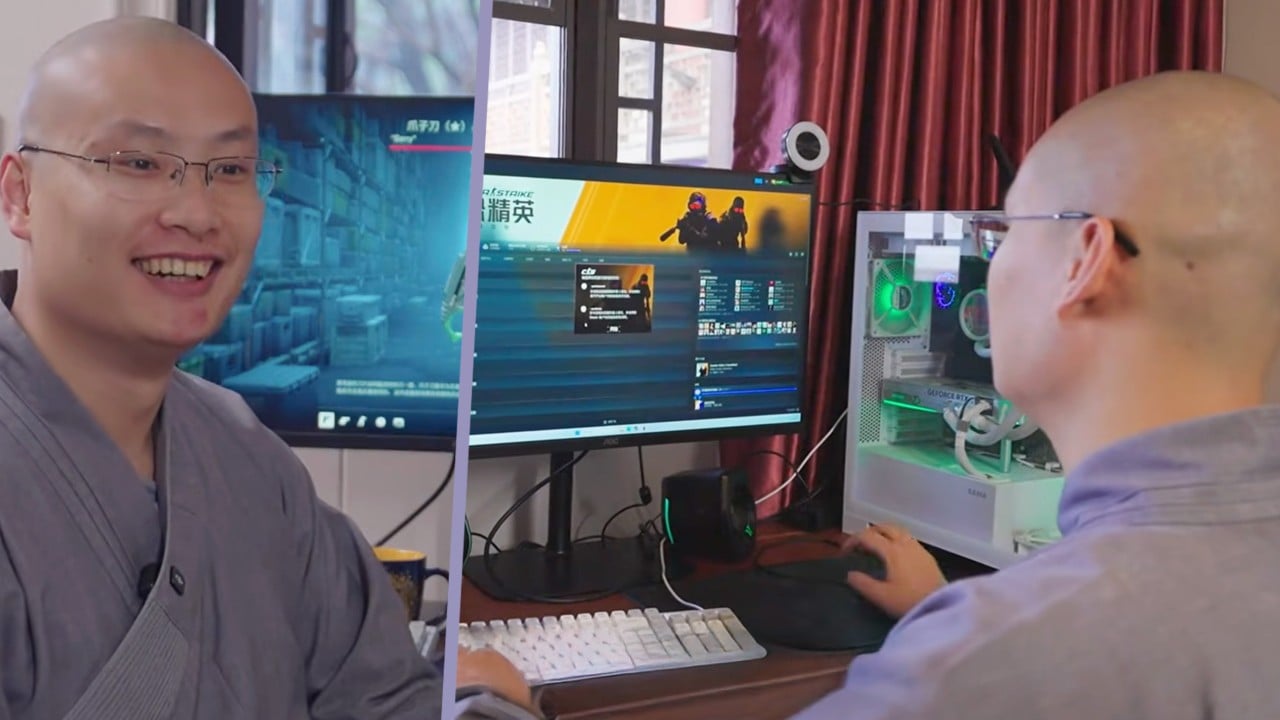
Buddhist monasteries in China are often viewed as the final holdouts against the frantic pace of modern consumerism. However, a growing number of monastics are trading silence for servers. Recent accounts of monks engaging with high-end video games have sparked a firestorm of debate across Chinese social media, forcing a collision between ancient asceticism and the world's largest gaming market. This is not about a few bored individuals killing time. It is a fundamental shift in how religious practitioners view the concept of "maya," or the illusion of reality, in an era where the most convincing illusions are rendered in 4K at 60 frames per second.
The controversy centers on the argument that gaming and religion serve identical psychological functions. Both offer a structured escape from the mundane. Both provide a sense of progression. Both require the mastery of complex systems. But for the traditionalists and the state regulators, this crossover is a bridge too far. They see it as a corruption of the cloth.
The Digital Sangha and the Illusion of Merit
At the heart of this movement is the idea that the virtual world is no more or less "fake" than the physical one. Traditional Buddhist thought suggests that our entire sensory experience is a construct. If the physical world is an illusion, then the digital world is simply an illusion within an illusion—a "nested maya."
Practitioners who defend their gaming habits argue that these platforms are modern tools for teaching focus and detachment. In a high-stakes competitive game, the player must maintain absolute composure under pressure. To lose one’s temper over a "game over" screen is to fail a spiritual test. It is a form of active meditation. However, the optics remain a nightmare for temple administrators. In a country where the government has spent years cracking down on gaming addiction among youth, seeing a shaven-headed monk in saffron robes discussing the nuances of a MOBA (Multiplayer Online Battle Arena) feels like a subversion of social order.
This isn't just about fun. It is about relevance. The modern Chinese monk is often highly educated, frequently holding degrees in engineering or computer science before taking their vows. They do not see a contradiction between their past lives and their spiritual goals. They see a continuum.
The Business of Belief and the Gamification of Grace
The intersection of faith and pixels also carries a heavy scent of pragmatism. Temples in China are not just spiritual centers; they are economic engines. Many have embraced "Smart Temple" initiatives, using facial recognition for entry and QR codes for donations.
When a monk speaks publicly about gaming, they are often reaching out to a demographic that has largely abandoned traditional organized religion. The Gen Z and Millennial cohorts in China are defined by "involution"—a state of intense, soul-crushing competition that leads to burnout. By framing gaming as a spiritual exercise, these monks are positioning Buddhism as a relatable solution to modern stress. They are meeting the youth where they live: on the screen.
The Dangers of Virtual Attachment
Critics argue that this logic is a slippery slope. The primary goal of monastic life is the cessation of craving. Video games, by their very design, are built to trigger craving. They use "loot boxes," "battle passes," and "daily login bonuses" to create a feedback loop of dopamine and desire.
- Variable Ratio Reinforcement: The same psychological mechanism that keeps gamblers at a slot machine keeps gamers chasing rare items.
- The Ego Trap: Rankings and leaderboards encourage a sense of "self" and superiority, which is the exact opposite of the Buddhist goal of "anatta" (non-self).
- Time Displacement: Hours spent grinding for virtual experience points are hours not spent in sutra study or communal labor.
To claim that gaming is "just another form of meditation" ignores the predatory architecture of modern software. A Zen garden does not try to sell you a seasonal skin for your rake. A meditation hall does not send you push notifications at 3:00 AM to remind you that your "spiritual energy" is full.
State Scrutiny and the Saffron Firewall
The Chinese government’s relationship with both religion and gaming is famously complicated. Under the current administration, "Sinicization" is the watchword. All religious practices must align with "socialist core values." Simultaneously, the state views gaming as "spiritual opium" for the masses, leading to strict curfews for minors and a freeze on new game approvals that lasted for months.
When these two monitored spheres overlap, it attracts the wrong kind of attention. A monk who promotes gaming could be seen as undermining the state's efforts to curb digital addiction. If a religious figure validates the "utility" of gaming, they are effectively countering a national public health narrative. This makes the "gaming monk" a political liability as much as a theological one.
We are seeing a tightening of the reigns. Temples that were once loose with their internal policies are now enforcing "digital fasts." The argument that gaming serves a life purpose similar to religion is being treated as a dangerous equivalence. One is a state-sanctioned path to moral improvement; the other is a commercial product that the state is actively trying to domesticate.
The Mechanical Reality of Modern Monasticism
To understand why this is happening now, we have to look at the daily life of a modern monk. It is not all mountain mists and incense. Many temples are located in the middle of dense urban centers. The "mountain" is now a skyscraper.
For a young man who has spent his entire life connected to the internet, the transition to a monastery is a form of sensory deprivation that can lead to psychological "bends." Gaming serves as a pressure valve. It allows for social interaction and mental stimulation that the rigid structure of a temple sometimes lacks.
But there is a darker side to this "reconstruction" of faith. If we redefine every hobby as a spiritual practice, the word "spiritual" loses all meaning. If gardening is meditation, and cooking is meditation, and playing Black Myth: Wukong is meditation, then meditation is simply "doing things I like." This leads to a consumerist version of faith where the practitioner never has to confront discomfort.
The Narrative of the "Cool Monk"
The media loves the trope of the "cool monk." Whether it’s a monk who DJs in Tokyo or one who plays games in Hangzhou, these stories go viral because they provide a sense of cognitive dissonance. They suggest that we can have our cake and eat it too—that we can enjoy the trappings of modern hedonism while maintaining a claim to ancient wisdom.
This narrative is a product. It is a way for temples to maintain their brand in a market where "traditional" is often synonymous with "obsolete." The veteran analyst knows that when a religious institution starts adopting the language of the entertainment industry, it is usually a sign of institutional anxiety, not spiritual evolution.
The Hard Logic of the Middle Way
The Middle Way is not about compromise; it is about the avoidance of extremes. The extreme of total digital immersion is clearly a violation of monastic vows. However, the extreme of total digital illiteracy is equally problematic in a society that is moving toward a fully digital infrastructure.
A monk who understands the mechanics of gaming is better equipped to counsel a parent whose child is lost in a virtual world. They can speak the language of the "addict" because they have walked through the same digital landscapes. There is a potential for a new kind of ministry here—one that doesn't dismiss gaming as "evil" but understands it as a complex psychological terrain that requires a specific kind of map.
The real danger is not the game itself, but the lack of intentionality. If a monk plays a game to observe the rising and falling of frustration, they are practicing. If they play because they are bored and want to see their level go up, they are just another consumer. The line between the two is invisible to the outside observer and often blurry to the monk himself.
The Inevitable Digital Schism
The tension between the "analog" elders and the "digital" youth in the sangha will eventually lead to a breaking point. We are likely to see the emergence of two distinct tracks within Chinese Buddhism.
One track will double down on traditionalism, banning all personal electronic devices and returning to a more rigorous, secluded form of practice. This will appeal to those seeking a total break from the modern world. The second track will be a "Techno-Buddhism" that fully integrates digital life into the path, potentially even creating virtual temples and AI-driven dharma talks.
This isn't a theory; it’s already happening in the fringes. The question is which version will receive the stamp of approval from the state and the support of the public.
The defense that gaming and religion serve similar purposes is a bold gamble. It attempts to elevate a pastime into a philosophy. But in the cold light of day, a game is a closed system with a predetermined outcome designed by a corporation for profit. Religion, at least in its purest form, is an open-ended inquiry into the nature of existence. Confusing the two may provide a temporary bridge to the youth, but it risks turning the temple into just another server room.
Temples must decide if they are centers of radical transformation or merely high-end wellness centers for the digitally exhausted. If the goal of the monastery is to wake people up, it cannot do so by plugging them into a different dream. The monk with the controller is either a pioneer of a new consciousness or the ultimate symptom of our inability to be alone with ourselves.
The state will eventually provide the final answer. In China, the "purpose" of any activity is ultimately defined by its contribution to social harmony. If gaming monks lead to a more compliant, less stressed population, they may be tolerated. If they are seen as a distraction from the "real work" of national rejuvenation, the consoles will be unplugged as quickly as they were installed.
Stop looking for the "zen" in the pixels and start looking at the power structures that want you to believe it’s there. The controller is not a mala. The screen is not a mandala. And a level-up is not an enlightenment.
The digital world is a tool, but for the monk, it is also a trap. The challenge for the modern practitioner is to navigate the game without becoming a player. In a world designed to keep you clicking, the most radical act is to stop.
Focus on the breath, not the frame rate.