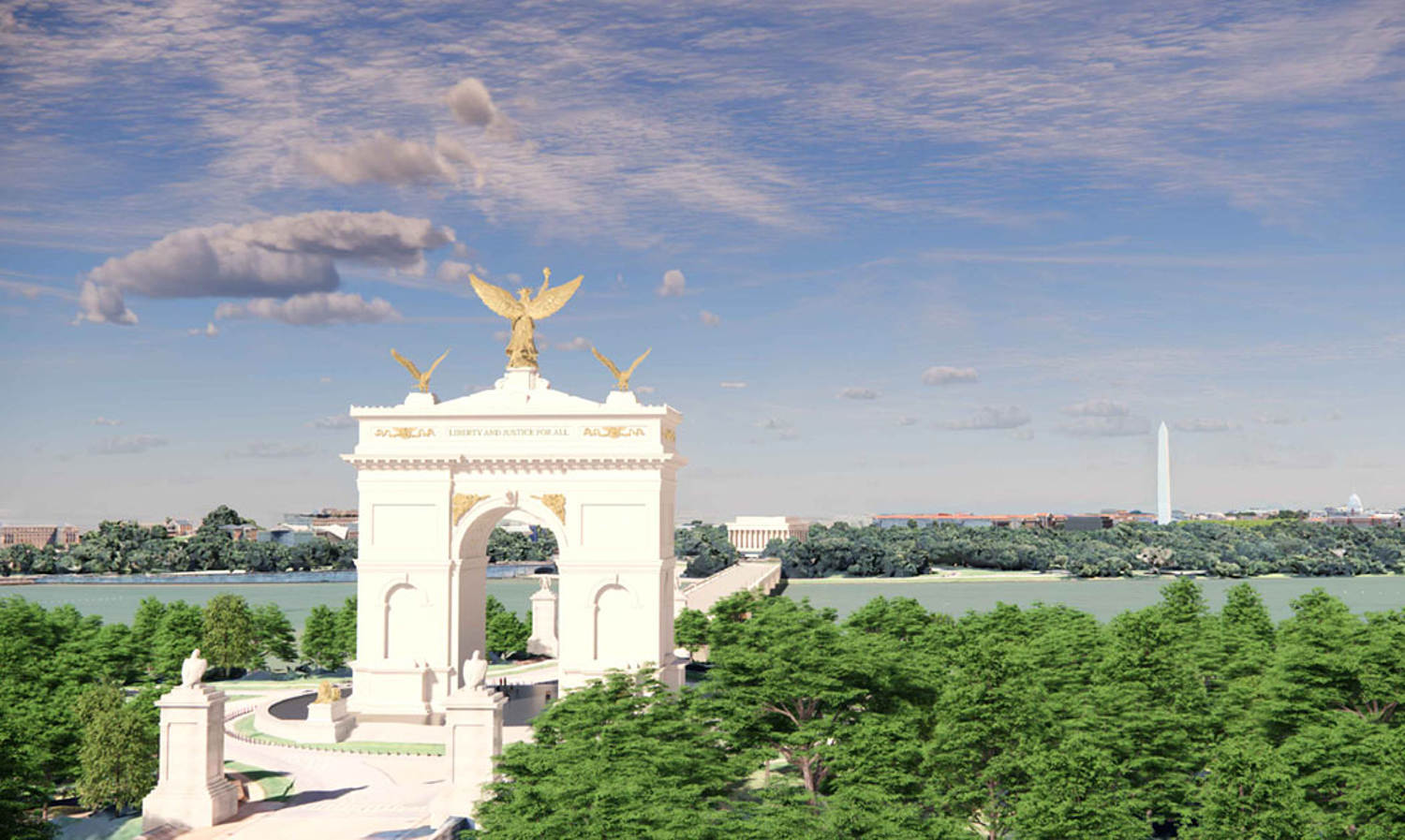
The proposed 250-foot "Trump Arch" in Washington, D.C., represents an unprecedented intersection of classical triumphalism and modern structural engineering that challenges existing height restrictions and the aesthetic equilibrium of the National Mall. To evaluate the feasibility and impact of this project, one must move beyond the surface-level aesthetics of the renderings and instead examine the structural load requirements, the disruption of the L'Enfant Plan's sightlines, and the legislative hurdles inherent in a city governed by the Height of Buildings Act of 1910.
Structural Geometry and the 250-Foot Threshold
The primary constraint on any significant vertical construction in the District of Columbia is the 1910 Height of Buildings Act. This federal law limits the height of buildings based on the width of the adjacent street. Generally, commercial buildings are capped at 130 feet, while sections of Pennsylvania Avenue allow for 160 feet. At 250 feet, the proposed arch would stand significantly taller than the surrounding skyline, second only to the Washington Monument (555 feet) and the Basilica of the National Shrine of the Immaculate Conception (329 feet).
The engineering profile of a 250-foot arch introduces specific technical variables:
- The Wind Load Coefficient: Because the structure is essentially a hollow aperture, it creates a venturi effect. Wind speeds accelerate as they pass through the opening, requiring lateral bracing that exceeds standard skyscraper requirements to prevent oscillation.
- Material Density and Foundation Pressure: A structure of this scale, likely utilizing white marble or reinforced concrete with stone cladding, exerts massive downward pressure. The swampy soil conditions of the National Mall area (primarily Potomac Group clay) would necessitate deep-pile foundations reaching bedrock to prevent the settling issues currently plaguing the Jefferson Memorial.
- The Aspect Ratio: An arch with a 250-foot apex requires a proportional width to maintain structural integrity. This footprint consumes significant horizontal acreage, necessitating the displacement of existing parkland or transit infrastructure.
Urban Integration and the L’Enfant Framework
Washington D.C.’s layout is not accidental; it is a rigid grid overlaid with diagonal avenues designed by Pierre L’Enfant to preserve specific vistas between the Capitol and the White House. The introduction of a 250-foot arch acts as a visual block.
The disruption occurs in three distinct layers:
The Reciprocal Vista
The L’Enfant plan relies on "reciprocal vistas," where one monument is visible from the base of another. A 250-foot structure placed within the central core would likely sever the visual link between the Lincoln Memorial and the Washington Monument, or the Capitol and the White House, depending on its exact GPS coordinates. This is not merely an aesthetic concern but a violation of the "Commemorative Works Act," which governs how new structures are integrated into the historical fabric.
Volumetric Density
Current renderings suggest a massive, solid-state presence. In urban planning terms, this creates a "shadow cast" that affects the microclimate of the surrounding area. A 250-foot solid mass creates a wind tunnel at the base level, potentially making the surrounding pedestrian plazas unusable during winter months.
Symbolic Hierarchy
The Washington Monument remains the tallest structure in the city by design, symbolizing the primacy of the founding. Placing a 250-foot arch—nearly half the height of the Monument—recalibrates the symbolic hierarchy of the National Mall. It shifts the focus from a singular vertical obelisk to a dual-axis focal point, fundamentally altering the "sacred space" of American civic architecture.
The Legislative Bottleneck and Federal Oversight
Project execution is not a matter of executive decree but a multi-agency gauntlet. The path to realization for a project of this magnitude involves three primary veto points:
- The Commission of Fine Arts (CFA): This body reviews the design of all "public works" in D.C. They historically reject designs that appear "out of scale" or "historically dissonant."
- The National Capital Planning Commission (NCPC): The NCPC evaluates the project’s impact on federal interests, specifically focusing on security perimeters and transit flow. A 250-foot arch creates a high-vantage point that would likely be flagged as a security risk for the surrounding federal buildings.
- Congressional Authorization: Because the National Mall is federal land, any permanent structure requires an Act of Congress. Given the current political polarization, the legislative path for a monument of this scale is statistically improbable without a supermajority or a significant rider in a must-pass spending bill.
Economic and Maintenance Modeling
The cost of a 250-foot marble-clad arch is not merely in the construction but in the lifecycle maintenance.
- Capital Expenditure (CapEx): Based on the costs of the Gateway Arch in St. Louis (adjusted for inflation) and the recent renovations of the Washington Monument, the initial build would exceed $500 million. This includes the high cost of sourcing premium-grade stone that matches the existing D.C. palette.
- Operational Expenditure (OpEx): Massive stone structures in the D.C. climate are subject to "spalling" due to the freeze-thaw cycle. A 250-foot arch requires a specialized vertical maintenance team and constant laser-scanning to monitor structural shifts in the silt-heavy soil.
Strategic Forecast
If the project proceeds, it will likely be forced into a "scale-down" phase. To pass the Commission of Fine Arts, the height would realistically need to be reduced to approximately 110–130 feet to align with the existing cornice lines of the Federal Triangle. This reduction would mitigate the foundation issues and the wind-load variables, making the project an engineering reality rather than a conceptual provocation.
The most viable path forward for the proponents of the Arch is to seek a location outside the primary "Historic Core" of the National Mall. Moving the site toward the Anacostia waterfront or the North Capitol street corridor would bypass the most stringent height restrictions and sightline protections, though it would diminish the intended symbolic impact of being "at the center" of the capital.
The final strategic move for any entity backing this project is to pivot from a "monumental" classification to a "functional" classification. By incorporating a museum or observation deck within the legs of the arch, the project could potentially tap into different funding streams and zoning categories, though it would still face the insurmountable wall of the 1910 Height Act. Without a federal exemption, the 250-foot Trump Arch remains a mathematical impossibility in the current D.C. legislative environment.



