The loudest place in the world is the baseline of Court Philippe-Chatrier during a semifinal match. It is not just the roar of fifteen thousand people, though that is deafening. It is the sound of slide. The violent, scraping friction of premium tennis shoes dragging against crushed brick. It sounds like tearing canvas.
Every player who stands there looks like a gladiator, but if you look closer, past the sponsors' logos and the pristine wristbands, you see the real geography of a human being.
Sports journalism loves a vacuum. It loves to pluck an athlete out of mid-air, slap a label on them—"Cinderella story," "Qualifier," "Underdog"—and pretend they didn't exist before Monday morning of the first week. They treat a grand run at a major tournament like a lottery ticket that happened to cash. But luck does not survive five sets in the Parisian heat.
Look at the left wrist. Just above the joint, partially obscured by a sweatband that is grey with sweat and clay dust. It is a tiny, ink-black marking. No larger than a coin. In the grand broadcast angles, it disappears entirely. But when the camera zooms in for the high-tension changeover, there it is.
A permanent scar chosen on purpose.
To understand the weight of that ink, you have to understand the sheer, crushing monotony of the tennis carousel. People see the lights. They see the trophy presentation. They do not see the hotel room in a third-tier city where the carpet smells like stale cleaner and the television only plays local news you cannot understand. They do not see the flight booked at 2:00 AM because losing in the first round means you cannot afford to stay another night.
Tennis is an isolation chamber disguised as a sport. You cannot coach from the boxes in the moments that matter. You cannot substitute out when your shoulder feels like it is being bored into with a rusty bit. It is just you, a yellow ball, and the voice in your head that has been lying to you since you were seven years old.
The voice always says the same thing: You are not supposed to be here.
The tattoo was not a celebration of victory. It was an anchor dropped in the middle of a storm that happened years before this tournament ever began.
Imagine sitting in a training facility during a November winter. The sky is the color of wet asphalt. Your knee throbbing from a micro-tear that doesn't warrant surgery but makes every lateral step feel like stepping on broken glass. The ranking has slipped. You are no longer in the main draw of the majors. You are playing the Challengers, where the prize money barely covers the stringing bill.
That is where careers die. Not on television. They die in the quiet realization that the dream has outgrown the talent.
The ink was a refusal to look at the scoreboard. It is a specific phrase, or perhaps a symbol—the exact nature matters less than the function it serves. It represents a contract signed with the self. It says, The outcome is a lie. The process is the only truth.
When you are facing three break points against a top-ten player who moves like silk and hits like a truck, the human brain panics. It enters survival mode. It looks for an exit. The crowd is against you because they want the favorite to advance to the final Sunday. The umpire feels like an executioner.
In that exact millisecond, before bouncing the ball for the second serve, the eyes drop.
They don't look at the coach. They don't look at the opponent's positioning. They look at the wrist.
The visual cue breaks the panic loop. It is a physical reset button. One breath. The smell of the clay. The weight of the racket in the hand. The reminder that three years ago, playing in front of twenty people in a wind-swept town outside of Prague, the stakes felt exactly this high and the survival was just as sweet.
The match turns not on a tactical masterstroke, but on the refusal to break.
The favorite misses a forehand wide. Then a double fault. The momentum shifts, not like a wave, but like a heavy iron gate slowly swinging on rusted hinges. The crowd notices. The murmurs begin. The commentators scramble for their notes, looking up the statistics of a player they hadn't bothered to research two weeks ago. They look for patterns in the data, counting first-serve percentages and unforced errors.
They are measuring the shadow while ignoring the object that casts it.
The run to the final is called a shock by the people who buy tickets, but for the person on the court, it feels more like an eviction notice served to doubt. Every round passed is another room cleared of ghosts. The tiny tattoo stays damp under the band, a hidden engine driving a machine that everyone else thought ran on luck.
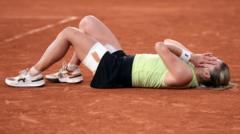
The sun begins to dip behind the upper tiers of the stadium, casting long, dramatic shadows across the red surface. The match is over. The racket is on the ground, and the clay is on the white shirt, a badge of honor earned through friction.
During the on-court interview, the microphone is held up, and the standard questions flow. How did you do it? What does this mean to you?
The answers given are polite, standard, and entirely inadequate. The player smiles, thanks the crowd, and glances down at their left arm, where the real explanation remains written in skin.