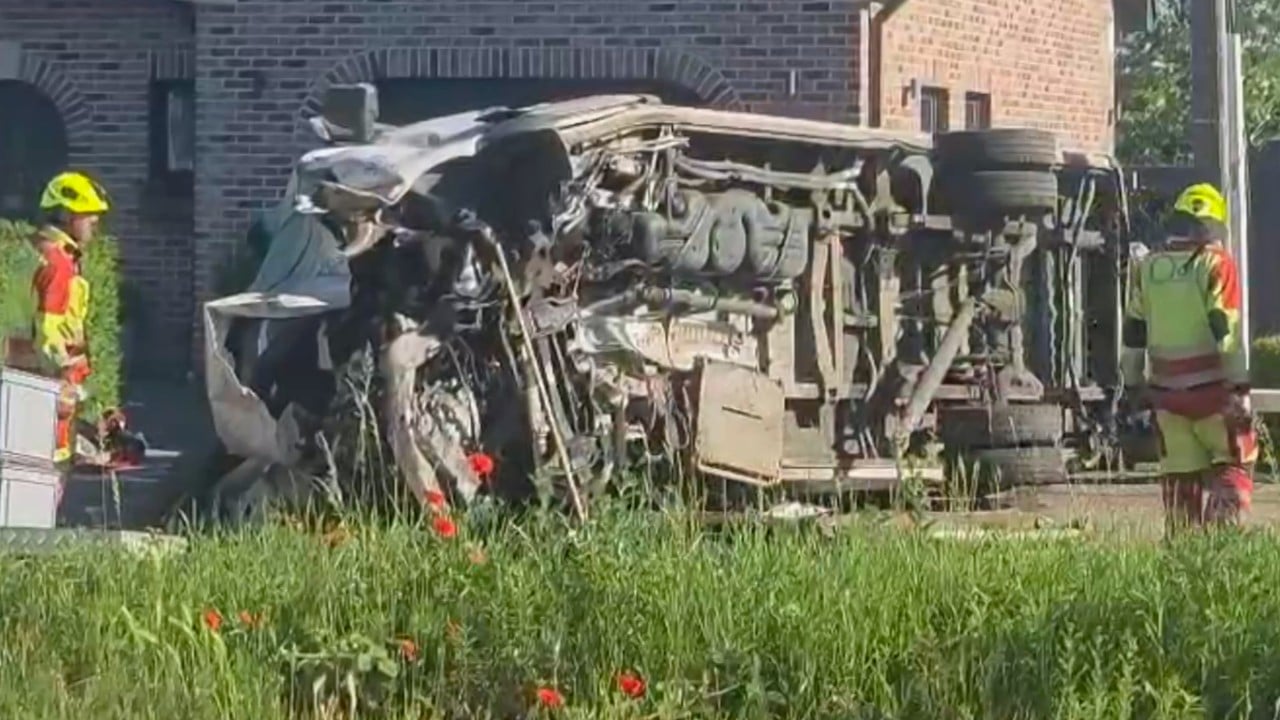
The collision between a 120 km/h passenger train and a specialized education school minibus at a level crossing in Buggenhout, Belgium, demonstrates the stark physical limitations of active grade-crossing protection systems when driver compliance fails. Early reporting framed the incident—which resulted in four fatalities, including two children aged 12 and 15, the 49-year-old driver, and a 27-year-old chaperone—through the lens of emotional tragedy. However, a structural analysis reveals that the catastrophe is an execution failure at the interface of human behavior and kinetic infrastructure.
To evaluate how a fully functional, active warning system failed to prevent a catastrophic breach, we must isolate the variable mechanics of the incident. These span braking physics, level-crossing topology, and the systemic challenges inherent to Europe's densest rail networks.
The Kinetic Imperative: Braking Mechanics and Braking Distance
The fundamental error in public perception of rail accidents is the assumption that train operators possess the agency to avoid an obstacle upon visual confirmation. The collision occurred at approximately 08:08 AM as an SNCB passenger train, en route from Bruges to Buggenhout carrying roughly 100 passengers, approached a station located one kilometer ahead.
According to Infrabel, the national rail infrastructure manager, the train was traveling at its line speed of approximately 120 km/h ($33.3\text{ m/s}$) when the minibus entered the crossing. The physics of rail-on-wheel friction dictates an exceptionally low coefficient of friction ($\mu$), typically ranging between 0.15 and 0.20 under standard atmospheric conditions, dropping lower in wet or contaminated track scenarios.
The deceleration equation governing emergency braking applications is expressed as:
$$d = \frac{v^2}{2g\mu}$$
Where:
- $d$ is the emergency stopping distance in meters
- $v$ is the velocity ($33.3\text{ m/s}$)
- $g$ is the acceleration due to gravity ($9.81\text{ m/s}^2$)
- $\mu$ is the adhesion coefficient
Assuming an optimal adhesion coefficient of 0.15, the absolute theoretical minimum stopping distance required for this passenger train to come to a complete halt exceeds 370 meters. This calculation completely excludes the train driver's perception-reaction time and the pneumatic propagation delay of the air brake system, which adds an extra 2 to 3 seconds ($66\text{ to }100\text{ meters}$) to the total stopping distance.
Because the train driver applied emergency brakes only upon gaining visual line-of-sight of the obstruction—well within this 470-meter critical threshold—the impact was physically inevitable. The kinetic energy dissipated during the collision, calculated via $E_k = \frac{1}{2}mv^2$, was transferred entirely into the 49-year-old driver’s white minivan, catapulting the vehicle into the driveway of an adjacent residence and crushing its frontal profile. The train mass, rendering it relatively unscathed, experienced negligible deceleration from the impact itself.
Systemic Validation: The Functionality of Active Grade Crossings
The public prosecutor’s office of East Flanders and Infrabel confirmed via security camera footage that the level-crossing infrastructure at Vierhuizen operated exactly as designed. The system deployed a standard active protection sequence:
- Activation Trigger: The approaching train crossed an electronic track circuit or axle counter at a predetermined distance, completing a circuit that initiated the warning sequence.
- Visual and Auditory Signaled Warnings: Flashing red lights and acoustic alarms engaged to alert road users.
- Physical Barrier Deployment: Mechanical half-barriers descended to close off the oncoming traffic lane, providing a physical deterrent while leaving the exit lane open to prevent vehicles from becoming trapped on the tracks.
Federal Police reports state that the minibus ploughed through the descended barrier while the red lights remained active. This acts as a clear indicator of a human-factor failure mode rather than a technical malfunction.
The vehicle remained in motion when the impact occurred. This negates the hypothesis of a mechanical breakdown or stalling on the tracks, shifting the analytical focus to driver error, cognitive distraction, or acute medical incapacitation.
Network Topology and Risk Distribution
Belgium features one of the oldest and most geographically dense rail networks in the world. This high density introduces structural risks. The relationship between network density and level-crossing incidents can be categorized into three distinct operational pressures.
The Intersector Intersection Challenge
The proximity of rail corridors to dense residential and agricultural zones in Flanders means that road and rail traffic cross paths frequently. Every single grade crossing represents a permanent vulnerability in the network's safety perimeter.
Traffic Density and Exposure Windows
With high frequencies of both passenger and freight transport, the total time that barriers remain closed daily increases. This prolonged closure creates a psychological bottleneck for road users, increasing the likelihood of risk-taking behaviors like driving around or through lowered gates.
Mixed-Use Vulnerabilities
The Buggenhout incident involved a vehicle transporting children to a special educational needs school. Vehicles carrying vulnerable populations require longer clearance times at grade crossings due to non-standard dimensions, specific acceleration curves, or onboard operational requirements. This increases their exposure window within the danger zone.
Infrabel’s annual reports reveal a steady contraction of this risk profile through targeted capital expenditure. In 2024, the network recorded 30 level-crossing accidents resulting in five fatalities and nine serious injuries. This represents a historic low compared to the historical baseline of 45 to 50 annual accidents documented between 2008 and 2021.
This reduction is due to a long-term engineering program aimed at eliminating grade crossings entirely. Over the past 21 years, Infrabel dismantled 450 level crossings, replacing them with underpasses, overpasses, or adjacent connecting roads. However, approximately 1,600 crossings remain active across the network, representing an ongoing safety challenge.
Strategic Mitigation Engineering
The investigation by the public prosecutor and forensic experts will establish the exact human factors that led to this breach. However, relying solely on driver compliance is an insufficient long-term safety strategy. To systematically eliminate the risk of vehicles entering active rail paths, infrastructure networks must move beyond passive and standard active warnings toward automated, zero-trust enforcement mechanisms.
The first operational limitation of current systems is the half-barrier configuration. While designed to prevent vehicles from being trapped on the tracks, it leaves an open path for drivers to maneuver around the gates.
Upgrading high-risk crossings to full-barrier installations, supported by inductive loop vehicle detection or AI-driven computer vision systems, would prevent vehicles from entering the tracks while automatically alerting oncoming trains if the zone is blocked.
The second limitation is the lack of real-time communication between crossing infrastructure and the vehicle itself. Integrating level-crossing status data with GPS routing apps and vehicle-to-infrastructure (V2I) communication networks would allow heavy transport and school buses to receive early audio-visual warnings long before they reach the crossing perimeter.
Ultimately, the only definitive solution to grade-crossing accidents is complete physical separation. Rail operators and regional governments must accelerate their capital deployment schedules to prioritize replacing remaining crossings with grade-separated infrastructure. This is especially critical on lines where train speeds reach 120 km/h or higher, entirely removing human error from the rail safety equation.