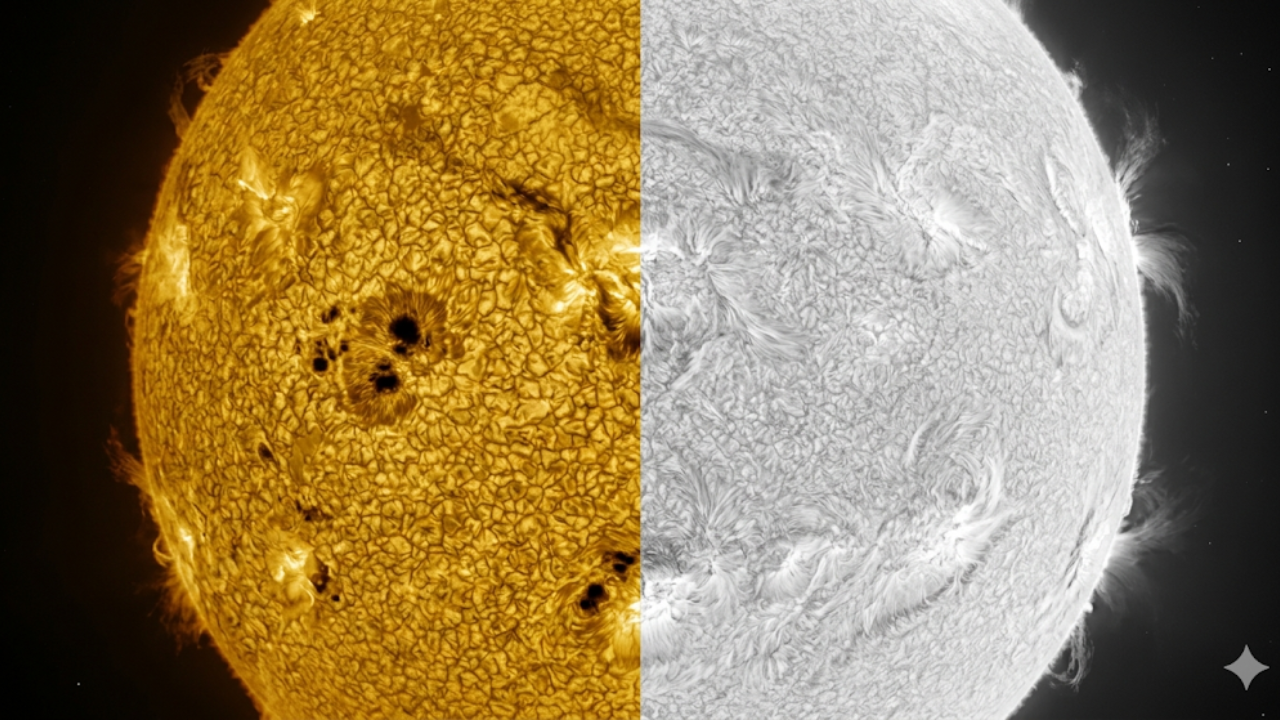
The common perception that the Sun is a yellow orb is a fundamental misinterpretation of astrophysical data caused by a planetary-scale filtering mechanism. In interstellar space, the Sun operates as a white light source, radiating energy across a broad, continuous spectrum. The transition from its true space-based profile to its perceived terrestrial profile is governed by two fixed physical phenomena: the blackbody radiation profile of a G-type main-sequence star and the selective wavelength scattering of the Earth's atmosphere.
Understanding this variance requires moving past superficial descriptions and analyzing the precise mechanics of fluid dynamics, optics, and human sensory architecture. Recently making waves in related news: The Theft of the Unseen Hour.
The Blackbody Emission Profile of the Solar Core
To analyze why the Sun appears white in its native environment, one must first quantify its output using Planck's Law. The Sun functions as a near-perfect blackbody radiator with an effective surface temperature of approximately 5,778 Kelvin ($5505^\circ\text{C}$).
Planck's Law dictates the spectral radiance of electromagnetic radiation at all wavelengths emitted by a blackbody at a given temperature. When plotted, the solar emission curve spans from ultraviolet through the visible spectrum and into the infrared. More information regarding the matter are detailed by Engadget.
$$B_\lambda(\lambda, T) = \frac{2hc^2}{\lambda^5} \frac{1}{e^{\frac{hc}{\lambda k_B T}} - 1}$$
Wein's Displacement Law identifies the peak wavelength of this emission curve. By dividing Wien's displacement constant ($b \approx 2.897 \times 10^{-3} \text{ m K}$) by the solar temperature (5,778 K), the peak emission is calculated to be approximately 502 nanometers.
$$\lambda_{\text{max}} = \frac{b}{T}$$
This peak falls squarely within the green-blue region of the visible light spectrum. However, human eyes do not perceive the Sun as green because the peak is not an isolated spike; it is the crest of a broad, continuous curve. The Sun simultaneously emits massive quantities of lower-energy red photons and higher-energy violet photons. When the human visual cortex processes this entire distribution across the visible spectrum (380 to 750 nanometers), the simultaneous stimulation of all three cone cell types results in the perception of pure white light.
The Terrestrial Filtering Mechanism: Rayleigh Scattering
The transformation of this broad-spectrum white light into a yellow terrestrial variant occurs when the solar wavefront encounters the Earth's atmosphere. This fluid boundary layer acts as a wavelength-dependent filter through a process known as Rayleigh scattering.
Rayleigh scattering applies when light interacts with particles significantly smaller than the wavelength of the radiation itself—primarily nitrogen ($N_2$) and oxygen ($O_2$) molecules in the upper atmosphere. The efficiency of this scattering is inversely proportional to the fourth power of the wavelength.
$$I = I_0 \frac{8\pi^4 \alpha^2}{\lambda^4 R^2} (1 + \cos^2\theta)$$
Because the denominator is $\lambda^4$, shorter wavelengths are scattered with extreme efficiency compared to longer wavelengths:
- Violet light (
400 nm) scatters roughly 9.3 times more efficiently than red light (700 nm). - Blue light (~450 nm) scatters roughly 5.8 times more efficiently than red light.
As sunlight penetrates the atmosphere, the blue, violet, and green wavelengths are deflected repeatedly by air molecules, diffusing across the sky. This isotropic redirection is why the sky appears blue.
The direct solar beam—the photons traveling on a straight path from the Sun to an observer's eye—is depleted of these shorter, bluer wavelengths. By subtracting blue and violet from the original white mixture, the remaining direct spectrum shifts toward the longer-wavelength end of the scale, favoring yellow, orange, and red.
The Mathematical Variable: Optical Depth and Air Mass
The intensity of this color shift is not static; it is a function of the optical depth of the atmosphere, quantified by the Air Mass (AM) coefficient. The path length that light must travel through the atmospheric column varies based on the solar zenith angle ($\theta_z$).
$$\text{AM} \approx \frac{1}{\cos(\theta_z)}$$
When the Sun is directly overhead at the zenith, the light travels through the minimum amount of atmospheric material, designated as AM1. At this trajectory, attenuation is minimal, and the Sun appears very close to its true white color, with only a slight tint of yellow.
As the planet rotates and the Sun approaches the horizon, the zenith angle increases sharply. At sunset or sunrise, the solar beam travels obliquely through the atmosphere, forcing it to pass through up to 38 times the amount of air mass compared to the vertical path (AM38).
This extreme path length creates a compounding bottleneck for short wavelengths. Blue and green photons are completely scattered out of the direct line of sight. The surviving beam consists almost entirely of the longest wavelengths: orange and deep red. The human eye witnesses this progression not as a change in the Sun itself, but as a dynamic shift in the atmospheric transmission efficiency.
Human Visual Architecture and Trichromatic Processing
The final layer of this system is the biological sensor array: the human retina. Humans possess trichromatic vision, driven by three distinct types of photosensitive cone cells, each tuned to a specific, overlapping band of the electromagnetic spectrum:
- S-Cones (Short wavelength): Peak sensitivity around 420–440 nm (Blue).
- M-Cones (Medium wavelength): Peak sensitivity around 534–545 nm (Green).
- L-Cones (Long wavelength): Peak sensitivity around 564–580 nm (Red).
When space-based solar radiation hits the retina, it saturates all three cone types equally. The brain translates this uniform, high-intensity activation across the entire visible band as white.
When observing the Sun from Earth, the Rayleigh-induced deficit in the blue-violet range skews the input data. The S-cones receive significantly fewer photons relative to the M and L cones. The brain integrates this asymmetrical signal—high L-cone activation, moderate M-cone activation, and depressed S-cone activation—and constructs the psychological perception of yellow.
A critical limitation in human sensory hardware is its inability to detect absolute spectral composition without context. The human visual system relies heavily on chromatic adaptation, constantly adjusting its white balance based on ambient light. Because the blue sky surrounds us, our visual cortex establishes the scattered blue light as the background reference frame, further enhancing the perceived yellowness of the direct solar disk by contrast.
Astronomical Classifications vs. Physical Reality
A common point of confusion stems from professional astronomical nomenclature. Morgan-Keenan (MK) stellar classification catalogs the Sun as a G2V star.
- G denotes a star with a surface temperature between 5,300 K and 6,000 K, historically termed a "yellow dwarf."
- 2 indicates the Sun is on a decimal scale of 0 to 9 within that temperature class, placing it closer to the hotter F-type stars than the cooler K-type stars.
- V signifies that it is a main-sequence star generating energy via hydrogen fusion in its core.
The term "yellow dwarf" is an archaic taxonomic convention, not an empirical description of the star’s radiation profile. It was coined by comparing G-type stars to hotter blue-white stars (O, B, A types) and cooler red stars (M types) through early, low-resolution ground-based telescopes that suffered from the same atmospheric distortion detailed above. In contemporary astrophysics, the label remains as a legacy classification system, while satellite instrumentation confirms the star's actual emission profile is a clean, un-scattered white.
Operational Impacts on Space Exploration and Sensor Calibration
The variance between space-based solar white and terrestrial solar yellow is not merely academic; it dictates the design specifications of modern technology. Space agencies and aerospace manufacturers cannot rely on ground-based lighting models when developing orbital infrastructure.
Photovoltaic solar panels deployed on the International Space Station or deep-space probes encounter the unmitigated AM0 spectrum (zero atmosphere). These panels must be engineered to capture the high-energy blue and ultraviolet photons that never reach the surface of the Earth. Ground-based solar arrays, conversely, are optimized for the AM1.5 spectrum, which matches the average light distribution of the contiguous United States, biased heavily toward the yellow-green and red regions.
Imaging sensors on space telescopes like James Webb or Hubble face a similar calibration challenge. Without an atmospheric reference point, digital sensors must utilize absolute radiometric calibration to prevent images from washing out under the intense, balanced blast of full-spectrum solar white. Every digital rendering of space must account for this shift, translating raw, unfiltered stellar data into formats compatible with human eyes that evolved under a protective, blue-scattering sky.
To model this transition systematically, engineers utilize the standard ASTM E490 solar spectral irradiance curves. The data shows a sharp drop in irradiance below 450 nm for terrestrial measurements compared to space-borne data, providing concrete mathematical proof of the atmospheric filter.
[Space / AM0 Spectrum] ---> All Wavelengths Equal ---> True White Visual Profile
                                 |
                     [Earth Atmosphere Layer]
                     Rayleigh Scattering: Short Wavelengths (400-480nm) Deflected
                                 |
[Surface / AM1 Spectrum] --> Blue Deficit / Red-Green Dominance --> Perceived Yellow
The design of any system interacting with solar energy must treat the Earth's atmosphere as a variable optical component. Operators and engineers must calculate the exact solar zenith angle, local atmospheric pressure, and aerosol density to predict the precise spectral composition hitting a sensor at any given moment on the planet's surface.