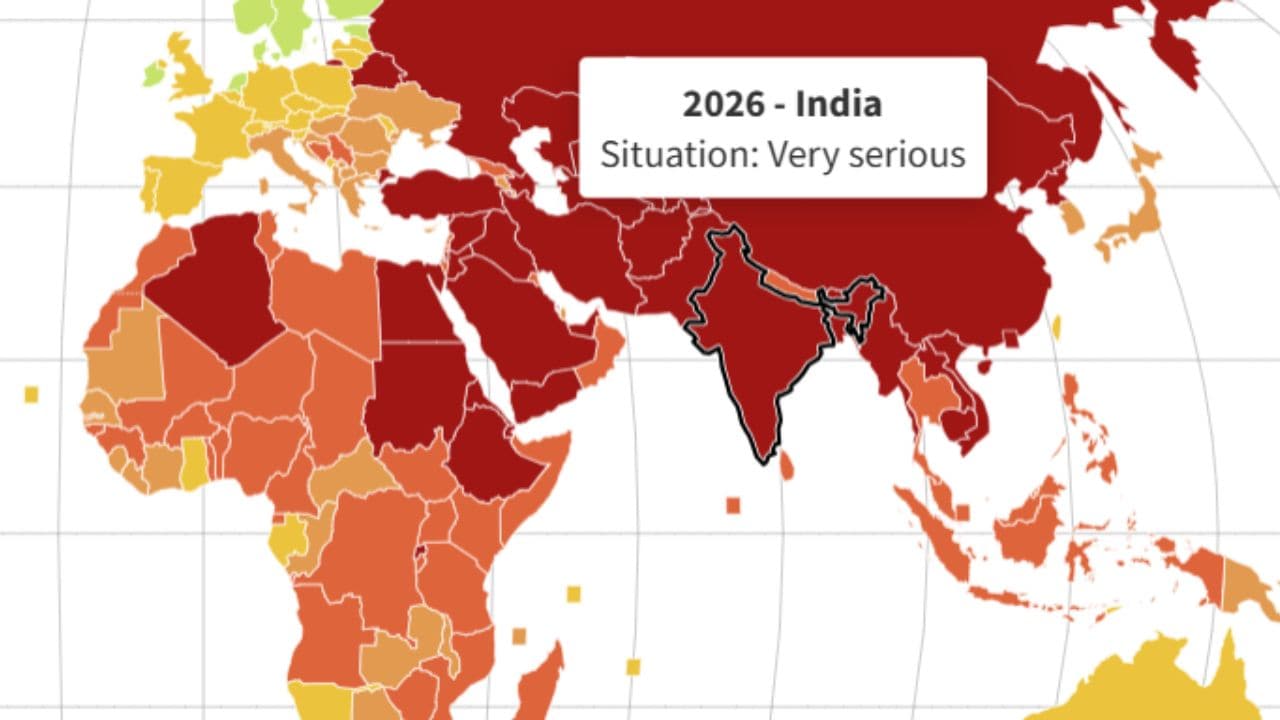
Ranking nations by "freedom" sounds noble. It makes for great headlines. It feeds the craving for a simple moral hierarchy. But when Organizations like Reporters Without Borders (RSF) release their annual World Press Freedom Index, they aren't providing a scientific measurement. They are publishing a subjective perception survey wrapped in the authority of data science.
The standard narrative is simple: India is "free-falling," the media is "shackled," and the world is becoming a dark place for truth. This is the lazy consensus. It ignores the structural flaws of the index itself and the reality of how information actually flows in a digital-first, multi-polar world. If you want the truth about press freedom, stop looking at a spreadsheet designed in Paris and start looking at the incentives of the people filling out the forms.
The Methodology Is a Black Box
Most people assume the Press Freedom Index is based on hard, objective metrics—things like the number of journalists jailed or the number of defamation suits filed. While those are factors, they are weighted against a qualitative questionnaire sent to "experts."
Who are these experts? RSF keeps the list secret. We don't know their biases, their funding sources, or their specific political leanings. We are essentially being told to "trust the process" while the process remains hidden behind a curtain. When you rely on subjective surveys, you don't measure freedom; you measure the vibe of a specific circle of academics and activists.
In many cases, the index rewards stability over transparency. A small, homogenous country with a quiet, state-aligned media might rank higher than a massive, chaotic democracy where thousands of digital outlets are screaming at each other. The noise of a healthy, aggressive democracy is often mistaken for the "instability" of a failing one.
The India Paradox
India usually finds itself ranked below nations that lack even a fraction of its vibrant, albeit chaotic, media ecosystem. According to the index, India has previously trailed behind countries where the state owns every printing press and monitors every IP address.
I’ve seen how these narratives are constructed. In global consulting, we call this "expectation bias." If the global narrative is that a country is backsliding, every minor local regulatory tweak is reported as a systemic crackdown. Meanwhile, massive structural censorship in "favored" nations is overlooked as "administrative necessity."
India has over 100,000 registered publications. It has hundreds of 24-hour news channels. It has a digital news scene so fragmented and fierce that no single entity can control the narrative. Does the government try to influence the press? Yes. Every government does. From the UK’s D-Notices to the US government’s quiet "requests" to social media giants, the struggle between state power and the Fourth Estate is universal. Ranking India at the bottom suggests a total lack of perspective on what actual, monolithic state control looks like.
Quantifying the Unquantifiable
You cannot measure "freedom" with a single number. It is a logical fallacy.
Imagine a scenario where Country A has no jailed journalists but every journalist is on the government payroll. Now imagine Country B has five journalists in legal battles for defamation but has 5,000 independent YouTubers calling the Prime Minister a liar every single day. The RSF index often favors Country A because its "legal framework" looks cleaner on paper.
This is the "Stability Trap." The index prioritizes the safety of the institution over the efficacy of the information. In the modern era, the real threat to truth isn't just a government with a stick; it’s the lack of an economic model for independent journalism. By focusing almost entirely on political pressure, these indices ignore the fact that the greatest censor in 2026 is the algorithm and the bankruptcy court.
The Colonial Gaze of Global Rankings
There is an undeniable Eurocentric bias in how these metrics are weighted. The "ideal" press environment is modeled after a very specific, mid-20th-century Western European ideal. This model assumes a polite, centralized media that acts as a gatekeeper.
Global South nations don't fit this mold. Their media is often partisan, loud, and deeply integrated into social movements. To a researcher in an office in Brussels, this looks like "unprofessionalism" or "polarization." To a citizen on the ground, it’s the sound of a thousand different interests finally getting a seat at the table.
We need to stop treating these rankings as gospel. They are advocacy tools, not scientific papers. They are designed to exert pressure, not to provide an accurate diagnosis. When we obsess over whether India moved from 140 to 150, we are playing a game where the rules were written by people who don't understand the local context.
The Rise of the Sovereign Narrative
The real story isn't the "free fall" of an index; it’s the death of the global information monopoly. For decades, a few Western outlets and NGOs decided what was "true" and who was "free." That era is over.
Nations are now pushing back against these metrics because they realize the metrics are often used as soft-power weapons. If a country wants to attract foreign investment, a bad "Freedom Index" score can be used by competitors to drive up risk premiums. It’s a financialized version of a playground insult.
If we actually cared about press freedom, we would be talking about:
- The democratization of bandwidth: Giving every citizen the ability to broadcast.
- The protection of whistleblowers: Not just the famous ones, but the local ones.
- Decentralized funding: Moving away from both state and corporate ad-dollar dependency.
Why This Matters for Investors and Leaders
If you are a business leader making decisions based on these rankings, you are getting a skewed view of reality. A "low" ranking in the Press Freedom Index doesn't necessarily mean a country is unstable or that information is suppressed. Often, it means the country is in the middle of a massive, messy transition toward a more pluralistic (and therefore more contentious) media environment.
The downside of my contrarian view? It requires more work. You can't just look at a color-coded map and think you understand the geopolitical risk of a nation. You have to actually look at the laws, the court rulings, and the diversity of the digital space.
The "lazy consensus" wants you to believe that the world is getting darker. The truth is that the world is getting louder. The "shackles" the index talks about are often just the growing pains of a world where the old gatekeepers no longer have the keys.
Stop asking where a country ranks. Start asking who is doing the ranking and what they have to gain from the result. The Press Freedom Index isn't a mirror of the world; it’s a filter. And it’s time we looked at what the filter is hiding.
Burn the map and start looking at the territory.