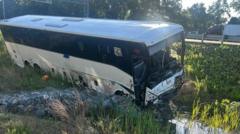
A horrific motorcoach collision on Interstate 95 in Stafford County, Virginia, has left five people dead, dozens injured, and a commercial driver facing five counts of involuntary manslaughter. Jing Sheng Dong, a 48-year-old driver from Staten Island, New York, allegedly plowed a passenger bus operated by E&P Travel Inc. into a line of vehicles slowed down for an early morning highway work zone.
The tragedy wiped out a family of four from Greenfield, Massachusetts—Dmitri Doncev, his wife Ecaterina, and their children Emily, 13, and Mark, 7—who were traveling to a weekend wedding. Priscilla Mafalda, 25, of Worcester, Massachusetts, was also killed when Dong’s bus rammed her Chevrolet Suburban, initiating a chain-reaction pileup involving six vehicles.
Behind the criminal charges lies a deeper, systemic failure within the interstate budget-bus industry. Federal investigators are now confronting uncomfortable realities about regulatory oversight, driver vetting, and the enforcement of basic highway safety standards.
A Predictable Path of High-Speed Violations
Criminally negligent homicide rarely happens in a vacuum. A Grand Jury indicted Dong on three additional manslaughter counts and a reckless driving charge, following initial charges filed right after the crash.
Court records reveal that Dong possessed a history of aggressive driving that went largely unaddressed by his employer.
- November 2024: Dong was convicted of driving 73 mph in a 55 mph zone in Colonial Heights, Virginia. He paid a minor fine and court costs.
- March 2026: Just months before the fatal collision, Maryland state troopers cited Dong for operating a white commercial coach bus at 72 mph in a 50 mph zone.
He was scheduled to appear in a Maryland traffic court to contest that speed violation just days after the Stafford County disaster occurred.
The fact that a driver with multiple high-speed citations in a commercial vehicle remained behind the wheel of an overnight passenger coach exposes severe vulnerabilities in corporate accountability. Commercial carriers often ignore recurring citations to keep seats filled and routes active, treating civil fines as a cost of doing business rather than a warning sign of impending catastrophe.
The Illusion of Federal Enforcement
The National Transportation Safety Board (NTSB) launched an intensive investigation into the operator, E&P Travel Inc., based out of Kings Mountain, North Carolina. Preliminary assessments from federal investigators noted a distinct absence of skid marks at the crash site, signaling that Dong applied little to no braking before impacting the Suburban.
Beyond mechanical data, federal authorities are focusing on the driver's core qualifications. U.S. Transportation Secretary Sean Duffy confirmed that Dong does not speak English, a direct violation of Federal Motor Carrier Safety Administration (FMCSA) regulations. Under existing federal law, any individual operating a commercial motor vehicle in interstate commerce must be able to read and speak English sufficiently to converse with the public, understand highway traffic signs, and respond to official inquiries.
Federal Motor Carrier Safety Regulation 49 CFR § 391.11(b)(2): A person is qualified to drive a commercial motor vehicle if he/she can read and speak the English language sufficiently to converse with the general public, to understand highway traffic signs and signals in the English language, to respond to official inquiries, and to make entries on reports and records.
Dong obtained his Commercial Driver’s License (CDL) in 2024. The reality that a driver could pass state licensing requirements while lacking the federally mandated language skills raises serious questions about state-level CDL testing integrity and carrier compliance. Language proficiency is not a bureaucratic technicality; it is an essential safety component required to comprehend digital highway signs warning of upcoming construction zones and sudden traffic slowdowns.
Fatigue and the Overnight Shift Economy
The collision occurred at roughly 2:35 a.m., a period notoriously associated with circadian dips and severe driver fatigue. The NTSB is executing a standard 72-hour retrospective analysis of Dong’s schedule to reconstruct his sleep patterns, duty hours, and potential logging violations.
Low-cost curbside bus operations frequently run demanding overnight schedules between major metropolitan hubs like New York City and Charlotte, North Carolina. To keep ticket prices artificially low, these discount carriers push drivers to the absolute limits of federal hours-of-service regulations. The combination of high speeds, a language barrier that prevents a clear understanding of dynamic roadside warnings, and deep overnight exhaustion creates a volatile environment on major transit corridors.
Criminal indictments isolate individual blame, but they do not solve the structural problems of the transport sector. Holding a single driver accountable does nothing to alter the corporate practices of low-cost carriers that consistently cut corners on safety, training, and driver verification. Until federal regulators enforce strict compliance and punish carriers for employing drivers with known safety violations, the structural hazards of interstate bus travel will remain.
Dong remains under state police custody at an area hospital, where he is being treated for injuries sustained during the crash. Upon his medical discharge, he will be transferred to the Rappahannock Regional Jail without bond to await trial. He faces up to 10 years in prison for each count of involuntary manslaughter if convicted.