You wake up, pack a bag, and join 50,000 of your neighbors fleeing a quiet suburban zone in Orange County. No smoke fills the air. No flames are visible. Yet, six cities face a sweeping mandatory evacuation order because of a single industrial storage container at the GKN Aerospace facility.
The culprit isn't a weapon or a nuclear fuel rod. It's an ordinary industrial chemical called methyl methacrylate (MMA).
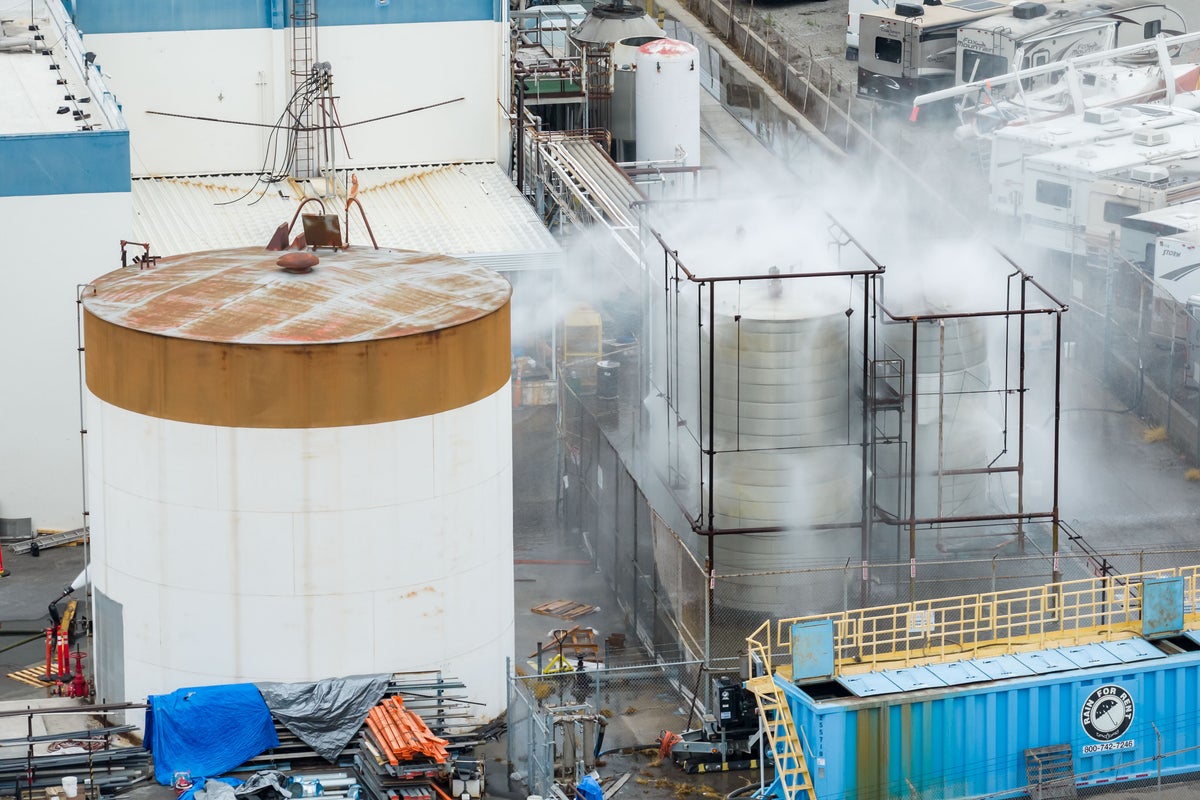
The crisis started on May 21, 2026, when a 34,000-gallon storage tank containing roughly 7,000 gallons of MMA began to overheat. When industrial chemicals start warming up on their own, you aren't just dealing with a hot liquid. You're dealing with a ticking clock. Fire officials initially warned of a potential BLEVE—a Boiling Liquid Expanding Vapor Explosion—which could violently shatter the structure and trigger a domino effect across neighboring chemical units.
Fortunately, emergency crews confirmed on May 25, 2026, that a structural crack naturally relieved internal pressure, dropping the tank temperature to 93°F and eliminating the immediate explosion threat. But the emergency isn't over. Evacuations remain in place across Garden Grove, Anaheim, Buena Park, Cypress, Stanton, and Westminster while crews evaluate the container's structural integrity.
To understand why this scenario forced a federal emergency declaration, you have to look at the volatile chemistry of plastics manufacturing.
Why Methyl Methacrylate Triggers Thermal Runaway
MMA is a colorless liquid used worldwide to produce clear acrylic plastics, resins, and specialized coatings. It's the core ingredient behind tough, transparent sheets like Plexiglas and the high-strength window assemblies used in commercial and military aviation. Under normal conditions, the chemical is stable. The danger begins when the chemical starts reacting with itself.
The underlying process relies on polymerization. MMA molecules want to link together to form long polymer chains. Manufacturers intentionally trigger this process under controlled factory conditions to create solid plastics. Because polymerization releases heat, it's categorized as an exothermic reaction.
If a storage tank gets too warm or if a stabilizing agent fails, the chemical can start polymerizing spontaneously.
When that happens, the liquid produces heat. That heat raises the temperature of the surrounding liquid, speeding up the reaction. A faster reaction generates even more heat. This self-reinforcing loop is known as a thermal runaway.
If the tank remains sealed, the liquid rapidly transitions into a gas. Gas takes up far more volume than liquid, sending pressure levels skyrocketing. In Garden Grove, a faulty valve prevented crews from draining or chemically neutralizing the tank contents, forcing responders to rely purely on external water streams to cool the outer hull.
What Happens Inside a BLEVE Blast
When fire officials threw around the term BLEVE during the first 72 hours of the crisis, they were preparing for a worst-case scenario. A Boiling Liquid Expanding Vapor Explosion occurs when a pressurized vessel containing a liquid far above its normal boiling point suffers a sudden structural failure.
If the structural shell rips open under extreme pressure, the sudden drop in pressure causes the liquid to boil instantaneously. The liquid turns to vapor in milliseconds, expanding up to several hundred times its original volume.
This rapid expansion generates a massive blast wave capable of throwing heavy metal shrapnel for blocks and shattering windows hundreds of feet away. Because MMA is highly flammable, the immediate release of superheated vapor mixes with atmospheric oxygen, creating a massive fireball.
The shockwave from an MMA explosion at GKN Aerospace could have ruptured adjacent storage units containing aviation fuels or other manufacturing chemicals. That risk explains why the Orange County Fire Authority drew a strict nine-square-mile evacuation zone around the perimeter.
The Toxic Reality of MMA Vapor Exposure
An explosion isn't the only hazard. Even without a blast, a leaking or venting tank releases a dense chemical cloud into the lower atmosphere.
MMA possesses an intensely acrid, sweet odor that humans can detect at microscopic concentrations long before it reaches dangerous levels. According to the Environmental Protection Agency, acute exposure to these vapors irritates the eyes, skin, and mucous membranes.
- Inhalation Hazards: Breathing the fumes causes immediate chest tightness, wheezing, coughing, and shortness of breath.
- Neurological Impacts: Short-term exposure triggers severe headaches, dizziness, and nausea.
- Long-Term Concerns: Chronic exposure is linked to degraded lung function and respiratory tract scarring.
Because wind patterns can shift unpredictably, first responders couldn't gamble on localized containment. While the Environmental Protection Agency and local hazmat crews haven't detected hazardous ambient vapor levels in the surrounding neighborhoods, the lingering threat of a sudden valve failure or structural collapse means the exclusion zone remains active.
Securing Your Home and Managing Evacuation Risks
If you live in or near an industrial corridor, managing chemical emergency risks requires immediate, practical steps.
If local authorities issue an evacuation order, leave immediately. In Garden Grove, roughly 15% of residents initially refused to leave their homes, creating unnecessary complications for local police and the Orange County Sheriff's Department. Emergency workers have already deployed sandbags and physical soil barriers around regional storm drains to catch potential liquid runoff and protect local waterways.
If you are just outside an active evacuation boundary and smell a sweet, sharp chemical odor, do not stay outside to investigate. Move indoors immediately. Shut all windows, turn off your air conditioning system to stop pulling outside air into your home, and monitor local emergency channels for air quality updates.
For those seeking an analytical breakdown of how industrial teams manage these volatile chemical threats, the U.S. Chemical Safety Board Analysis outlines the specific mechanics of thermal runaway prevention. This resource details why stabilizing agents and secondary cooling systems are vital for preventing storage container failures.