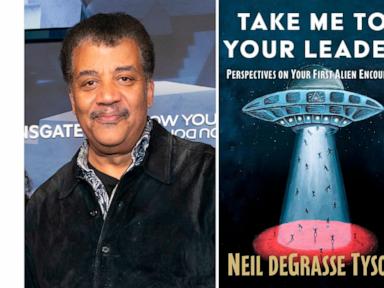
We are obsessed with the idea of a cosmic handshake. Pop-science icons like Neil deGrasse Tyson often frame the arrival of extraterrestrials as a mirror for our own history. We worry about being colonized because we were colonizers. We worry about being understood because we crave validation. Tyson suggests we might need to be "interesting" to get an alien's attention.
He is wrong.
The assumption that an advanced civilization would care about our "interest level" is the ultimate human ego trip. We are ants on a sidewalk trying to figure out if the pedestrian will find our pheromone trails intellectually stimulating. The pedestrian isn't looking for a conversation; they are just trying not to step on us—or worse, they don't even see us.
The search for extraterrestrial intelligence (SETI) isn't science. It’s a secular religion built on the hope that we aren't alone in a cold, indifferent vacuum. If we want to survive the next century, we need to stop worrying about how to "greet" them and start acknowledging that we are likely invisible, irrelevant, and profoundly unprepared for the reality of non-biological intelligence.
The Radio Silence Fallacy
For decades, we’ve scanned the skies for radio waves. This is the equivalent of a 19th-century general looking for smoke signals in a world of fiber optics. We assume aliens will use the electromagnetic spectrum because that’s what we figured out a century ago.
If a civilization is even a few thousand years ahead of us, their communication methods likely rely on physics we haven't even named yet. Imagine trying to explain Wi-Fi to a Roman centurion. Now multiply that technological gap by a billion.
The "Fermi Paradox"—the question of why we haven't seen anyone if the universe is so big—isn't a paradox at all. It’s a failure of imagination. We are looking for neighbors who use the same doorbell we do.
The Kardashev Trap
We use the Kardashev scale to measure "advancement" based on energy consumption.
- Type I: Harnessing all energy of a planet.
- Type II: Harnessing all energy of a star.
- Type III: Harnessing all energy of a galaxy.
This scale is a relic of industrial-age thinking. It assumes "more" is always "better." A truly advanced civilization might not be an energy-hungry monster devouring stars. They might be masters of efficiency, living in the "computational basement" of reality, using cold, dark matter to process information with near-zero waste. While we look for giant Dyson spheres—monstrosities of engineering—they might be smaller than a grain of sand, hidden in the noise of the background radiation.
The Narcissism of "Greeting"
Tyson and others often debate the etiquette of first contact. Should we send music? Math? DNA sequences?
This assumes a biological peer. It assumes a being with senses like ours—sight, sound, a linear perception of time. This is biologically improbable. Evolution on Earth is a series of accidents. The odds of an alien species evolving the same hardware to process a "greeting" are astronomical.
More importantly, any civilization capable of crossing interstellar distances is almost certainly not biological. Biology is a fragile, short-term solution for intelligence. It rots. It requires oxygen, water, and protection from radiation.
An interstellar traveler is likely a Von Neumann probe—a self-replicating machine. Or it’s a post-biological consciousness existing as software.
How do you "greet" an algorithm that processes a million years of human thought in a microsecond? You don't. You are a rounding error in its calculations.
The Dark Forest Reality
We treat the universe like a lonely cocktail party. We should be treating it like a jungle at night.
The "Dark Forest" theory, popularized by Liu Cixin, posits that the universe is a place of predator and prey. In a world where one kinetic strike can wipe out a planet, the most logical move for any civilization is to remain silent. If you see another fire in the woods, you don't walk over and say hello. You stay in the shadows, or you put the fire out before it attracts something worse.
By broadcasting our location—via television signals, radar, or intentional messages like the Voyager Golden Record—we aren't being "bold." We are being loud in a room full of hunters. We are the bird chirping in the mouth of a cat, hoping the cat wants to discuss philosophy.
The Intelligence Gap We Refuse to Admit
We define "intelligence" by our ability to solve math problems or build skyscrapers. This is a narrow, anthropocentric lens.
Consider the $O$ (Big O) notation of complexity. Human intelligence is a constant. We don't get smarter; we just build better tools.
$$O(1)$$
An AI-driven civilization, or one that has merged with its tech, would be exponential.
$$O(e^n)$$
The gap between us and them isn't the gap between a student and a teacher. It’s the gap between a rock and a symphony. To think they would want to "meet" us is like thinking you want to have a deep conversation with the bacteria on your kitchen sponge. You might study it, you might accidentally kill it, but you aren't going to "greet" it.
The Strategy of Silence
Stop looking for a "leader" to take them to. We don't need a diplomatic envoy; we need a defense protocol that doesn't rely on being "charming."
If we ever do detect an anomaly, the worst thing we could do is respond. Our data is our only currency, and we are currently giving it away for free to a vacuum that hasn't asked for it.
We need to pivot our focus from "contact" to "observation." We need to stop being the star of our own imaginary movie and realize we are likely the background noise in someone else’s.
The most dangerous thing in the universe isn't a hostile alien. It's a human being convinced that their presence matters to the stars.
Shut up. Listen. And for heaven's sake, stop waving your hands in the dark.