British policing is caught in a political firestorm, and the data paints a vastly different picture than the loudest voices on social media claim.
Following the tragic murder of 18-year-old student Henry Nowak in Southampton, Westminster and social media platforms have erupted with accusations of anti-white bias and two-tier policing. The fury peaked after harrowing bodycam footage revealed Hampshire police officers handcuffed and arrested a dying Nowak. They believed his killer, Vickrum Digwa, who falsely claimed he was the victim of a racist attack.
While right-wing commentators and politicians use the case to argue that British authorities are paralyzed by diversity quotas and institutional prejudice against white people, the underlying statistical reality of how this exact police force operates on the street tells a completely opposite story.
Official figures show that Hampshire Constabulary is over five times more likely to subject black people to a stop and search than white people.
If you look at the actual numbers, the theory of systemic anti-white bias falls apart.
The Stark Reality of Hampshire Stop and Search Statistics
To understand why the political narrative is so detached from everyday reality, you have to look at the hard data from the Home Office. For the most recent year of available data, Hampshire officers were 5.1 times more likely to stop and search a black person than a white person.
This isn't a national anomaly either. The average disproportionality rate across England and Wales sits at 3.8 times. Hampshire is significantly higher than the national average, and the gap is widening.
- 2023-2024: Black people were 4.1 times more likely to be stopped than white people.
- 2024-2025: The disparity jumped to 4.8 times.
- 2025-2026: The figure reached the current 5.1 times peak.
The overall volume of stop and search tactics used by the force has ballooned as well, rising to 15,000 stops from 12,000 just two years prior. What happens during these interactions? Very little in terms of fighting crime. A staggering 60% of those 15,000 stops resulted in absolutely no further action or advice. The force points to 6,000 "positive outcomes," but they don't explicitly define what that actually means. Often, it's just low-level cannabis possession, not the dangerous knife crime that ended Nowak's life.
If Hampshire police were genuinely operating under a directive of anti-white bias, these numbers wouldn't exist. You don't have a systemically anti-white police force that simultaneously targets black residents at five times the rate of white residents on a daily basis.
The Dangerous Myth of Two Tier Policing
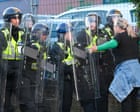
The term "two-tier policing" has become a weaponized phrase. High-profile figures like Reform UK leader Nigel Farage and tech billionaire Elon Musk have heavily pushed the narrative that the UK justice system treats ethnic minorities with kid gloves while aggressively prosecuting white people. Farage used his platform to call for "pure cold rage" over the Nowak case, helping to ignite violent clashes outside Southampton police station that left 11 officers injured.
But talk to people who actually have decades of firsthand experience with police failures, and they will tell you that the issue isn't a political conspiracy. It's incompetent street-level policing.
Take Duwayne Brooks, who was 18 when his best friend Stephen Lawrence was murdered by a racist gang in 1993. Brooks survived that attack only to be treated as a suspect by the Metropolitan Police on the scene. He knows exactly what it feels like to be a traumatized victim ignored by officers.
Brooks explicitly rejected the claim of anti-white bias in the Nowak case. He points out that the victim was white, the arresting officers were white, and Hampshire has a predominantly white police force (96.4% white compared to a local population that is 90.6% white).
"We've always received lazy policing," Brooks stated. "Now it is more widespread and more people are experiencing it and a boy lost his life. Police have a blasé attitude. I have not seen or heard any evidence of anti-white bias in policing."
The tragic truth is that when officers arrive at a chaotic scene, they frequently look for the easiest narrative to grab onto. In this case, they blindly believed a manipulative lie told by a killer, entirely failing to assess the physical reality of a bleeding, unconscious teenager.
What Really Caused the Failure in Southampton
Right-wing critics have pointed to internal documents like the National Police Chiefs' Council (NPCC) anti-racism commitment, which stated that policing does not mean treating everyone the same or being colour-blind. They claim this language forces officers to side against white people in any dispute involving an ethnic minority.
Policing experts say that's a total misunderstanding of how officers are trained. Former counter-terrorism head Neil Basu clarified that guidelines stemming from the landmark 1999 Macpherson report dictate that when a victim alleges a racial motivation, police must record and investigate it seriously. They are not supposed to automatically believe it without checking facts.
In Southampton, the officers completely abandoned basic investigative procedures. They failed to notice that Nowak had been stabbed five times in the legs and heart with an eight-inch blade. When Nowak gasped that he couldn't breathe and had been stabbed, an officer dismissively replied, "I don't think you have, mate."
They treated a dying teenager as a hostile threat because they accepted the first story they heard. That isn't woke ideology at work. It's a profound failure of basic first-aid assessment, scene management, and professional skepticism.
Moving Past the Rhetoric
The Independent Office for Police Conduct (IOPC) is actively investigating the officers involved, and a full coroner's inquest with a jury is set to examine the systemic operational failures.
Meanwhile, the victim's family has begged politicians to stop exploiting their son's death to stoke racial hatred. Nowak’s father, Mark, condemned the "inhumane and degrading" treatment of his son but made it clear he does not want Henry's memory used to fuel divisions.
If you want to actually address the problems in British policing, you have to ignore the social media culture wars. The path forward requires holding individual officers accountable for basic operational incompetence while forcing police leadership to explain why their stop and search tactics continue to disproportionately target black communities with minimal criminal justice results.
The next step isn't to dismantle diversity training or scream about two-tier systems. It's demanding that when a human being tells a police officer they are bleeding to death, the handcuffs stay off and the medical kit comes out.


