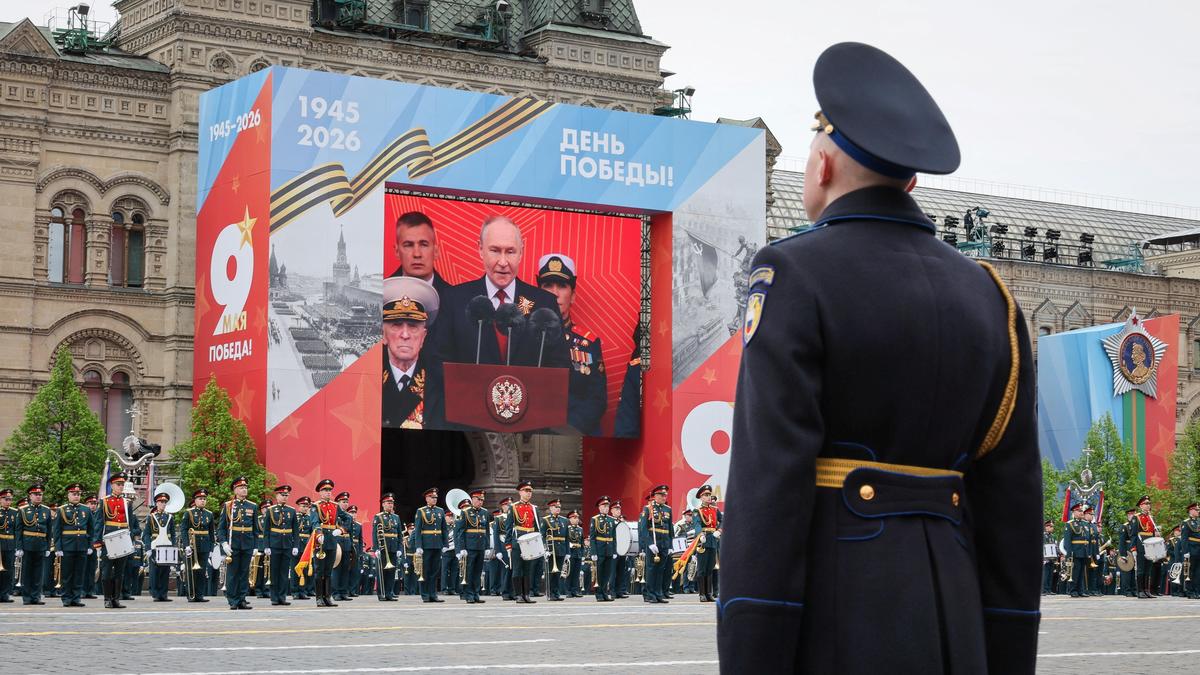
The annual Victory Day parade in Moscow has transitioned from a historical commemoration to a functional instrument of state mobilization, designed to frame contemporary kinetic conflict through the lens of existential survival. By positioning the current engagement in Ukraine as a direct continuation of the Great Patriotic War, the Russian administration utilizes a specific psychological framework to justify the sustained allocation of resources toward a high-intensity war of attrition. This strategy relies on three distinct pillars: the externalization of the adversary, the moralization of the conflict, and the signaling of long-term endurance to Western observers.
The Externalization Framework: Redefining the Adversary
The core of the recent Victory Day rhetoric lies in the assertion that Russia is not merely fighting a regional neighbor, but an "aggressive" NATO-backed force. This shift in the definition of the combatant serves a critical domestic purpose. Engaging a smaller neighbor can be perceived as a choice; engaging a global military alliance is presented as a necessity.
The logic follows a predictable pattern of escalation:
- The Proxy Variable: By highlighting Western military hardware and intelligence support, the state minimizes the agency of Ukrainian forces. This frames the conflict as a defensive measure against "globalist elites."
- Historical Continuity: Invoking the 1945 victory creates a cognitive bridge. If the Soviet Union faced a singular existential threat then, the current Russian state argues it faces an identical threat now. This removes the nuance of modern geopolitics and replaces it with a binary survivalist logic.
- The Expansionist Claim: The rhetoric suggests that NATO’s "aggressive" posture is the primary driver of instability. This reverses the standard Western causal chain, placing the burden of provocation on the North Atlantic alliance rather than the initial border crossing.
The Cost Function of Moralized Conflict
When a state characterizes a war as a moral crusade, it fundamentally alters the public's tolerance for loss. In standard military engagements, the "cost function" is a calculation of whether the strategic objective is worth the expenditure of lives and capital. In an existential narrative, the cost becomes irrelevant because the alternative—annihilation or loss of sovereignty—is presented as infinitely more expensive.
The Russian administration’s emphasis on "defending the Motherland" functions as a mechanism to absorb the economic and social friction caused by prolonged sanctions and mobilization. This moralization creates a high barrier for dissent. To question the war's objectives is no longer a political disagreement; in the context of Victory Day, it becomes an affront to the memory of the millions who died in World War II.
Strategic Signaling to the West
Beyond domestic consumption, the Victory Day address serves as a signaling device for foreign intelligence and diplomatic circles. The presence of nuclear-capable hardware, such as the Yars intercontinental ballistic missile system, is a calibrated display of the "escalation ladder."
The signal is twofold:
- Asymmetric Persistence: Russia is communicating that it has the domestic political stability to maintain this conflict indefinitely. By tying the war to the most sacred date in the Russian calendar, the state signals that it will not negotiate from a position of perceived weakness.
- Nuclear Deterrence as a Baseline: The display of strategic missile forces during a civilian-military parade reminds NATO that any direct intervention would bypass conventional boundaries. It is a reminder of the "mutually assured destruction" (MAD) doctrine, repurposed to ensure a localized conflict remains localized on Russian terms.
The Structural Mechanics of Narrative Alignment
The success of this mobilization strategy depends on the alignment of historical memory with current military objectives. This is achieved through the institutionalization of the "Immortal Regiment" and similar commemorative practices. These events transform passive history into active participation.
The mechanism of alignment operates as follows:
- The Transgenerational Contract: Older generations find meaning in the revival of Soviet-era triumph, while younger generations are integrated into a culture of militarized patriotism.
- Information Dominance: By controlling the historical narrative, the state ensures that any counter-information regarding frontline setbacks is filtered through a prism of "necessary sacrifice."
This creates a self-reinforcing loop. The more the West supports Ukraine, the more the Russian state can point to that support as evidence of the "aggressive" NATO force it warned about, thereby justifying further mobilization.
The Logistics of Attrition vs. The Rhetoric of Victory
While the rhetoric focuses on historical glory, the physical reality on the ground is governed by the cold mathematics of industrial output. Russia has pivoted its economy to a "war footing," with defense spending reaching approximately 6% of GDP. This shift is sustainable in the medium term due to high energy revenues and a successful pivot to Asian markets, but it creates structural vulnerabilities.
- Labor Shortages: Mass mobilization and emigration have tightened the labor market, leading to wage-push inflation in the non-defense sector.
- Technology Bottlenecks: Despite the "aggressive" labeling of NATO, Russia remains dependent on Western or dual-use microelectronics. The rhetoric of self-reliance often masks a complex web of shadow imports and third-party intermediaries.
- Resource Diversion: The capital allocated to the "defense of the Motherland" is capital stripped from infrastructure, healthcare, and education.
The Victory Day speech is designed to provide the emotional capital required to offset these material deficits. It is a psychological subsidy for a war-weary population.
The Geopolitical Risk Matrix
The current trajectory suggests a deepening of the "fortress Russia" mentality. As the Kremlin continues to define the conflict as a struggle against a Western-backed existential threat, the space for traditional diplomacy shrinks.
The primary risks inherent in this strategy include:
- The Commitment Trap: By elevating the conflict to the level of 1945, the administration makes any compromise look like a betrayal. This limits the "off-ramp" options for Russian leadership.
- Over-reliance on Historical Analogy: Modern warfare, driven by drones, electronic warfare, and precision strikes, bears little resemblance to the massed infantry movements of the 1940s. Relying on an outdated military mythos can lead to tactical rigidity.
- Internal Friction: While the narrative is currently dominant, its efficacy may diminish if the discrepancy between the "Victory" promised and the reality of the front line becomes too wide to bridge with rhetoric.
Strategic Forecasting
The Russian state will likely continue to escalate the "NATO-backed" narrative as a primary justification for the 2024-2026 military campaign. This framing is essential for maintaining the internal cohesion necessary for a long-term war of attrition. Investors and geopolitical analysts must view these speeches not as mere propaganda, but as operational roadmaps for state intent.
The most effective counter-measure for Western actors is not to engage with the historical rhetoric—which only reinforces the state’s defensive narrative—but to focus on the material constraints of the Russian economy. The war will not be decided by who claims the mantle of 1945, but by whose industrial base can sustain the requisite rate of fire and technological adaptation over a multi-year horizon.
To navigate this environment, organizations must de-risk from any remaining exposure to Russian state-linked entities and prepare for a permanent shift in the European security architecture. The era of "strategic ambiguity" has ended; we are entering a period where historical mythos is as much a weapon as a cruise missile. Monitor the Russian defense budget's percentage of total government expenditure as the true barometer of intent, rather than the seasonal fluctuations of public speeches.