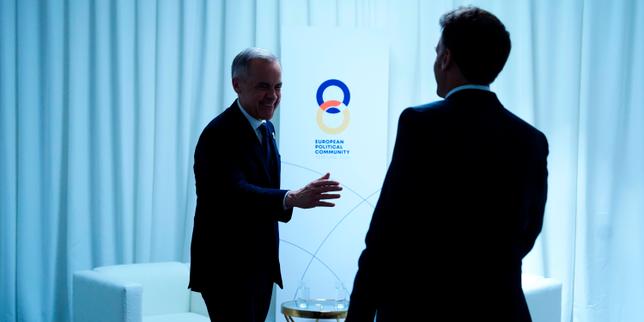
The headlines coming out of Armenia are predictable. They are also wrong.
Watching the diplomatic core from Ottawa and Brussels huddle in Yerevan to "build a wall" against the impending return of Trumpian economics is like watching a group of sailors try to stop a tidal wave with a screen door. They call it "strategic autonomy" and "multilateral resilience." In reality, it is a desperate attempt to preserve a 1990s world order that has already been liquidated.
The consensus view—the one being peddled by every major outlet covering the meeting—is that Canada and Europe can form a coherent, unified counterweight to a protectionist United States. This is a fantasy. It ignores the fundamental physics of trade and the brutal reality of energy dependency.
The Myth of the Third Way
The "lazy consensus" argues that by deepening ties with each other, middle powers can bypass the volatility of the White House. This assumes that Canada and Europe are complementary pieces of a puzzle. They aren't. They are competitors in a shrinking market for high-end manufacturing, and they are both fundamentally tethered to the American consumer.
Canada’s economy is not a sovereign entity in the way Ottawa likes to pretend. It is an integrated subsidiary of the North American industrial machine. Roughly 75% of Canadian exports go to the United States. To suggest that a "bloc" with Europe—a region currently struggling with its own deindustrialization crisis—can offset a 10% or 20% universal tariff from the U.S. is mathematically illiterate.
Europe isn't a lifeboat. It's a region in the middle of an existential panic. Between Germany's collapsing manufacturing base and France's fiscal instability, the EU has zero capacity to absorb Canadian goods or provide the security guarantees that the U.S. currently provides for free.
The Energy Trap No One Mentions
The discussions in Yerevan focus on "values" and "democratic alignment." They should be focusing on British Thermal Units (BTUs) and kilowatt-hours.
The U.S. is now the world’s largest producer of oil and gas. While Europe spent the last decade chasing a green transition that made them dependent on Russian pipelines (and now expensive American LNG), the U.S. achieved energy independence. Any "bloc" formed between Canada and Europe starts with a massive structural disadvantage: the U.S. has cheaper energy and more of it.
When Trump returns to the "drill, baby, drill" playbook, the cost of production in the U.S. will drop even further. Europe, hampered by high energy costs and rigid labor laws, cannot compete. Canada, which has the resources but lacks the political will to build the pipelines to get them to the coast, remains stuck. Forming a bloc with Europe doesn't solve Canada's problem; it just aligns it with a partner that has the same chronic illness.
Stop Asking How to Stop Trump
The "People Also Ask" sections of the internet are filled with variations of: "How can Europe protect its economy from Trump?"
The premise is flawed. You don't "protect" against a shift in the global trade architecture; you adapt or you go bust. The real question is: "How can these economies become competitive enough that they don't care who is in the White House?"
The answer is painful. It requires dismantling the very social and regulatory structures that the Yerevan delegates were there to celebrate.
- Europe needs to stop regulating technologies it hasn't even built yet. The AI Act is a prime example of a region trying to manage an industry it has already lost to Silicon Valley.
- Canada needs to stop treating its natural resource sector like a shameful secret and start treating it like the geopolitical lever it is.
The "multilateralism" being touted in Armenia is actually a code word for "stagnation." It is an agreement to move at the speed of the slowest member. In a world of bilateral "America First" deals, speed is the only currency that matters.
The Security Parasite Problem
There is a blatant hypocrisy in these talks. The delegates speak of "standing firm" while standing under the protection of the American nuclear umbrella.
European defense spending, while increasing, is still a fraction of what is required to maintain a credible deterrent without the U.S. Canada is even worse, consistently failing to meet the 2% NATO target while lecturing others on "global responsibility."
If you want to "face" Trump, you have to be able to survive without his military. None of the countries represented in Yerevan can do that. Not even close. Trump knows this. He sees the Yerevan meeting not as a threat, but as a group of tenants complaining about the rent while they have nowhere else to live.
The Brutal Advice for the C-Suite
If you are running a company in Toronto, Berlin, or Paris, ignore the joint statements from Yerevan. They are political theater designed to soothe domestic voters who are terrified of a changing world.
- Onshore to the U.S. now. Don't wait for the tariffs to hit. If your primary market is American, your production needs to be within the fortress walls.
- Abandon the "Values-Based" Supply Chain. It sounds good in a press release, but "values" don't pay for 20% import duties. Look for efficiency and proximity.
- Hedge Against the Euro and Loonie. Both currencies are vulnerable to a rampant U.S. dollar backed by higher interest rates and domestic energy production.
The Inevitability of the Bilateral
The era of the "Grand Bloc" is over. The future is a series of transactional, cold-blooded bilateral deals. Trump doesn't do "multilateral." He does "What have you done for me lately?"
By trying to form a united front, Canada and Europe are actually making themselves bigger targets. They are consolidating their weaknesses instead of leveraging their individual strengths. Canada, in particular, should be distancing itself from European malaise and leaning into its role as the essential neighbor to the American superpower. Instead, it chooses to play second fiddle in a European orchestra that is out of tune.
I’ve seen boards of directors waste years trying to "out-wait" a market shift. They think if they just hold hands and stay the course, the old reality will return. It never does. The world being built in Yerevan is a museum of 2012. The world being built in Mar-a-Lago and the industrial hubs of the Rust Belt is the one you actually have to live in.
The meeting in Yerevan isn't a show of strength. It's a support group for the soon-to-be-irrelevant. Stop looking for safety in numbers and start looking for leverage in reality.
The wall they are building isn't going to keep Trump out; it’s just going to keep them trapped inside.


